Translate

Showing posts with label Julius Schwartz. Show all posts

Monday, January 18, 2021

Number 2488: Rex the Wonder Dog ain’t just a-woofin'

Rex the Wonder Dog is a super-smart dog we love to imagine. Dogs may astonish us sometimes, but they are not as smart as fiction makes out. Rex the Wonder Dog, for instance, can smell out evil. I understand that a dog’s smeller is one of nature’s marvels, but I’ll be dog-boned if evil is smellable. According to the Grand Comics Database (using editor Julius Schwartz’s records), the story was written by Robert Kanigher, and he endowed Rex with that ability. I haven't read beyond that story, which I read mostly because Alex Toth and Sy Barry did the artwork for this evil-sniffing anthropomorphic canine.

Oh, wait! I look again and see the story is titled “Trail of the Flower of Evil.” So there you go. The flower smells like evil. Puzzle solved!

The Adventures of Rex the Wonder Dog #1, which is our source for the story, came out in 1952, and lasted 46 issues until 1959. 


Monday, January 11, 2021

Number 2486: Thinking of a stinker, the Thinker

The Flash was one of my favorite superheroes in 1960-1961...I was especially rocked when The Flash #123 came out in ’61, and the cover featured both the Barry Allen Flash, and the alternate world Flash, Jay Garrick. 
 
 
That issue introduced the concept of Earths One and Two to the DC Universe, and it was a genius move on the parts of DC editor Julius Schwartz, and writer Gardner Fox. Schwartz and Fox, as well as artist Carmine Infantino, had all worked for DC Comics (then called “National”) during the 1940s. In the days of my youth I read every fanzine I could get my hands on, and wanted to see the early versions of the DC/National characters I liked.

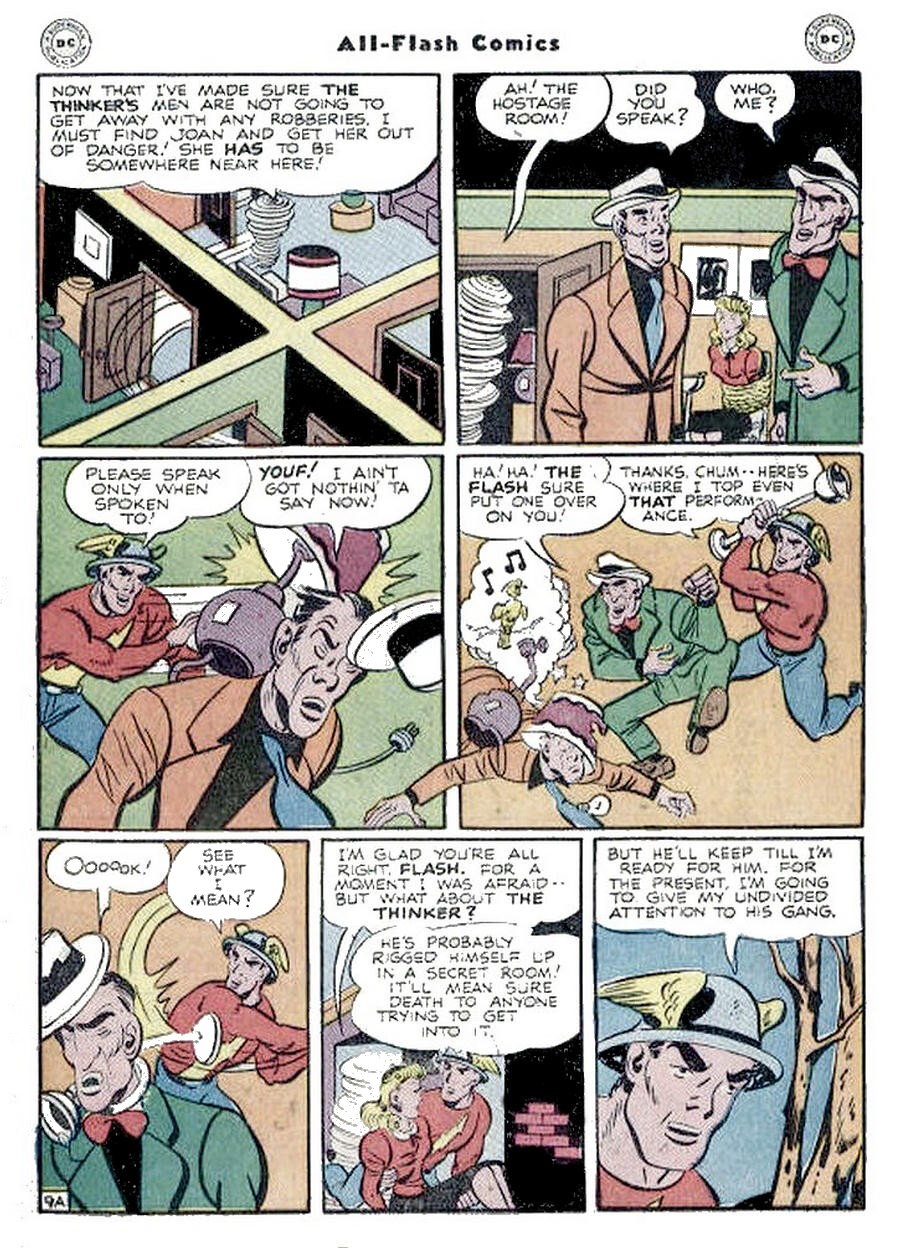
The Flash story below, from All-Flash #27 (1947) is drawn by Martin Naydel with story credited to Robert Kanigher. The villain, the Thinker, does his criminal acts while throwing a variety of gases around. He would have been unacceptable to me had I seen the story in 1961. No costume! What kind of superhero comic book villain goes out without a costume? Perhaps having just broken out of prison the Thinker hadn’t the time between his escape and gassing people to shop for a good costume.


Wednesday, May 04, 2016

Number 1885: The Phantom Stranger and the Moon ©ult

DC’s initial run of the title, Phantom Stranger, lasted six issues. It was another of Julius Schwartz’s books, and as I have mentioned with his equally short-lived Danger Trail, it may have had something to do with his newer titles of that era, Mystery In Space and Strange Adventures, both hits needing his close attention. Or, it could just be that Phantom Stranger, despite provocative covers and good art, just didn’t survive in a crowded comic book market. It is too late to ask any of the principals involved.

“The Three Signs of Evil” is by John Broome, drawn by Carmine Infantino, inked by Sy Barry and Joe Giella. The first thing that struck me was the "c" in the circle, which here is an evil sign, but is also the symbol for copyright, as in “Copyright © 1952 National Comics Publications, Inc.”

Unlike my example, the boilerplate indicia DC used in that day doesn't use the symbol. So, for the purposes of this posting an evil symbol it is, and forget I said anything.

From Phantom Stranger #2 (1952):


In 2012 I showed the debut of the Phantom Stranger. Just click on the thumbnail.


Wednesday, February 10, 2016

Number 1852: Writer of other worlds, Ed Hamilton

Alex Toth and Sy Barry drew “Artist of Other Worlds!” for Strange Adventures #13 (1951). Typical of comic books at that time the artists got no credit, but in an unusual turn, the writers did...at least in the early issues of the science fiction comics edited by Julius Schwartz. Edmond Hamilton is bylined as the author.

Hamilton had a long history of writing science fiction for pulp magazines. His first published story was published in Weird Tales in 1926,* and he remained popular with readers for his entire 50-year career. He went into comics when the pulp markets were drying up in the 1940s. (See the short article below the story, with quotes from Hamilton about his history with DC Comics.)

Hamilton, who had written Captain Future stories in the early forties, was invited into comic books after pulp editors Mort Weisinger, Jack Schiff and Julius Schwartz moved from the pulps to the comic books. Comics seemed a natural for science fiction writers (Otto “Eando” Binder is another example), especially someone who had a reputation for writing stories about heroes who did extraordinary things. That was Hamilton’s history, and it made him a natural for comic books.


 *“Monster-God of Mamurth,“ which can be found here.

***********

“Fifty Years of Heroes” is an autobiographical piece written by Edmond Hamilton in 1976, and published  in Byron Preiss’s anthology series, Weird Heroes Volume 6. It went to press just after Hamilton’s death in early 1977. In the article Hamilton gives an entertaining view of his long career writing science fiction (including when he was known to fans as World-Saver Hamilton), and a brief history of his 20 years writing comic books. To quote the article:

    “In 1946 I heard again from Mort Weisinger. He had returned from his war service to take up his job again at National Comics Publications, as DC Comics were known at the time. He and Jack Schiff had left Standard Magazines in 1941 to work in the comics field, and later on Julie Schwartz had joined them at DC.

    “Mort wanted me to write comic scripts for DC magazines, to start with Batman. I had some doubts at first, as the format was quite different from fiction stories. In those days after the war, the pulp magazine market was very poor . . . I had to write a few very poor scripts before I began to catch on to the ways of comic writing.

    “For the first year or two, all my scripts for DC were Batman stories. Mort and Jack Schiff were the nicest guys in the world to work for, but they took their work seriously, and if I made a stupid error or scuffed over anything, they told me so at once, and loudly.

    “After a year or two I started to do Superman stories, also. I think I did better on Superman than Batman, simply because it was more science-fictional.

    “Julius Schwartz first edited the science fiction magazines at DC — Strange Adventures, Mystery in Space. . . I did a good many sf stories for those, and when I started doing them I thought, “This will be a breeze . . . writing for an old pal like Julie will be no trouble.” I was wrong! Friendship cut no ties when Julie read a story, and he was as strict with me as with anyone else. I guess that’s why he became one of the greatest editors in the business.

    “I wrote for DC Comics from 1946 to 1966. During that time, I was still writing science fiction and produced a good many sf books and magazine stories. When I resigned from comic work in 1966, it was only because Leigh [Hamilton’s wife, author and screenwriter Leigh Brackett] and I were about to go on some long-deferred world travels — to Egypt, India, and so on — and I would not be able to fill any schedules. But I always enjoyed working for the hero comics, particularly for such a great bunch of guys.”

Wednesday, October 21, 2015

Number 1803: Men in Space: Secret of the Flying Saucers!

This is the second of our Men in Space theme week. In this case the story is about a man who is taken aboard a flying saucer.

In the sixties there were UFO flaps around the United States. UFO sightings made the news, fueling further speculation about a flying saucer “mystery” that had been going on at that time for 20 years. When I was in the U.S. Army in '67 and '68 there were a lot of paperback books about flying saucers circulating around the barracks, several of them promising an answer to the mystery. I read some of them, and the cover of each one promised the real, true, amazing answer to the riddle of the flying saucers. Yet each book presented a different real, true, amazing answer. I love stories about UFO/flying saucers, but I am a true skeptic. Land a flying saucer in front of me, have the aliens come out and talk to me, tell me what the “secret of the flying saucers” is, and I might believe it. Of course, I would never make the mistake of Captain Martin Croft, in this tale from Strange Adventures #2 (1950). I would not tell anyone about my experience. Marty was not believed. With a wild tale like that the only thing anyone would believe is the teller is in need of some strong medication.

This issue of Strange Adventures had one other story about aliens concerned with the human history of violence. “Endless War” can be found at Pappy's #1683. It is written by David Vern. “Secret of the Flying Saucers” is written by David V. Reed, who is actually David Vern, who is actually David Levine. The Grand Comics Database credits Jim Mooney for the artwork.


From 2011: Two more flying saucer tales. Just click on the thumbnail.