Translate
Showing posts with label Joe Giella. Show all posts
Monday, February 27, 2017
Number 2016: Hairy shadows
DC’s supernatural comics had a habit of turning what looked supernatural into something more down-to-earth, but this is different. The hairy shadows may not be supernatural, but they're not of this earth. Manly Wade Wellman is credited by Grand Comics Database as writer, with Murphy Anderson (pencils) and Joe Giella (inks) as artists.
From Phantom Stranger #4 (1953):
Wednesday, May 04, 2016
Number 1885: The Phantom Stranger and the Moon ©ult
DC’s initial run of the title, Phantom Stranger, lasted six issues. It was another of Julius Schwartz’s books, and as I have mentioned with his equally short-lived Danger Trail, it may have had something to do with his newer titles of that era, Mystery In Space and Strange Adventures, both hits needing his close attention. Or, it could just be that Phantom Stranger, despite provocative covers and good art, just didn’t survive in a crowded comic book market. It is too late to ask any of the principals involved.
“The Three Signs of Evil” is by John Broome, drawn by Carmine Infantino, inked by Sy Barry and Joe Giella. The first thing that struck me was the "c" in the circle, which here is an evil sign, but is also the symbol for copyright, as in “Copyright © 1952 National Comics Publications, Inc.”
Unlike my example, the boilerplate indicia DC used in that day doesn't use the symbol. So, for the purposes of this posting an evil symbol it is, and forget I said anything.
From Phantom Stranger #2 (1952):
In 2012 I showed the debut of the Phantom Stranger. Just click on the thumbnail.
“The Three Signs of Evil” is by John Broome, drawn by Carmine Infantino, inked by Sy Barry and Joe Giella. The first thing that struck me was the "c" in the circle, which here is an evil sign, but is also the symbol for copyright, as in “Copyright © 1952 National Comics Publications, Inc.”
Unlike my example, the boilerplate indicia DC used in that day doesn't use the symbol. So, for the purposes of this posting an evil symbol it is, and forget I said anything.
From Phantom Stranger #2 (1952):
In 2012 I showed the debut of the Phantom Stranger. Just click on the thumbnail.
Friday, December 12, 2014
Number 1669: The millionaire robot
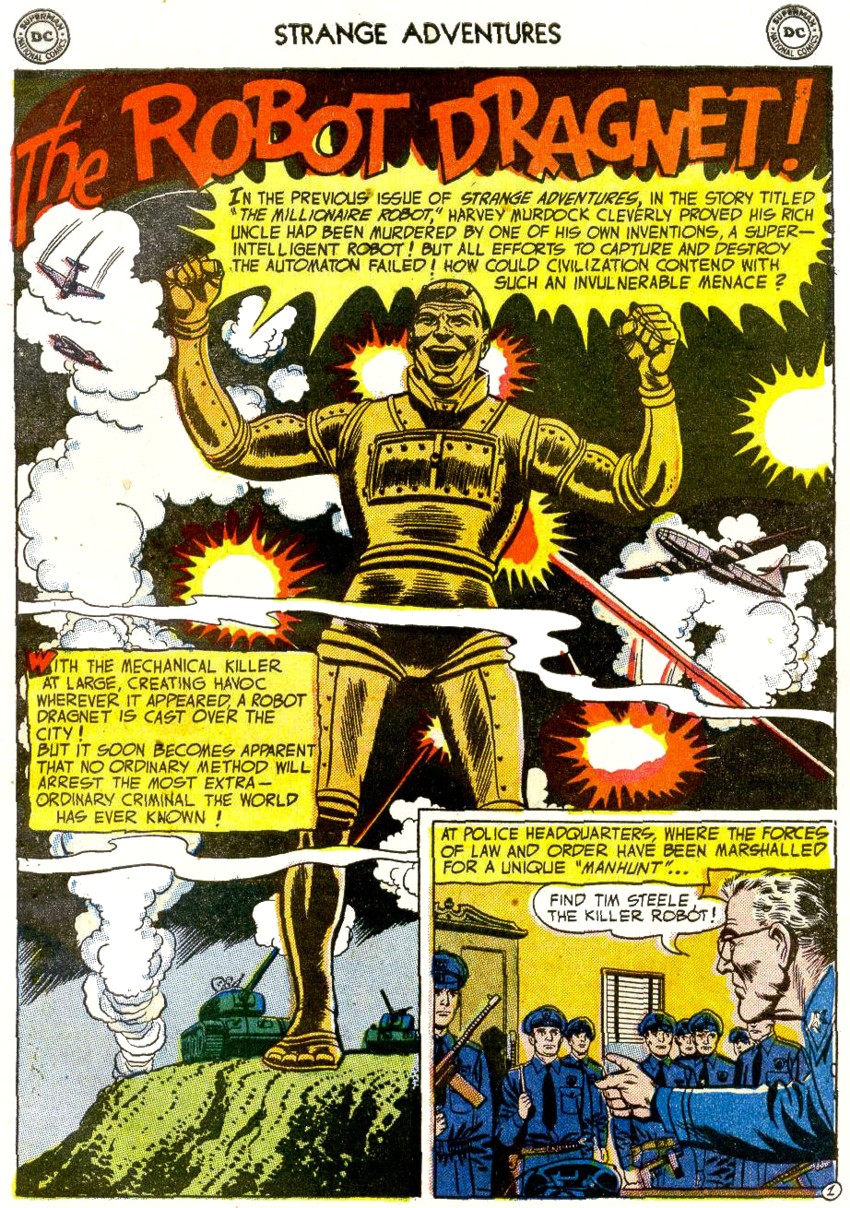
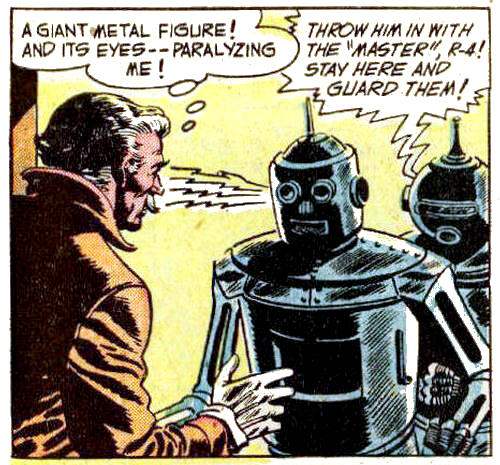
The final entry in our theme week, Strange Robot Adventures, is a 12-page story split across two issues, numbers 53 and 54 (1955), in 6-page chapters. The robot in this tale is a crook.
It is written by Otto Binder (who created the sentient robot pulp character, Adam Link, and was chief scripter for Captain Marvel for many years), so in the robot we have an interesting character, at least. In my opinion this reads like a Captain Marvel story without Captain Marvel and without the whimsy that character represented. That isn’t to say there isn’t satire; at second glance it appears to be a jab at greed, wealth and materialism. And the message to me in the robot Tim Steele’s “scorn for money” is an attack on The American Way of Life! You can draw your own conclusions.
The first episode, “The Millionaire Robot,” is from the last pre-Comics Code issue of Strange Adventures, and the second is from the first Code-approved issue. It doesn’t seem to make much difference. There does not seem to be anything in the earlier tale that would be blocked by the heavy hand of the censor.
According to the Grand Comics Database the art is by Henry Sharp and Joe Giella.
Here is a two-part story of the Black Rider, where the first part is pre-Code and the second part produced under the Comics Code with perceptible differences. Just click on the thumbnail.
It is written by Otto Binder (who created the sentient robot pulp character, Adam Link, and was chief scripter for Captain Marvel for many years), so in the robot we have an interesting character, at least. In my opinion this reads like a Captain Marvel story without Captain Marvel and without the whimsy that character represented. That isn’t to say there isn’t satire; at second glance it appears to be a jab at greed, wealth and materialism. And the message to me in the robot Tim Steele’s “scorn for money” is an attack on The American Way of Life! You can draw your own conclusions.
The first episode, “The Millionaire Robot,” is from the last pre-Comics Code issue of Strange Adventures, and the second is from the first Code-approved issue. It doesn’t seem to make much difference. There does not seem to be anything in the earlier tale that would be blocked by the heavy hand of the censor.
According to the Grand Comics Database the art is by Henry Sharp and Joe Giella.
Here is a two-part story of the Black Rider, where the first part is pre-Code and the second part produced under the Comics Code with perceptible differences. Just click on the thumbnail.
Wednesday, December 10, 2014
Number 1668: Time capsule from 1,000,000 B.C.
We continue our Strange Robot Adventures theme week with yet another continuing character who appeared in the early issues of Strange Adventures, Captain Comet. Created by John Broome using a pen-name, and drawn by Murphy Anderson and Joe Giella, Captain Comet is a mutant with the body of a man 100,000 years in the future. He would have to be extra sharp to pick up all of the incredible stuff he has to figure out in this story, [SPOILER ALERT] especially when the incredible stuff turn out to be some dirty doin's by a scientist’s free-thinking robots. Because of the red herring of the so-called time capsule from 1,000,000 B.C. we don’t get to see the robots until page 4.[END OF SPOILER]
It is of its era...I like the panel on page 6 where Captain Comet clobbers the robot, knocking out some springs and at least one vacuum tube. From Strange Adventures #29 (1953):
The two-part origin of Captain Comet! Click on the thumbnail.
It is of its era...I like the panel on page 6 where Captain Comet clobbers the robot, knocking out some springs and at least one vacuum tube. From Strange Adventures #29 (1953):
The two-part origin of Captain Comet! Click on the thumbnail.
Monday, January 06, 2014
Number 1503: Hiking the Danger Trail
The King Faraday lead story from DC’s Danger Trail #1 (1950) begins with a reference to a popular 1948 movie, Sorry, Wrong Number. Here’s an ad for the movie, taken from Life magazine:
The story that follows is as unlikely as the plot of the movie that King complains about, but is entertaining in its pulpish way. When you get through the overcooked first person narrative and snappy dialogue there is even a bit of space left for the artist to work in! The type of smartass, two-fisted character represented here by King Faraday was familiar to pulp magazine and paperback book readers, as well as radio listeners of the forties. In contrast to that other media, a comic book should let the pictures, not hefty captions, tell most of the story.
Story by Robert Kanigher, edited by Julius Schwartz, art by Carmine Infantino and Joe Giella.
**********
Here’s another King Faraday story. Just click on the thumbnail:
Subscribe to:
Posts (Atom)