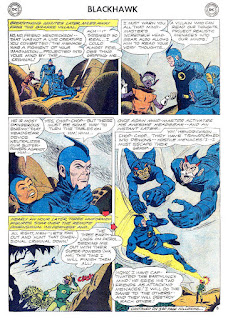
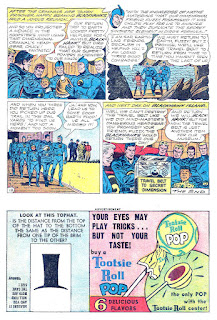
In the '60s I had disdain for the Blackhawks. Jack Schiff, editor, had changed the characters into one of those teams challenged by some science fiction creatures. Going back over a batch of coverless and poor condition comics I got years ago for a couple of dollars, including early '60s issues of Blackhawk, I have a different attitude. The stories are wild and oftentimes just silly, but nowadays, with my brain burned out by what seems like a million comic books that are wild and silly, I have at least decided to recognize Schiff by giving him something of a pat on the back. (Schiff is deceased, so it's symbolic at best.)
In this story four of the Blackhawks end up in the “Secret Dimension,” but I must’ve missed the reason it is secret. Those Blackhawks are given super powers. The Blackhawk crew would later get themselves some super powers, but this story came out a few years before that happened.
Story by Dave Wood, art by the team of Dick Dillin and Chuck Cuidera. From Blackhawk #186 (1963):
Translate
Showing posts with label DC Comics. Show all posts
Wednesday, January 05, 2022
Wednesday, December 22, 2021
Number 2586: I read the news today, oh boy — boys can fight!
Newsboys, once a common sight in big cities, sold newspapers on the street. In the pre-television and pre-Internet days they hustled their papers to the many people on the sidewalk, morning and afternoon. Newspapers are becoming passé, and kids selling them on the street are gone. Jack Kirby and Joe Simon used newsboys as another kid gang. Their token adult was the Guardian, a civilian who put on a costume and used underage boys to help him fight.
The Newsboy Legion, along with the Guardian, were created in the early '40s and got cancelled later in the decade. Simon and Kirby also created Boy Commandos, which followed much the same arrangement of team members. A male adult, and some underage boys. I have always assumed the boys were meant to bring interest to teenage and younger boys who would identify with some kids their own age kicking the butts of criminals or America’s enemies. That feature also came to an end in the late '40s.
Jack Kirby could draw action, and perhaps it was about what he said a few times in interviews: when he was a kid he fought a lot. When people got socked in a Jack Kirby panel you know it had to hurt. In that way Jack could reminisce at the drawing board about the fists that had flown in skirmishes from his youth.
From Star-Spangled Comics #14 (1942):
The Newsboy Legion, along with the Guardian, were created in the early '40s and got cancelled later in the decade. Simon and Kirby also created Boy Commandos, which followed much the same arrangement of team members. A male adult, and some underage boys. I have always assumed the boys were meant to bring interest to teenage and younger boys who would identify with some kids their own age kicking the butts of criminals or America’s enemies. That feature also came to an end in the late '40s.
Jack Kirby could draw action, and perhaps it was about what he said a few times in interviews: when he was a kid he fought a lot. When people got socked in a Jack Kirby panel you know it had to hurt. In that way Jack could reminisce at the drawing board about the fists that had flown in skirmishes from his youth.
From Star-Spangled Comics #14 (1942):
Wednesday, December 08, 2021
Number 2582: “The Golden Gladiator reigns supreme”
The Brave and the Bold was a comic book created as a wholesome entertainment for young readers, those who were now buying censored Comics Code-approved comics, that is. The idea was simple: create three feature characters for the title, make them historical. Even the Comics Code would pass a bit of historical mayhem. Golden Gladiator was one of the characters, along with Viking Prince and the Silent Knight. Of the three Golden Gladiator must not have attracted much attention, despite some excellent (as usual) dynamic artwork by Russ Heath. The Brave and the Bold #6 was the last appearance of the Golden Gladiator.
In this story from The Brave and the Bold #2 (1955), we are told that Golden Gladiator is good in the ring. We don't get to see the bodies piled up as entertainment, but we get the gist of it. Golden Gladiator’s girlfriend, Lucia, cheers for him, while her uncle, “Wily Cinna,” hates Marcus (the Gladiator’s real name).
I wondered if Attila the Hun and his hordes were around during the heyday of the Romans, and then read this online: “Attila the Hun was one of the most fearsome enemies that Romans ever faced.” For me, that is a history lesson in one simple sentence. What got my attention in the story was that Attila took on the Gladiator by himself, while surrounded by his own army, then kept banging with his sword an iron bracelet on the Gladiator’s wrist, which must have been given to Golden Gladiator by an ancestor of Wonder Woman.
Ed Herron wrote the story.
In this story from The Brave and the Bold #2 (1955), we are told that Golden Gladiator is good in the ring. We don't get to see the bodies piled up as entertainment, but we get the gist of it. Golden Gladiator’s girlfriend, Lucia, cheers for him, while her uncle, “Wily Cinna,” hates Marcus (the Gladiator’s real name).
I wondered if Attila the Hun and his hordes were around during the heyday of the Romans, and then read this online: “Attila the Hun was one of the most fearsome enemies that Romans ever faced.” For me, that is a history lesson in one simple sentence. What got my attention in the story was that Attila took on the Gladiator by himself, while surrounded by his own army, then kept banging with his sword an iron bracelet on the Gladiator’s wrist, which must have been given to Golden Gladiator by an ancestor of Wonder Woman.
Ed Herron wrote the story.
Monday, November 01, 2021
Number 2570: Alan Ladd gets mad because he's been had!
Hollywood star Alan Ladd makes a movie, and is up against a tricky young woman with an identical twin. Unbeknownst to Alan the twin is doing the acting, and Ladd is duped. How many times have we seen similar plots in movies, television, and books? Personally I’d think it could have been pretty good for Alan...two beautiful women...but the plot is fairly standard. The artwork is good, because artist Ruben Moreira was a good artist.
From Adventures of Alan Ladd #3 (1950):
Monday, September 20, 2021
Number 2558: The giant shell game
I mentioned last week that artist Nick Viscardy began his comic book career as a young man. The Wikipedia entry on Nick Viscardy a/k/a Nick Cardy (name used for comic book art) and Nick Cardi (used for illustration art) says this:
“Cardy becme the primary DC cover artist from the early to mid-1970s.
“A popular but apocryphal anecdote, told by DC editor Julius Schwartz, concerned Cardy being fired by DC editorial director Carmine Infantino for not following a cover layout, only to be rehired moments later when Schwartz praised the errant cover art. Cardy said in 2005: ‘At one of the conventions ... I said, ‘You know, Carmine, Julie Schwartz wrote something in [his autobiography] that I don't remember at all and it doesn't sound like you at all.’ And I told him the incident ... and he said, ‘That's crazy. You know I always loved your work. Gee, you were one of the best artists in the business. The guy's crazy.’ So I said, ‘Okay, come on.’ We went over to Julie Schwartz's table and we told him what our problem was. And Carmine and I said, ‘We don't remember the incident.’ So Julie said, ‘Well, it's a good story, anyway.’ [Laughs] And that was it. He let it go at that. [Laughs] He just made it up.’”
Cardy did this story for DC. Nice artwork, and he did some excellent drawings of the monsters in the story. In those days at DC it seemed to me that every comic, super hero, mystery or even some of the kids' comics, had some sorts of monsters. This issue of House of Secrets #40 (1961) is one I found in my basement in a box of all coverless comics from that era which I bought (cheap) years ago. When I flipped through them I noticed a story drawn by Nick Cardy, so I read it. The story itself is loopy...the hero goes after a girl from a myth, which is not a good place to look for girls. But the artwork is representative of Cardy’s usual good job regardless of the quirky story, which is why I am showing it.
“Cardy becme the primary DC cover artist from the early to mid-1970s.
“A popular but apocryphal anecdote, told by DC editor Julius Schwartz, concerned Cardy being fired by DC editorial director Carmine Infantino for not following a cover layout, only to be rehired moments later when Schwartz praised the errant cover art. Cardy said in 2005: ‘At one of the conventions ... I said, ‘You know, Carmine, Julie Schwartz wrote something in [his autobiography] that I don't remember at all and it doesn't sound like you at all.’ And I told him the incident ... and he said, ‘That's crazy. You know I always loved your work. Gee, you were one of the best artists in the business. The guy's crazy.’ So I said, ‘Okay, come on.’ We went over to Julie Schwartz's table and we told him what our problem was. And Carmine and I said, ‘We don't remember the incident.’ So Julie said, ‘Well, it's a good story, anyway.’ [Laughs] And that was it. He let it go at that. [Laughs] He just made it up.’”
Cardy did this story for DC. Nice artwork, and he did some excellent drawings of the monsters in the story. In those days at DC it seemed to me that every comic, super hero, mystery or even some of the kids' comics, had some sorts of monsters. This issue of House of Secrets #40 (1961) is one I found in my basement in a box of all coverless comics from that era which I bought (cheap) years ago. When I flipped through them I noticed a story drawn by Nick Cardy, so I read it. The story itself is loopy...the hero goes after a girl from a myth, which is not a good place to look for girls. But the artwork is representative of Cardy’s usual good job regardless of the quirky story, which is why I am showing it.
Subscribe to:
Posts (Atom)