The original (if you prefer, “Earth Two”) version of Green Lantern puts on a costume over his GL costume for a party. He and his dumpy little buddy, Doiby Dickles, take on a villain from the future who landed in America in the 1940s after aiming for another time. Knodar, the villain, is the world’s last criminal! Also the dumbest for missing his time target. (Not much smarter are the future people who put the last criminal in a museum jail, rather than a real prison.)
Speaking of time, Green Lantern’s time as a forties superhero was coming to a close. With this issue, All-American Comics #100 (1948), Green Lantern was replaced on the cover by the Western hero, Johnny Thunder. A couple of issues later, All-American Western would replace the venerable flagship title of Maxwell Charles Gaines’ original comic book line, in partnership with DC Comics. Green Lantern would go on until 1949 with his own title, and until 1951 in All Star Comics, but after that would disappear until the new (if you prefer, “Earth One”) version would appear in 1959. Sheldon Mayer, who had been editor, quit that position to go back to drawing. Issue #100 was the first by editor Julius Schwartz, and the powers-that-be at DC thought some changes in the line-up were in order.
Credits by the Grand Comics Database have John Broome as writer, and Irwin Hasen the artist.
Translate
Showing posts with label John Broome. Show all posts
Monday, May 22, 2017
Wednesday, May 04, 2016
Number 1885: The Phantom Stranger and the Moon ©ult
DC’s initial run of the title, Phantom Stranger, lasted six issues. It was another of Julius Schwartz’s books, and as I have mentioned with his equally short-lived Danger Trail, it may have had something to do with his newer titles of that era, Mystery In Space and Strange Adventures, both hits needing his close attention. Or, it could just be that Phantom Stranger, despite provocative covers and good art, just didn’t survive in a crowded comic book market. It is too late to ask any of the principals involved.
“The Three Signs of Evil” is by John Broome, drawn by Carmine Infantino, inked by Sy Barry and Joe Giella. The first thing that struck me was the "c" in the circle, which here is an evil sign, but is also the symbol for copyright, as in “Copyright © 1952 National Comics Publications, Inc.”
Unlike my example, the boilerplate indicia DC used in that day doesn't use the symbol. So, for the purposes of this posting an evil symbol it is, and forget I said anything.
From Phantom Stranger #2 (1952):
In 2012 I showed the debut of the Phantom Stranger. Just click on the thumbnail.
Wednesday, December 10, 2014
Number 1668: Time capsule from 1,000,000 B.C.
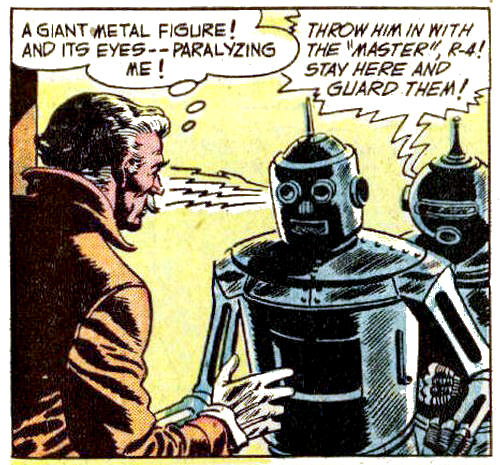
We continue our Strange Robot Adventures theme week with yet another continuing character who appeared in the early issues of Strange Adventures, Captain Comet. Created by John Broome using a pen-name, and drawn by Murphy Anderson and Joe Giella, Captain Comet is a mutant with the body of a man 100,000 years in the future. He would have to be extra sharp to pick up all of the incredible stuff he has to figure out in this story, [SPOILER ALERT] especially when the incredible stuff turn out to be some dirty doin's by a scientist’s free-thinking robots. Because of the red herring of the so-called time capsule from 1,000,000 B.C. we don’t get to see the robots until page 4.[END OF SPOILER]
It is of its era...I like the panel on page 6 where Captain Comet clobbers the robot, knocking out some springs and at least one vacuum tube. From Strange Adventures #29 (1953):
The two-part origin of Captain Comet! Click on the thumbnail.
It is of its era...I like the panel on page 6 where Captain Comet clobbers the robot, knocking out some springs and at least one vacuum tube. From Strange Adventures #29 (1953):
The two-part origin of Captain Comet! Click on the thumbnail.
Friday, December 07, 2012
Number 1276: “It's a woman's world!”
This is the fourth and final posting of our silly science” theme week. I've saved this one for last, because when I first read it I was slack-jawed with amazement. Yep, sixty years ago in these United States we had a whole different mindset about gender roles, did we not? I grew up in that era; my mom was a housewife and stuck to her “traditional female” role. It was how we saw the world, and role-reversal is the gimmick of this story, from Mystery in Space #8 (1952). Boys reading it in those days would think this would never happen! When Mrs. Pappy and I got married in 1969 the feminists (we called them “women's libbers”) were making headlines, and from my own spouse I could feel the change a-comin’!
In 1971 feminism was so threatening to some men that a book like this could be published.
This Mystery in Space story, written by John Broome under the pen-name John Osgood, and drawn by Bob Oksner and Bernard Sachs, had a publication history that straddled the feminist movement, before and after. It was reprinted the same year as The Feminists, in 1971 in From Beyond the Unknown #11 (where I first saw it), and in 1980 in the Simon and Schuster compilation, Mysteries in Space, the Best of DC’s Science Fiction Comics.
The last two panels of the story are howlers. You'll see when you read them. Talk about a male fantasy. “Okay, you chicks had your fun, now move on over and the boys are back in charge!” As all of us have noticed in our 2012 society that kind of talk may have worked in 1952, but not now.
Friday, October 26, 2012
Number 1251: Phantom Stranger makes his debut
The Phantom Stranger has a whole history with DC Comics, encapsulated in this Wikipedia entry. For our purposes today we're ignoring all of that to show you the first Phantom Stranger story from The Phantom Stranger #1 (1952).
[SPOILER ALERT] This is shown with a caveat: it's a story that appears to be supernatural but is shown to be a hoax. That was a basic trademark of DC's mystery comics line, which during the horror comics fad of the early '50s fell short of horror due to the debunking done in virtually every horror story. There's a fictional tradition of this type of mystery, and while a gimmick, it's a clever gimmick. For those who prefer their supernatural straight with no twists at the end to spoil the illusion, years later DC went full-bore into the supernatural, including the stories featuring this character.[END OF SPOILER]
This first series featuring The Phantom Stranger had a short run, just six issues. It was edited by Julius Schwartz.
This story is written by long-time DC scripter John Broome, and is drawn by Carmine Infantino and Sy Barry.
Subscribe to:
Posts (Atom)