Translate

Monday, August 09, 2021

Number 2546: Bathroom stop 20,000,000 miles


I am not sure more than one episode of “The Space Speedsters” ever appeared. Nedor Comics sometimes had guest appearances from other comic characters in their comics. The story, “The End of the World,” appeared in Black Terror #23 in 1948. "The Space Speedsters" are not promised to return, either in the next issue or in any other comic book. That seems to be be a sign it was a one-and-done feature. 

Going through my archives I have shown more than one story from other publishers that include a spaceman and his girlfriend flying through space in a ludicrously small craft. This one gets some sort of howler alert you can see in the panel above, where the space guy says, “I figure that planet is 20,000,000 miles from Earth! We’ll make it in under five hours, Jinx!” Perhaps he is telling her because based on the size of the spacecraft, five hours might be the as long as Jinx and the pilot/boyfriend, Randy Colman, can go without needing a toilet.

I’m old, I think of things like that.

No writer credited; art credited to Stan Aschmeier by the Grand Comics Database.


Wednesday, August 04, 2021

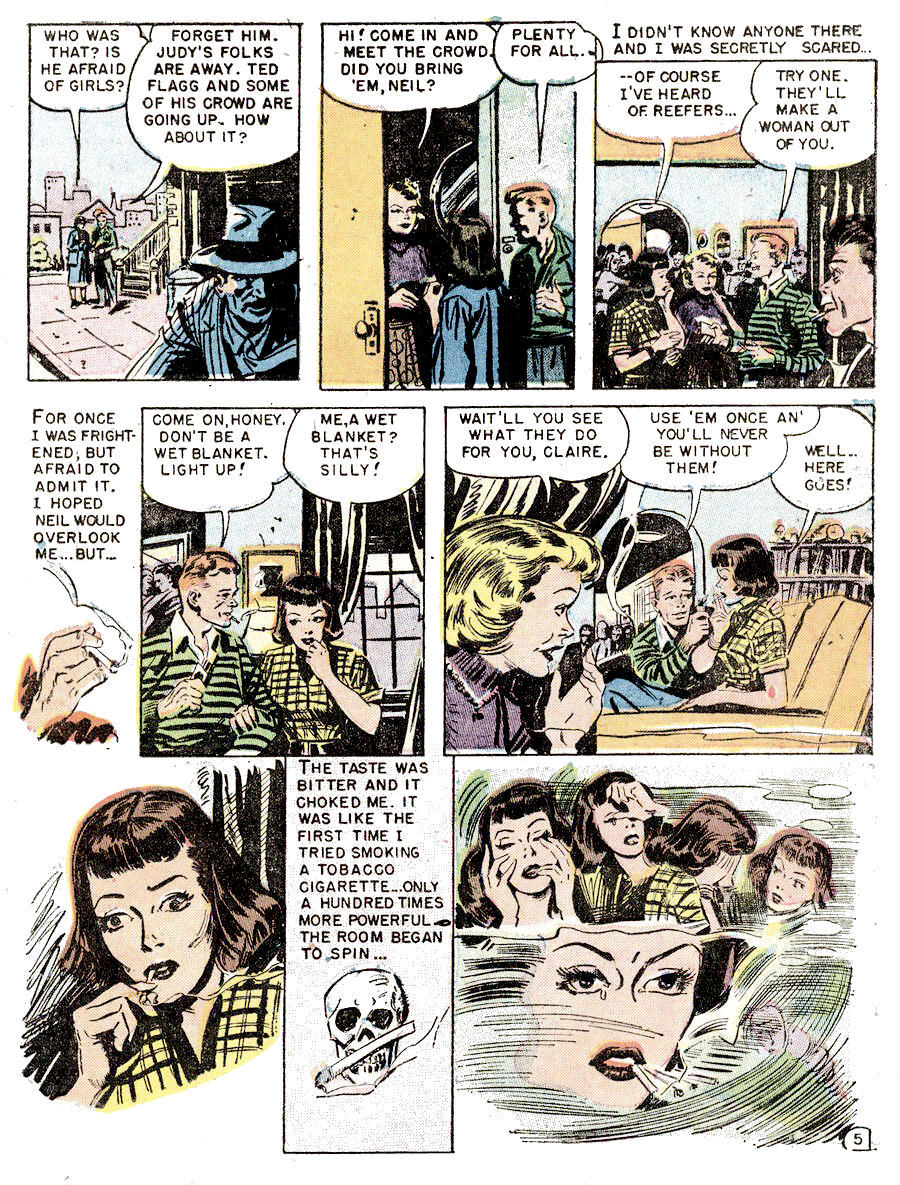
Number 2545: “Just try one and you’ll never be without ’em!”

This story, from Avon’s Realistic Romances #16 (1954), is reprinted from Romantic Love #6 (1951). It is anti-marijuana, which was the vogue in drug stories of the era. The lovely Claire is led into marijuana addiction, saying, “I lost popularity with all the boys at the school! Before I knew it, I had the habit...with all the evil consequences.” Later, she ends up behind bars in a mental hospital. She is shown a woman who is completely gone from smoking the devilish weed.

Need I say it? This is a love comic. Love wins out, and Claire finds her happily ever after.

I chose this both for its cautionary tale, circa early '50s, and the artist, Everett Raymond Kintsler. Kinstler went from the comic books and pulp magazine illustrations to become a highly regarded portrait artist. Kinstler is deceased now, and his history of portraits of several presidents of the U.S. is well known. He also regarded his early work in comics and illustration as being part of his artistic growth.


Monday, August 02, 2021

Number 2544: The ghost who can be conked

Public Domain Super Heroes says this about the character, The Duke of Darkness: “The Duke of Darkness was Paddy Sullivan [emphasis by me, Pappy], a police officer from an unnamed American city. When he was killed in the line of duty, Danny [another emphasis of mine] discovered that he continued to exist as an 'Earth-bound spirit.' He decided to continue fighting crime as the Duke of Darkness.”

The bringing up the two civilian names of Duke of Darkness (from his former mortal existence, of course) is because at the bottom of the entry for Duke of Darkness the anonymous writer for PDSH says this: “Many sites state ‘Danny’ as the character's real name however, this [Danny name] never appeared in a public domain story.”

Tsk tsk. Looks like some editing is needed. I depend on that site, so I'm just giving those fine folks at the PDSH a friendly heads-up.

It wasn’t like the Duke of Darkness set any records for longevity. He made but a few appearances and then was gone. Each comic book he appeared in had a different name, and each lasted one issue. I am supposing my old theory that they were published by someone who sold (or used) their paper ration at the end of World War II to cash in on the comic book market. Finally, the Public Domain Super Heroes site gives us this final note: “Even though he's a ‘ghost,’ he is able to be knocked out by a bump on the head such as in his first adventure.” Maybe there is a learning curve, watch your head, for people finding out they have died and are now a spirit.

Created by Sam Cooper and John Giunta, and presumably written and drawn by them for this first Duke’s story from K.O. Komics #1 (1945):


Wednesday, July 28, 2021

Number 2543: “Fire burn, cauldron bubble...”

Note to students: do not use this Shakespeare story to write a book report. Just thought I’d warn you. The story does hit some high points of Macbeth’s plot. The ending was made to fit a horror comic (as is explained in the splash panel), but not exactly what I would have expected. A better ending for me would be to have all of those of Macbeth’s assassination victims come back from the dead and go after Macbeth.

Charles (Chuck) A. Winter drew “Fire Burn and Cauldron Bubble” in a definite horror-story style. Lots of dark panels with heavy shadows, lots of work on evil grimacing faces, too. Winter was a guy who entered the comic book business by working for the art shops of Harry “A” Chesler and Jerry Iger. He also freelanced. Chuck Winter was born in 1896, and when he drew this story he’d been in Ye Olde Comick Booke business since 1938. I remember seeing his work in DC Comics of the early '40s, and the list of publishers who had used his work is fairly long. He appears to be an artist who dropped out of the industry after a while, and his biographical information ends right about then. I don’t know what he did after comic books. He died in 1967, age 70.

From Atlas’s Adventures Into Terror #27 (1954):


Monday, July 26, 2021

Number 2542: The devil is in the details

This well drawn comic book is another from Indian comic books published as Indrajal Comics by the Times of India, and...oh, wow! They have their own “Approved by the Comics Code” stamp on the cover! It is slightly modified from the American Comics Code stamp. At one point in the story they show a woman who may have been nude in the comic strip, and then covered up by an artist for the comic book, so that Comics Code stamp appears in the panel.

Garth is the hero, from the long running British comic strip created in 1943. In his original incarnation Garth was published until 1997. In 1971 Frank Bellamy (Dan Dare) took over the artwork, but Bellamy died in 1976. This comic book has the sort of sophisticated artwork I would expect from a strip from the UK, but I don't know when it appeared in the newspaper, and I don’t know who drew it.

Writer Peter O’Donnell (Modesty Blaise) who took over scripting Garth for awhile, said “The Garth stories are fantasy adventures about a very strong man whose best friend is a scientist, Professor Lumiere. In the stories, Garth can go back into the past or anywhere in the universe.” In “The Fiendish Mission” he goes up against the devil, who in the story is called Belial.

From Intrajal Comics #420 (1982):