A few months ago I showed a story by artist Everett Raymond Kintsler. It was a romance comic, like today’s posting. Far back in my past (50 years ago...yikes) I saw a couple of Kintsler comic book stories and thought his work didn't belong in comic books. My prejudices at the time were that comic book stories should look more like comic books than illustration. My complaint was that Kinstler’s art style looked more like those illustrations in slick magazines. Comic books just seemed like a whole other place, and purpose, than the illustrative work Kinstler did. I have changed my mind over those years, and now see his work as being solid story telling, but drawn with lines that were in vogue during the time of James Montgomery Flagg. Kinstler said more than once that Flagg was his inspiration, so an acolyte of Flagg ended up drawing comic books. Kinstler never disavowed his years in the comics, and I am sure they helped him learn how to draw just about everything needed in comics, which was also useful in his later art career.
Kinstler left comics and went into fine art. I admire that. He went on to do some great work. He died in 2019, age 92.
From Realistic Romance #8 (1952):
Translate
Monday, November 22, 2021
Number 2576: The comic artist who became the fine artist
Wednesday, August 04, 2021
Number 2545: “Just try one and you’ll never be without ’em!”
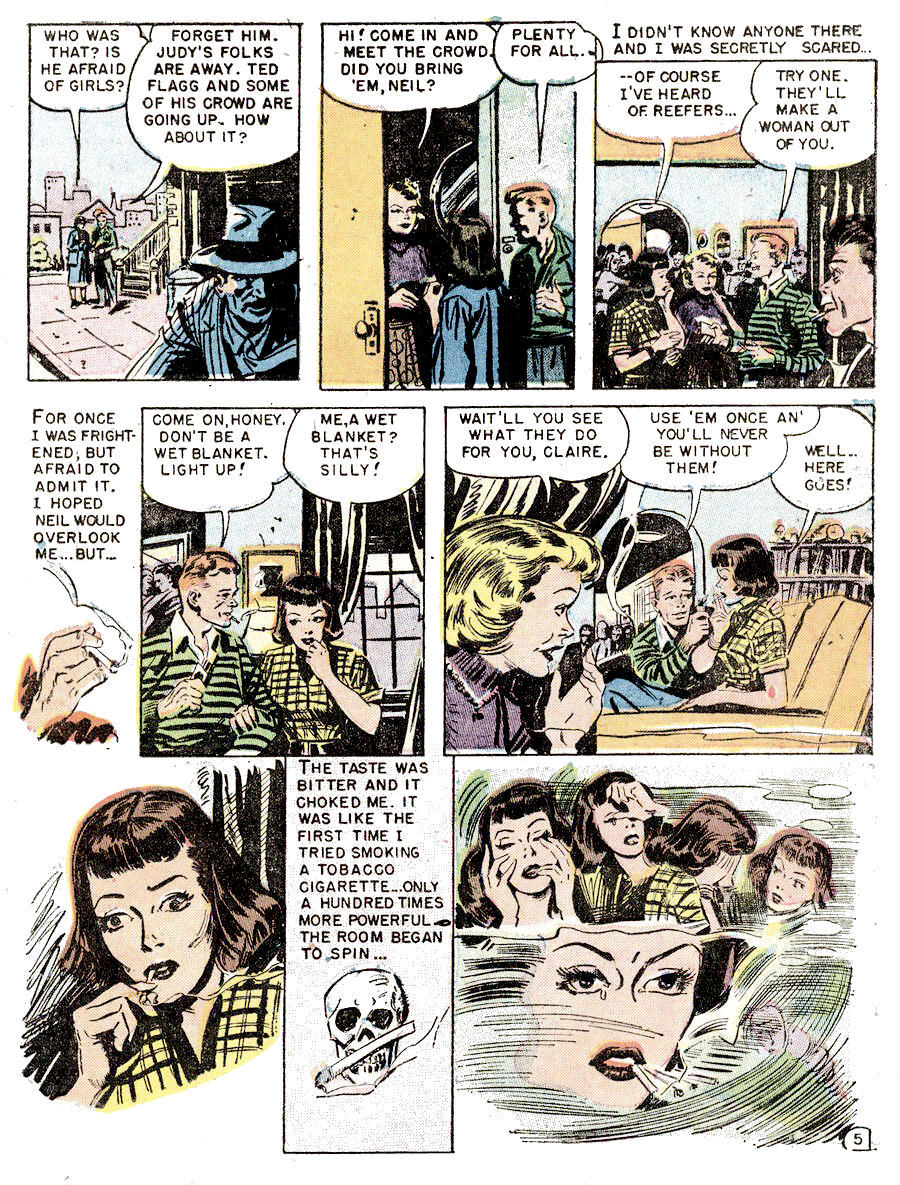
This story, from Avon’s Realistic Romances #16 (1954), is reprinted from Romantic Love #6 (1951). It is anti-marijuana, which was the vogue in drug stories of the era. The lovely Claire is led into marijuana addiction, saying, “I lost popularity with all the boys at the school! Before I knew it, I had the habit...with all the evil consequences.” Later, she ends up behind bars in a mental hospital. She is shown a woman who is completely gone from smoking the devilish weed.
Need I say it? This is a love comic. Love wins out, and Claire finds her happily ever after.
I chose this both for its cautionary tale, circa early '50s, and the artist, Everett Raymond Kintsler. Kinstler went from the comic books and pulp magazine illustrations to become a highly regarded portrait artist. Kinstler is deceased now, and his history of portraits of several presidents of the U.S. is well known. He also regarded his early work in comics and illustration as being part of his artistic growth.
Monday, March 25, 2013
Number 1338: Claire and her scandalous marijuana scare affair
From the days of reefer madness, when a toke of the Devil's herb could turn a teen into a slobbering, giggling murderer, comes this romance tale of drugs, wild nights and redemption, “My Scandalous Affair.” Not only have we a cannabis-cautionary tale, but it is very well illustrated by Everett Raymond Kinstler, who went on to fine art fame after his comic book career. Mr. Kinstler has forever earned my respect by not only reaching the top of his profession as a painter, but by not denying, indeed, by praising, his time in the comic book biz.
Personally, I have nothing to say about marijuana except I’m a sixties survivor, and besides, the statute of limitations on any illicit behavior has expired by now.
From Avon’s Realistic Romances #16 (1954):
Wednesday, September 29, 2010

E. R. Kinstler, famous artist, portrait painter, distinguished watercolorist, started his career in comic books at age 16. Unlike most other famous artists, Kinstler never denied his comic book work. In the biography, The Talented Miss Highsmith by Joan Schenkar, Kinstler worked with writer Patricia Highsmith (Strangers On A Train, The Talented Mr. Ripley) at Nedor in the early 1940s, when Highsmith was scripting stories for editor Richard E. Hughes. Kinstler, a teenager at the time, claimed he had a crush on her.
When Highsmith went on to new heights in her career she (almost) completely buried her comic book past. She wrote comics like Black Terror, and after the war wrote for Fawcett, scripting Golden Arrow, amongst others. Kinstler's career in comics is much easier to track, because he usually signed his stories. Even when he didn't, his work is easily spotted by his slashing pen style, influenced by James Montgomery Flagg. In "Untamed," done for the first issue of DC's Romance Trail*, in 1949, he doesn't use quite the fancy penwork he used later at Avon...probably due to the editorial dictates at DC, which had a prominent house style.
Highsmith wrote comic books for the extra income, and then when she became a world famous novelist never mentioned her work in the field. Kinstler features his comic book work in his biography because it's important to him to show that even though he came from what was considered at the time the bottom of the illustration industry, it helped turn him into the artist he later became.


*Julius Schwartz, who edited Romance Trail for DC, claimed it was DC's first love comic. (Source: Alter Ego #26, page 12.)
Friday, June 06, 2008

Number 320
Jungle Vengeance
How many white girls in tight-fitting animal-skin costumes were running around in the comic book jungle, anyway? Off hand I can think of Sheena, Rulah, Jann, Lorna, Judy, Tiger Girl, Shanna the She-Devil, Nyoka (who wore shorts) Jun-Gal…and Taanda, White Princess of the Jungle. I wonder if those jungle babes formed a coffee klatsch, got together in a hut somewhere once a week to swap stories of lions they'd killed, witch doctors they'd foiled, or white hunters they'd chased out of their jungles.
Well, whatever. Taanda appeared for a time in Avon Comics, drawn by Everett Raymond Kinstler, who went on to become a famous portraitist. This is from Skywald's 1971 Jungle Adventures #1, reprinted from White Princess Of The Jungle #2, from 1952.
Friday, September 21, 2007

Number 192
Death On The Earth-Mars Run!
Over the past few days I've been wondering if there's ever been a comic book artist who went as far in the art world as Everett Raymond Kinstler. He's a man who, in the early 1950s was drawing sci-fi potboilers like "Death On The Earth-Mars Run" for Avon's Strange Worlds #8, and by the turn of the 21st Century had painted the portraits of five U.S. Presidents, having two of them chosen as official White House portraits.

Offhand I can't think of anyone else who reached those heights after a background in comics.
Kinstler wasn't ashamed of his comic book work, either. He signed it when he did it; he mentions the comics work in his autobiographical materials. Kinstler was very influenced by James Montgomery Flagg, who is most famous nowadays for his iconic World War I poster image of Uncle Sam, pointing and saying, "I Want You!" In his pen and ink work Flagg was known for his flourishes with a flexible pen point, but that was the style of the day. By the time Kinstler used the Flagg-style in his comic book work it was passé. That didn't bother Kinstler, though, and it helped to make his work some of the most instantly recognizable of any comic book artist.
"Death On The Earth-Mars Run" strip isn't signed. Not my copy, anyway. I scanned it from a reprint in Skywald Comics' Heap #1, dated September, 1971.

There may be some other changes as well, dictated by the Comics Code, but I don't have the first printing with which to compare. It looks like Kinstler didn't spend a lot of time on it, but it's a fun read, anyway. Some of it is also similar to the work that Alex Raymond was doing on Flash Gordon in the mid-1930s. The whole story has an old-time feel to it; more like something published 20 years earlier. Nothing wrong with that; not when Everett Raymond Kinstler was wielding the pen.