Translate

Friday, June 21, 2013

Number 1388: Tough guy Tuska

A story about George Tuska has gone around for a long time. (It is also in semi-fictional form in The Dreamer by Will Eisner.) A woman — memory tells me it was Toni Blum — who wrote scripts for the artists in the comic shop bullpen was the subject of talk by the guys. Tuska liked her. Bob Powell apparently said something sexually insulting about her and Tuska got up from his board and punched Powell to the floor. In another report I read, Tuska, who was a big guy — and Powell was not — stood over Powell and said in the voice of Lennie (Lon Chaney Jr in Of Mice and Men), “You shouldn’t ought to have done that, Bob.” True, or exaggerated? I dunno. Good story no matter the truth? Hell, yeah!

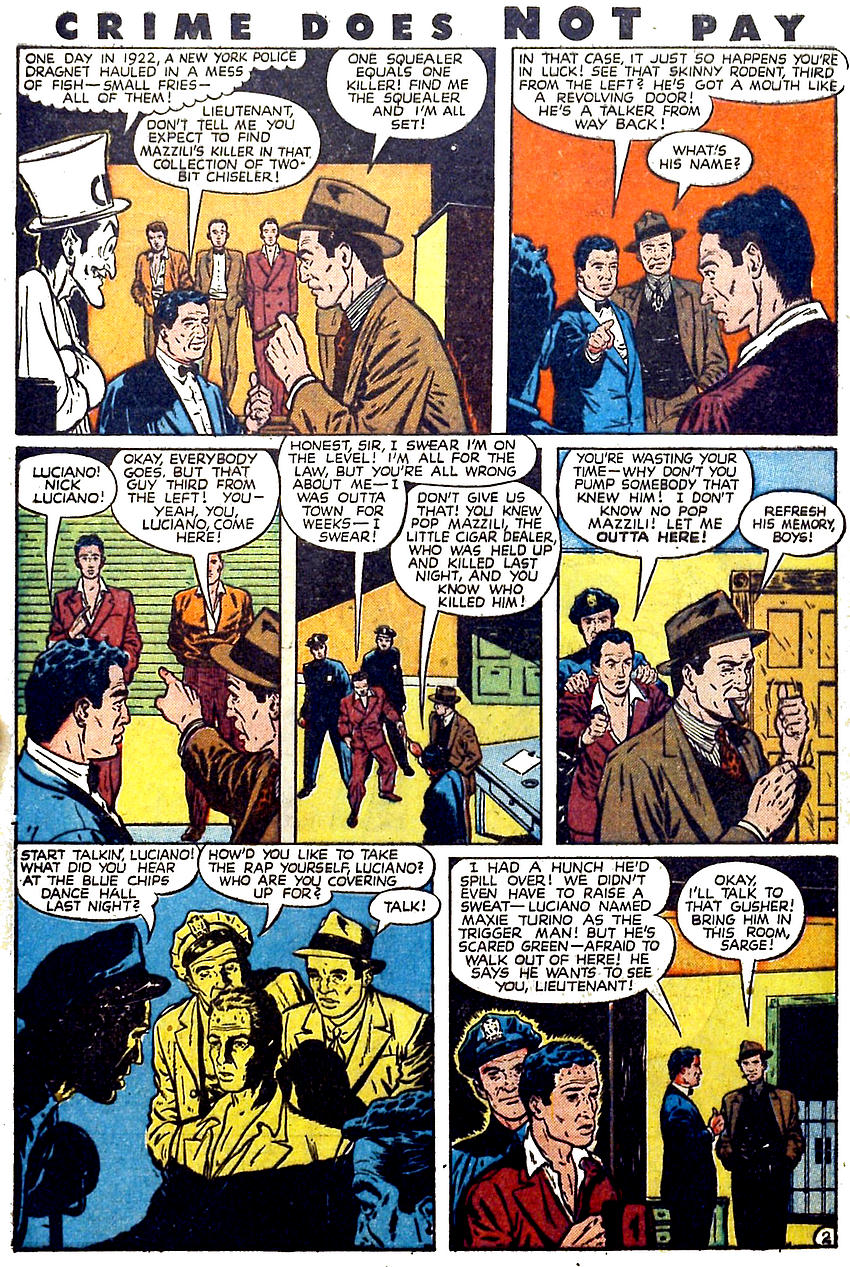
Tuska did the artwork on this lead story from Crime Does Not Pay #56 (1947). Cover by Biro.

Tuska, in my opinion, was at the absolute top of his illustrative skills when he did stories for Charlie Biro at Crime Does Not Pay. Biro was a demanding editor who made the artists draw everything, and that was even though the stories were burdened with text, captions and overloaded speech balloons. Still, Tuska managed to get all of the characters and violence into the panels. And speaking of violence, the sensitive among you need to be warned of some of the panels: a knife slices a cheek, a woman is shot.

Violence like that was part of what inflamed adults about crime comics being sold to children. Something a bit more subtle in this story is the message about being a squealer. Guys who tell on criminals meet a bad end. Remember that, kids.




 More classic Tuska: Butt Riley! Click on the picture.


**********
Your eyes will pop!

Another thing to cause concern amongst crime comic critics of the era is this ad from the same issue of Crime Does Not Pay: additional reading material from a third-party publisher. Five books, four of them concerned with crime. I don’t know for sure about the kids in 1947, but I sure would like to read them, and get the “hidden secrets, helpful information, inside ‘dope’.” That could be interpreted as ways to commit crimes. But there is one book, How Detectives Catch Crooks, that would be especially helpful. We still have that today: television programs about crime-busting through forensics, showing police methods, have helped some criminals.

It’s human nature to want to know about “Big-shot Gangsters, their crimes, careers and deaths!” and I’m no different. But I don’t plan to emulate them. I don’t commit crimes because I’m not a criminal, no matter how many books I read or TV shows I watch about crime. I suspect that’s true about most people, or despite all the crime-saturated entertainment the crime rate would be a lot higher than it is.


Wednesday, June 19, 2013

Number 1387: Atomic attack, 1972!


Just about a week ago I showed a 1946 atomic destruction story by Joe Simon. You can see it in Pappy's #1382.

Now, for today’s radioactive post:

Looking at this 1952 story of futuristic (1972) soldiers fighting an atomic war, lobbing H-bombs around, reminds me yet again of growing up in this era, when I was certain we were going to have the Big One dropped on us.

In this action-packed atomic tale, drawn by an unidentified artist for Atomic Attack! #5 (actually #1, continued from Attack! numbers 1-4), young Tommy reads a letter from his older brother, Pete, fighting for the good ol’ U.S.A. against the dirty Reds. Pete describes his squad in battle. I’m glad I didn’t see this story when it came out because I’m sure it would have just ratcheted up my paranoia.


Monday, June 17, 2013

Number 1386: “...nor iron bars a cage...”

Even if we accept for fictional purposes that a full-grown man can shrink himself into doll size and change instantly into a superhero, the idea that such a superhero would be held in a prison cell meant for normal beings causes incredulity. There’s more than the usual suspension of disbelief in this tale from Doll Man Quarterly #4 (1942). Superheroes exist in a universe where they are extraordinary beings, but beyond the reader accepting their powers we aren’t usually supposed to believe that anyone would be as extraordinarily dumb as the jail warder in this story.

The Grand Comics Database lists Max Elkan ? (question mark means they aren’t sure) as the artist.


Sunday, June 16, 2013

Number 1385: Jet Powers’ apocalyptic tale

Jet #3 did something I don’t think I’ve ever seen a comic do before; it began two separate cliffhangers in that issue, and completed them in #4 (the final issue). So what I’m doing today is showing both parts of the first serial from consecutive issues, and the second two-parter I’ll show at some point in the future.

I’ve shown these scans before a few years ago, and it’s time to dust them off (ho-ho) and show them again, improved from their last appearance.

From Jet #3 (1951) and #4 (1951), written by Gardner Fox and drawn by Bob Powell with his assistants.


Last year I showed the first story from Jet #1. Click on the pic to see it: