Over 11 years ago I first showed this story of the notorious serial killer, H. H. Holmes. At the time I neglected to mention it contains one of the most egregiously violent panels in crime comics. In the panel Holmes kills a child with a knife. The action is done in silhouette, but the dead mother is in the foreground, with blood dripping from her dead mouth. I wonder if that panel might be the reason that Fred Gardineer did not sign the splash panel with his signature, something he was otherwise known to do?
H. H. Holmes was born Herman Webster Mudgett, in 1861. He is the murderer known for the torture castle in Chicago. It is hard to tell what is true and what is exuberance from yellow journalists sensationalizing Holmes’s murderous lair. Holmes padded his own image as a killer. He lied about his body count, claiming to have killed people who were actually still living.
Besides the gruesome violence mentioned, something in the last panel gives me pause. When Holmes is hanged he is wearing the same clothes as he was wearing in court when he was sentenced. Maybe, with his status as a murderer to live up to, he did not want to be hung in some ugly old prison clothes. Holmes was only 34 years old when the gallows got him, and perhaps he wanted to look stylish.
From Crime Does Not Pay #53 (1947):
Translate
Showing posts with label Crime Does Not Pay. Show all posts
Monday, January 10, 2022
Monday, December 13, 2021
Number 2583: John Lee survived the gallows
Englishman John Lee, often called John “Babbacombe” Lee, was sentenced to death and met the hangman in 1885. The gallows trap door did not open, and after three attempts to hang the murderer, his sentence was changed to life imprisonment.
The version of John Lee, surviving execution as told in Crime Does Not Pay #26 (1943), has the basic story of Lee fairly straight, but the ending is fanciful. The problem is that Lee’s further fate, after prison is mostly unknown. Some say his fate brought him to the United States after deserting his family in England, the rotter! Lee is purported to have emigrated after deserting his wife and children. It makes for a good story, anyway, which makes it sound a lot like folklore.
Art by Dick Briefer.
Wednesday, October 09, 2019
Number 2398: Short in the saddle
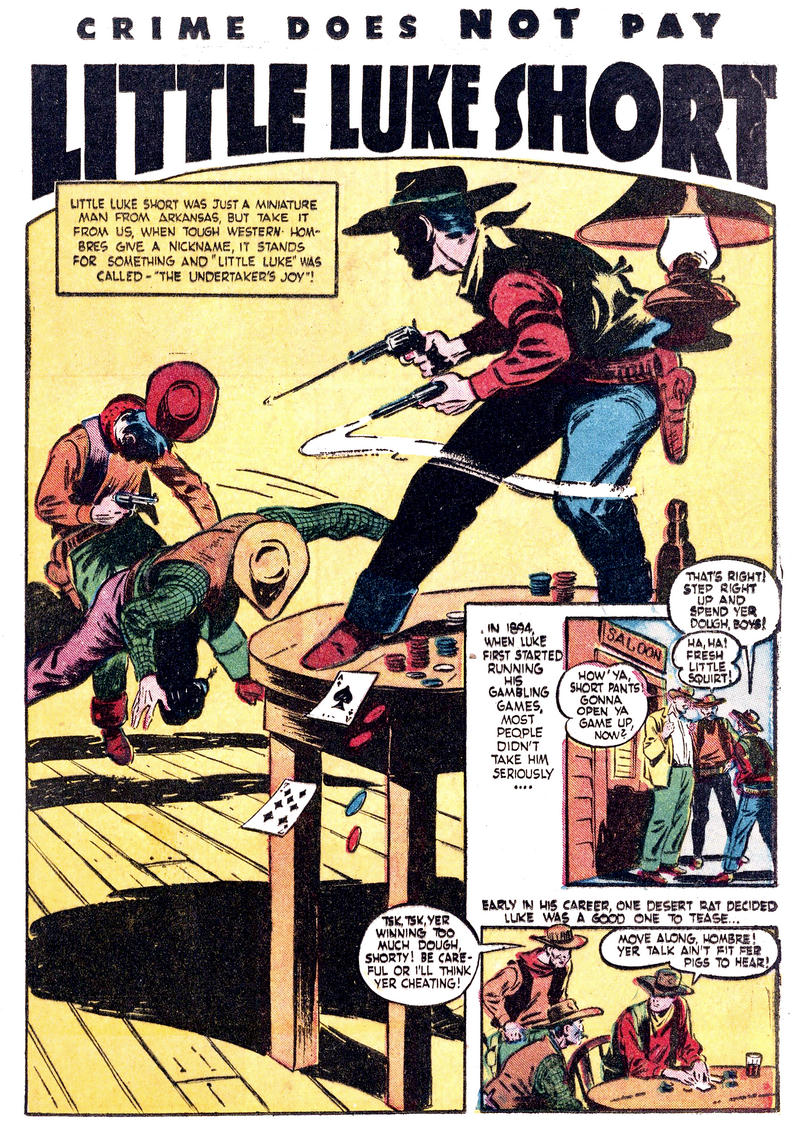
Luke Short’s name seems almost too good to be true. Short, an old West character who shot several men and killed many, if not most of them, was a short man. Maybe that is why men who were apt to pull their guns in a fight took him for an easy target. They were short-sighted.
Luke Short was something of an entrepreneur; he opened gambling dens, taverns, got into the boxing game as well as horse racing. But he also shot and killed people. Everyone has their flaws, I suppose. Short lived at the same time as well-known people like Wyatt Earp and Bat Masterson (who wrote a biographical tribute about Short after his death), but I had not heard much about him until I did a bit of research on this story from Crime Does Not Pay #29 (1943). The crime comics tried to justify showing crime and violence by having the criminal in the end get justice by being executed. They could not do much with Luke Short because he died of kidney disease, not a noose. A court found against him once for a shooting; he was fined $150 and released. You’d be selling Luke Short short if you assumed, as I did, that he was a typical Western bad man.
P.S. The Western novelist, Luke Short, used the name as a pseudonym. His real name was Frederick Dilley Glidden,
The Grand Comics Database has no idea who wrote or drew the story.
Friday, July 26, 2019
Number 2367: The funny side of murder
In its early days Crime Does Not Pay could be funny. As funny as crime and murder can be, that is.
Here we have two stories and a page of “gag” cartoons. (“This’ll Kill You!”) The cartoons were drawn by Dick Briefer. In one panel he drew himself with editors Biro and Wood. “The Poison Dove,” also by Briefer, looks like slapstick on the first page, but loses its funny very fast. “The Corpse That Wouldn’t Stay Dead” has some dark comedy about a barkeep and cronies attempting to bump off a homeless person (in those days called a “bum”) for insurance money. The problem is the victim keeps coming back. It is drawn by Jack Alderman. In those days Alderman had a stiff (ho-ho) art style and he used lots of ink and shadows to add to the noir qualities of his stories. The laugh it invokes in me is that Alderman drew Tweety and Sylvester stories for Dell in the late '50s.
The stories are from Crime Does Not Pay #29 (1943).
Today is the thirteenth anniversary of Pappy’s Golden Age Comics Blogzine. I have been going through some old files I saved on CD, and I found some artifacts from 2006 of what I had originally intended for my blog. I was going to do a horror comics blog, and it was to be called The Grim Reader’s Horror Comics. I stole...errrr, appropriated some prospective headers from a Mexican comic book, and then had second thoughts. First, at that time I did not have enough material to scan for an all-horror comics blog. However, I had a couple of boxes full of golden age comics in varying degrees of bad shape, just right for scanning and presenting. A year later or so the idea of a horror comics blog, The Horrors Of It All, was brought to life by Steve “Karswell” Banes, and a very fine job he has done of it.
Here are the re-purposed and original images from a Mexican horror comic from 1987, Sensational de Terror. It’s a small comic book, 4 1/2 inches by 6 inches. It is missing now. I can never find it when I am looking for it. It hides from my sight by having larger comics put on top of it.
Here we have two stories and a page of “gag” cartoons. (“This’ll Kill You!”) The cartoons were drawn by Dick Briefer. In one panel he drew himself with editors Biro and Wood. “The Poison Dove,” also by Briefer, looks like slapstick on the first page, but loses its funny very fast. “The Corpse That Wouldn’t Stay Dead” has some dark comedy about a barkeep and cronies attempting to bump off a homeless person (in those days called a “bum”) for insurance money. The problem is the victim keeps coming back. It is drawn by Jack Alderman. In those days Alderman had a stiff (ho-ho) art style and he used lots of ink and shadows to add to the noir qualities of his stories. The laugh it invokes in me is that Alderman drew Tweety and Sylvester stories for Dell in the late '50s.
The stories are from Crime Does Not Pay #29 (1943).
**********
Today is the thirteenth anniversary of Pappy’s Golden Age Comics Blogzine. I have been going through some old files I saved on CD, and I found some artifacts from 2006 of what I had originally intended for my blog. I was going to do a horror comics blog, and it was to be called The Grim Reader’s Horror Comics. I stole...errrr, appropriated some prospective headers from a Mexican comic book, and then had second thoughts. First, at that time I did not have enough material to scan for an all-horror comics blog. However, I had a couple of boxes full of golden age comics in varying degrees of bad shape, just right for scanning and presenting. A year later or so the idea of a horror comics blog, The Horrors Of It All, was brought to life by Steve “Karswell” Banes, and a very fine job he has done of it.
Here are the re-purposed and original images from a Mexican horror comic from 1987, Sensational de Terror. It’s a small comic book, 4 1/2 inches by 6 inches. It is missing now. I can never find it when I am looking for it. It hides from my sight by having larger comics put on top of it.
Friday, October 06, 2017
Number 2111: Legs Diamond, the human target
Jack “Legs” Diamond, infamous Prohibition-era gangster, was the target of killers four separate times. In the first three attempts at rubbing him out, Legs got a total of ten bullets in him. He survived each of those attacks. He might have felt invincible. But he ran with a rough crowd, and he did not survive the last attack in 1931, when a couple of goons put two bullets in his head. Goodbye, Legs!
Legs had a girlfriend, Marion “Kiki” Roberts. In this crime comics version of Legs’s life and career, Kiki becomes “Diki.” The editors would do that sometimes when the person they were referring to was still alive. Kiki, who had been a Ziegfeld Follies showgirl, went on the road with her newfound notoriety, after Legs was safely dead.
Artwork by Bob Q. Siege. From Crime Does Not Pay #44 (1945).
“It’s the Truth”
With this issue of Crime Does Not Pay, a 16-page rotogravure section was included with the comic book. It was done in standard detective magazine style, with lurid text articles like “The Riddle of the Bludgeoned Beauty!” and “‘That’s the Killer!’ Shrieked the Parrot!” The section included little fillers called “It’s the Truth” with things every young crime comics reader should know about hanging, the gas chamber, and accidental death by firearms. Also, an informational bit for young murderers: how not to make the mistake of placing a gun in a dead man’s hand, to make it look as if he used it on himself.
Subscribe to:
Posts (Atom)