Translate

Showing posts with label golden age comics. Show all posts

Sunday, November 19, 2006

Number 55


COVERING UP: Classic covers of Golden Age Comics


Trolling around the Internet is an interesting experience for me. I keep finding things I haven't seen before. Just when I thought there weren't any Golden Age comics I hadn't seen before, I find a couple that are new to me.


The first cover, Down With Crime #7, from November 1952, is a Fawcett Comic, with a cover that looks to be by Bernard Baily. I'm astonished a girl would have her window open to let a guy in, especially a guy wearing a gas mask and carrying a gun! At least she has a gun in the drawer to reach for, and she has the Hollywood style of hair: in bed with no hair out of place. Since I don't have the comic book itself to look at I'm not sure if the cover illustrates a story inside, but it reminds me of a famous true story I read years ago.

In a Texas town during WWII a woman reported that during the night a gasmask-wearing weirdo had opened her window and sprayed gas into her room. Within a short period of time other women were reporting the same thing. At first the reports were taken seriously, but quickly it was determined to be a case of mass hysteria. It was believed the power of suggestion and war jitters were making people imagine such crazy events. I don't know if there has ever been a resolution to this story, except that it's commonly used as an illustration of how delusional hysteria can become infectious.

The second cover, Crime Mysteries #4, also from November 1952, reminds me of Seduction Of The Innocent, by Dr. Fredric Wertham, M.D. That book reprinted an illustration of two crooks — and you could tell they were crooks, because they were wearing little Lone Ranger-style maskshad a girl on an operating table, tubes coming out of her. One crook is saying, "We'll drain this dame dry!" Dr. Wertham's caption mentioned (and I'm paraphrasing because I don't have the book to reference the exact quote): "Outside the forbidden pages of de Sade you will find draining a woman's blood only in a comic book."
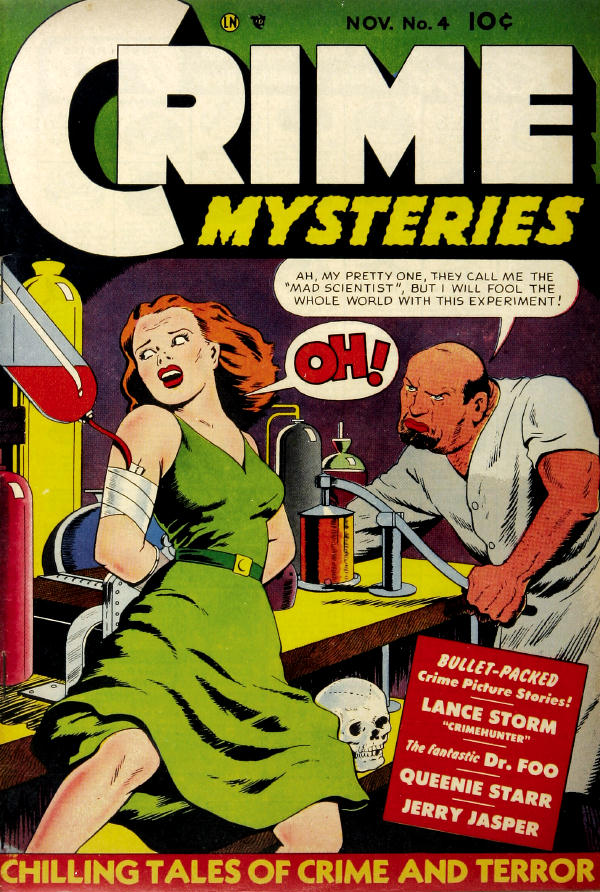
 
Crime Mysteries was part of a group of comic books that are tied to DC Comics. Twenty years earlier DC's owners were the publishers of the notorious Spicy pulp magazines. After the pulps went out of the business some of the same people associated with the Spicy line published comic books. It's kind of a murky tale, with the illustrated examples in the website, DC's "Other" Comics.

The whole early history of comics is somewhat shadowy and murky. Some of it deals with semi-pornography, and organized crime.

In the DC's "Other" Comics website there is a link to a bibliography detailing the earliest years of the comics. The bibliography includes my favorite article on the subject, "DC's Tangled Roots," by Will Murray, from Comic Book Marketplace #53, November 1997.

Friday, November 17, 2006


Number 54


Frankenstein Friday: Silas Grunch Gets His


This is the first story from Frankenstein Comics #7, May-June, 1947.The thing that strikes me the most when looking at this story is how hurried the artwork looks. It doesn't have the careful penciling and inking that characterized the earlier Frankenstein stories.

Briefer gives credit in the final panel to Ed Goggin for helping with these tales.

The story of an old miser who hates kids and gets his just due in the end sure wasn't new when this story was published. I think it was the basis for several movies, even some Our Gang short comedies. It was something of a plot staple in those days. Its literary antecedents can be found in A Christmas Carol and Silas Marner. Misers have always been popular to hate.


Saturday, November 11, 2006


Number 52


Jack Cole and Silver Streak, Part IV


This is the last of the Silver Streak stories published in the one-shot, unnumbered issue of Silver Streak, published in 1946. The story itself was originally published in Silver Streak Comics #7 in 1940.

Previous postings of Jack Cole's Silver Streak were Pappy's Number 6, Pappy's Number 18, and Pappy's Number 36.


In his comic book days Cole was never far from his bigfoot art style of the 1930s. As a matter of fact, I don't think the superhero stuff came easy to him, not as easy as the cartoony stuff, that is. This story has some really weird cartoon characters. The premise of the story is ludicrous, but that was something of a hallmark of early Golden Age comic book stories.

From Silver Streak Cole went on to Plastic Man, Midnight, even The Spirit during Will Eisner's Army service. Cole did some horror and crime stories before wrapping up his comic book career and becoming Playboy's top cartoonist. He then created a syndicated newspaper comic strip, Betsy and Me, before shooting himself to death.

Jack Cole would have had a lot of good years of drawing in him and we are poorer for losing out on so much. The old Silver Streak Comics, with their cartoony art and bizarre stories, were very fun, but came nowhere close to showing the inspiring talent that was routine for Jack Cole just a few short years later.


Friday, November 10, 2006

Number 51


Frankenstein Friday: Frankenstein Comics Covers


Frankenstein Comics by Dick Briefer had great covers. These issues, #3-6, are no exception, sporting bold, poster-colored covers, sure to stand out on any newsstand of the era.


I don't own any of these issues. I found these covers on the Internet.

Next week I'll be showing the first story in Frankenstein #7. Be here!

Thursday, November 02, 2006


Number 50


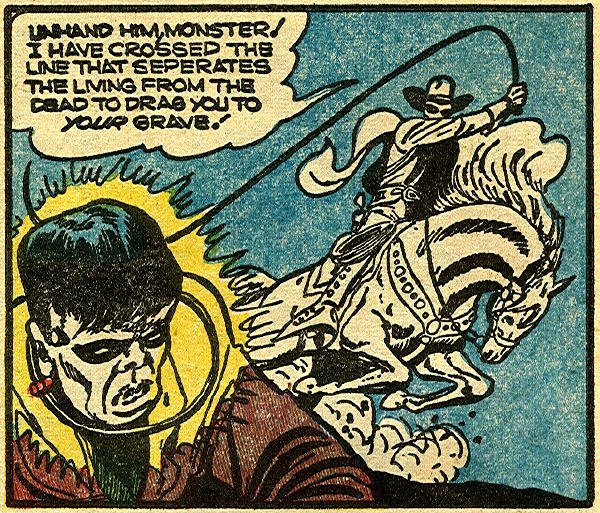
Frankenstein Friday: Ghost Rider Vs Frankenstein!


Dick Ayers, one of the finest of the Golden Age artists, was also one of the finest Silver Age artists, and as far as I know, at age 82, is still drawing! The Ghost Rider was his strip, very popular in its time, killed by the Comics Code.

Ayers went on to Marvel Comics in the early 1960s, drawing and also inking. His bold inking made Jack Kirby's bold pencils on his late '50s monster strips really eye-popping. There was nothing else like them anywhere.

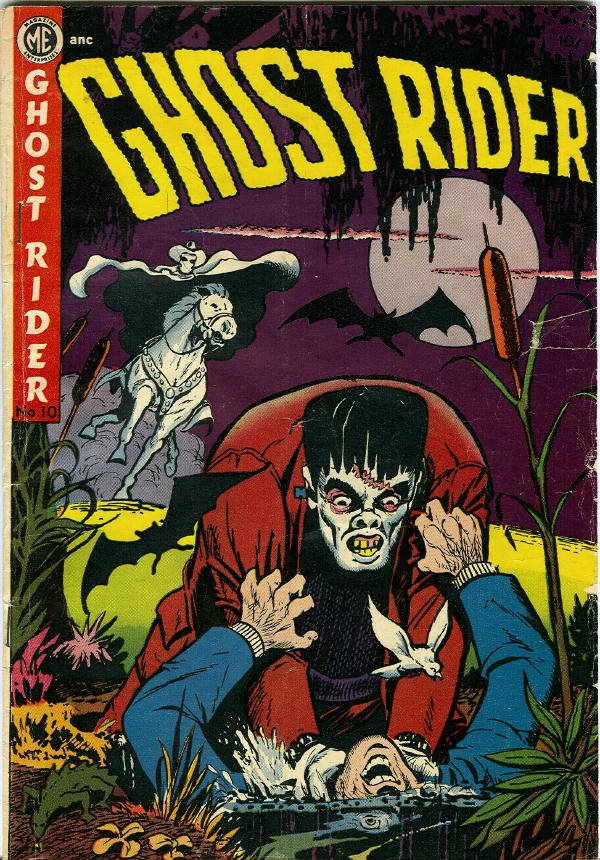
Ghost Rider was a combination western/fantasy/horror comic book, begun in 1950. It had fast moving stories and great art. (I probably don't need to mention that Marvel Comics also appropriated the name, if not the theme, of the Ghost Rider by creating its own character.)

The Ghost Rider Vs. Frankenstein story, from Ghost Rider #10, December, 1952, is widely regarded as one of the most memorable from the title. The cover alone is worth the price of the book.


If I have an objection to the story at all it's the cop-out ending. The rest of it is quite good, though.

Ghost Rider publisher, ME Comics, didn't really publish horror comics, but Ghost Rider was spooky enough in its own right. And it was due to the moody and evocative art of Dick Ayers.


Tuesday, October 31, 2006


Number 48


Jack Bradbury's Spencer Spook


After the unintentionally silly story in Pappy's #47, here is a story that is intentionally silly.

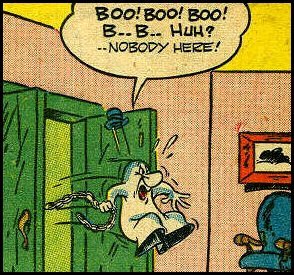
This is a Spencer Spook story, originally published in Giggle Comics #54, June, 1948. Jack Bradbury drew it.

Bradbury (1914-2004), was originally an animator and turned into a fine comic book artist. He worked on funny animal comic books for Richard E. Hughes, the same writer/editor who turned out Adventures Into the Unknown, Forbidden Worlds, and many other comics over the years. Later on Bradbury went to work for Western Publishing and did many Mickey Mouse and Disney stories for Dell Comics.

Personally, I thought his Disney stuff seemed stiff compared to the freedom his line showed in the old Giggle and Ha-Ha Comics.

This story contains a stereotyped African-American woman, a maid, who may be offensive to some readers. I'm presenting this story as it originally appeared 58 years ago, when this sort of racist caricature wasn't that uncommon.

Several artists over the run of the Spencer Spook strip worked on the character, but I liked Bradbury's version the best. The character was revived in the 1980s, with new stories illustrated by Pat Boyette. I appreciated Boyette's skill, but in my mind no one could top Jack Bradbury.


Sunday, October 29, 2006


Number 47


The Tomb Of Terror


This is an enjoyable but hokey story from Forbidden Worlds #5, March-April, 1952. It's drawn by Lou Cameron. He left comics some years ago to pursue a successful career as a writer of paperback novels.

I said this story is hokey, and it is. The plot is straight out of a pulp magazine. A doctor and his fiancée visit a town with a sinister castle, "Stormway Hall." The ghost of a girl leads the doctor into a supernatural situation involving a green sorcerer, some "fiends," and a ghost, all in a place the sorcerer refers to as The Tomb Of Terror. It was most likely written by the editor, Richard E. Hughes, who seemingly and single-handedly, wrote and edited the American Comics Group line until his death some years ago. Forbidden Worlds, and its big brother,  Adventures Into The Unknown, were successful comics that ran for many years.