Translate

Showing posts with label Richard E. Hughes. Show all posts

Wednesday, December 01, 2021

Number 2580: The writer is out of ideas at Out of the Night

American Comics Group editor, Richard E. Hughes, was inserted into stories a few times over the years in ACG’s supernatural comics, as they were referred to in house. This pre-Code story, “Adventure into Witchcraft,” has some panels of Hughes listening to a writer’s problem of not being able to write a good story. The ACG way in a story with a writer and an editor was having the writer encounter the type of situation for real to give his fiction some credibility. To the fictitious depiction of Hughes, that is.

Harry Lazarus was an artist who worked for ACG, both pre-Comics Code and post-Comics Code. He was a solid professional artist, which to me showed he could tell a story. He worked for several other publishers, also.

The story is from Out of the Night, a comic book ACG added to its list of supernaturals. ACG titles were apparently doing well in those days. I like the panels with Hughes at his desk with his door advertising not only Out of the Night, but Adventures Into the Unknown and Forbidden Worlds. Out of the Night ended in late 1954 after 17 issues.

From Out of the Night #5 (1952):


Wednesday, June 23, 2021

Number 2533: Tilt!

Ogden Whitney does an excellent job of drawing buildings in crazy positions, bending rubber-like, and threatening. It is one of the reasons I chose this story. That, and the main character, Edward Courtney, in order to understand dreams that frighten him, visits a psychiatrist.

Dr Farraday makes snap diagnoses: “Every dream has a meaning — it’s a manifestation of something in the subconscious which is trying to break through.” Sure, okay Doc...but what about the old man, with that straggly long hair who is in those dreams? Dr Farraday brings him up, “The old man might be the key to the whole affair!” Edward denies knowing the old man, and as far as I know, not shown, the doctor may have said, “Our session is over for today. Please give me a check for $100.” I imagine that because it happened to me several years ago when I sought professional counseling.

The tilting towers in “The House on Magnolia Street” are from Adventures Into the Unknown #73 (1956).


Wednesday, June 05, 2019

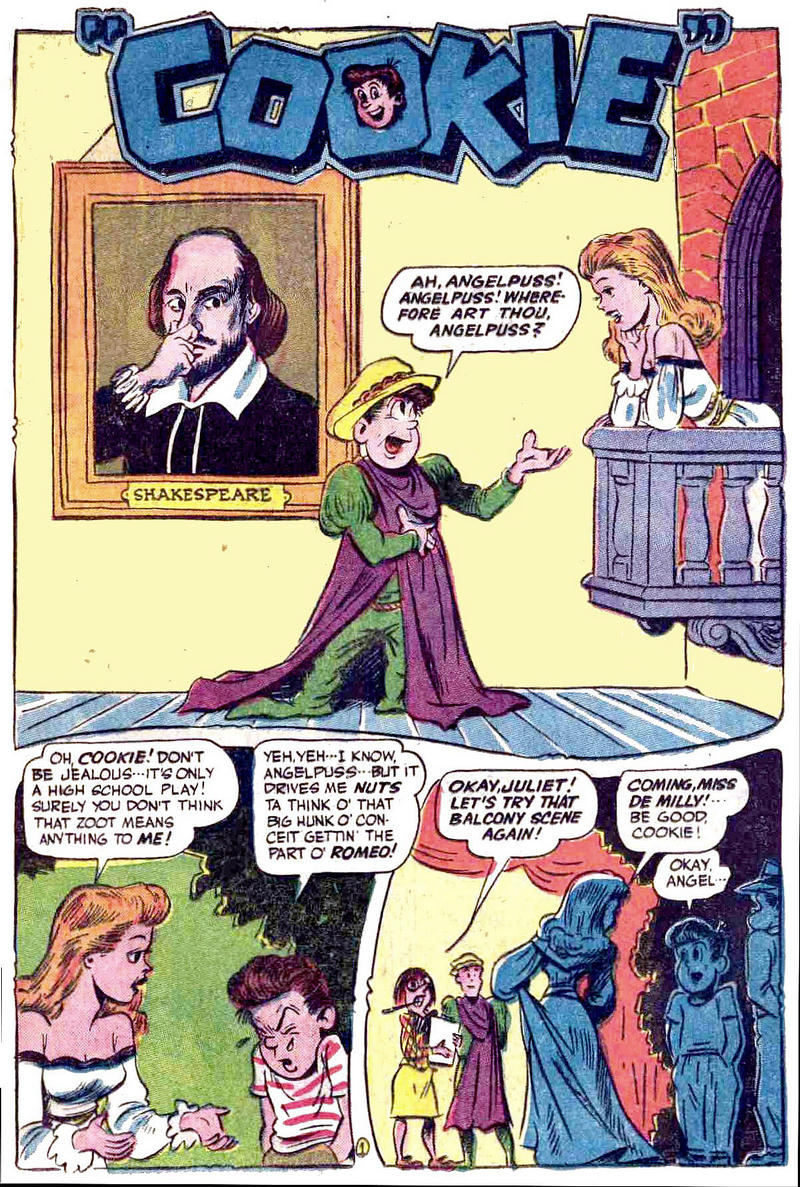
Number 2346: “Wherefore art thou, Cookie?”

Dan Gordon, who drew Cookie in a comic book of the same name, was an animator whose work in the field went back to the Van Beuren studios in the 1930s, then Paul Terry’s Terrytoons, to the Fleischer Brothers, where he worked on Popeye and also the classic Superman cartoons. After his time in comic books was over, he eventually went back to animation, working for Hanna-Barbera. Whew! The guy got around.

Gordon (who also signed his work “dang”) was a superb draftsman, a born cartoonist, and kept his stories moving along. In this tale, our hero, Cookie, is watching from the sidelines in a jealous fit over his girlfriend, Angelpuss, playing opposite his rival, Zoot, in a high school production of “Romeo and Juliet.” The story, funny as it is, gives me some memories that cause a cringe or two, especially jealousy of a rival for a girl I liked.

Cookie was another of the Archie imitators who cropped up in the late forties. The comic book was published by ACG, a company which also published Adventures Into the Unknown, Forbidden Worlds, Herbie, and others. Unlike most of Archie’s comic book rivals, Cookie had a good long run for a teenage comic.

From Cookie #11 (1948):


More Cookies! Just click on the thumbnail.


Wednesday, May 22, 2019

Number 2341: Boy Beetle, Herbie

This is a story about Herbie Popnecker, and how he found pop music stardom. He stuck a mop on his head, turned his name around to Eibreh Rekcenpop, then warbled a couple of songs to drive the girls wild! As pop stars of that era will tell you, it was not easy to compete with the Beatles. It was more of a long and winding road to stardom for most. But Herbie, errrr, I mean Eibreh, has some sort of irresistible charm about him. Herbie is so charming that he charmed a whole bunch of people into buying his comic book in the sixties, and even now it is seen as something still charming, even unique in comic book history.

In “Herbie, Boy ‘Beetle’” the Beatles really aren’t prominent; they appear in a few panels and then vanish, leaving the rest of the story to Eibreh and jealousy from established artists Dean Martin and Frank Sinatra. Just when you think the story couldn’t get any screwier, Dean and Frank assault Herbie by cracking objects over his head. That physical stuff never works on Herbie, who is impervious to harm..

Written for Herbie #5 (1964) by ACG editor Richard E. Hughes under the name Shane O’Shay, and drawn by the master of deadpan humor, Ogden Whitney. Herbie is, as always, a very unusual hero. And we love him, yeah yeah yeah.


Monday, April 15, 2019

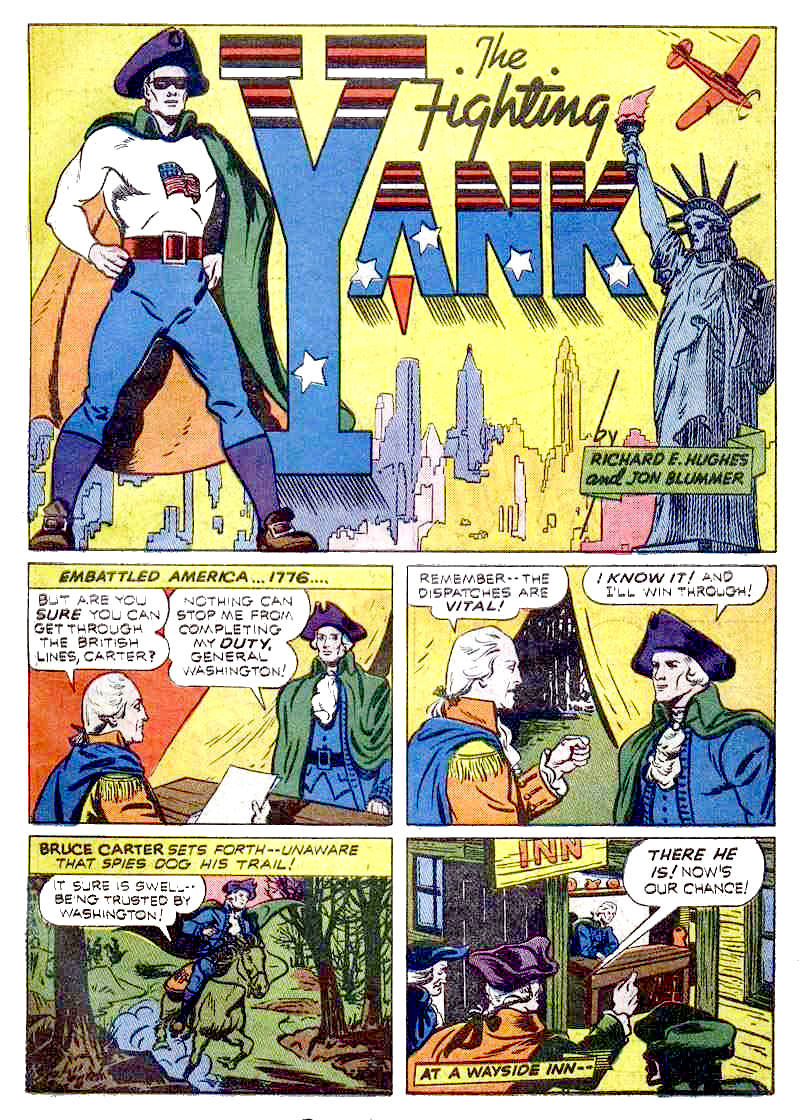
Number 2324: Enter the Fighting Yank!

The origin of Fighting Yank was published in 1942, the year that America entered the war. Patriotic heroes were popular, so Startling Comics editor, Richard E. Hughes, wrote the origin story, and it was drawn by Jon L. Blummer. The story, which has a supernatural cause for Bruce Carter’s powers as Fighting Yank, is fairly typical for the time; patriotic hero goes after Nazis. The character went on for several years and several artists, including a run by Jerry Robinson and Mort Meskin in the late '40s, before Fighting Yank hung up his cape and hat.

I have been doing some thinking about all of the heroes introduced in the wake of Superman, before official hostilities were declared, and then after the war began. Who bought all of these comic books that continually repeated themes? Despite much criticism, comic books had certainly come into their own, and they enjoyed huge sales. Kids bought comic books, or their parents bought comic books for them. Some of it was the convergence of the comic books with America’s entry into the war. Paper rationing was instituted, so each publisher had a paper allotment. With thousands of troops being drafted the comics sold extremely well in PX's. What I have read is that anything that was printed was sold. Publishers were encouraged to stay in the business because comic books were money in the bank...10¢ at a time. At least until the end of the war, when tastes changed from what had been traditional in comic books. My feeling is that troops were attracted to reading material that even for the less literate servicemen, could be “read” by looking at the pictures.

The comics were good for morale, the war was good for the comics.

The story is from Startling Comics #10 (1942):