Translate

Showing posts with label Jon L. Blummer. Show all posts

Monday, June 14, 2021

Number 2530: Gary Concord and the death by miasma


We see Gary Concord, the main hero among the other heroes of this tale, in the first panel of “The Miasma of Death!” Gary is an Important Man in 2240 A.D. He is the High Moderator of the United States of North America. That sounds important, all right. Gary gets to wear a stylish blue helmet and short-shorts that look like he put on his underwear that morning and forgot to wear his trousers.

A madman (or course he must be mad!), Dr Tor, is issuing dire threats with the diabolical form of death, so Gary and his pal Alec, and a beautiful blonde called Carlotta Zambezi (a great scientist, as claimed by Dr Stark) have quite a threat to stop. Our High Moderator says, after hearing a description of the malodorous gas, “Its victims strangle on their own exhalations!”

Wait, Gary...we residents of Earth in 2021 A.D. have paper masks we are using to try and fend off a deadly virus. Maybe if you ask around you’ll find a box of them somewhere in storage.

I have one more thing to add. Gary’s pal, Alec, has a handsome mustache, waxed on the ends, making him look like the villain in a melodrama. In one of the last panels Alec has his arms around two men with beards. Hairy faces being in vogue right now gives them all a classic look.

From All-American Comics #14 (1940). Grand Comic Database credits Jon L. Blummer for both writing and drawing.


Monday, April 15, 2019

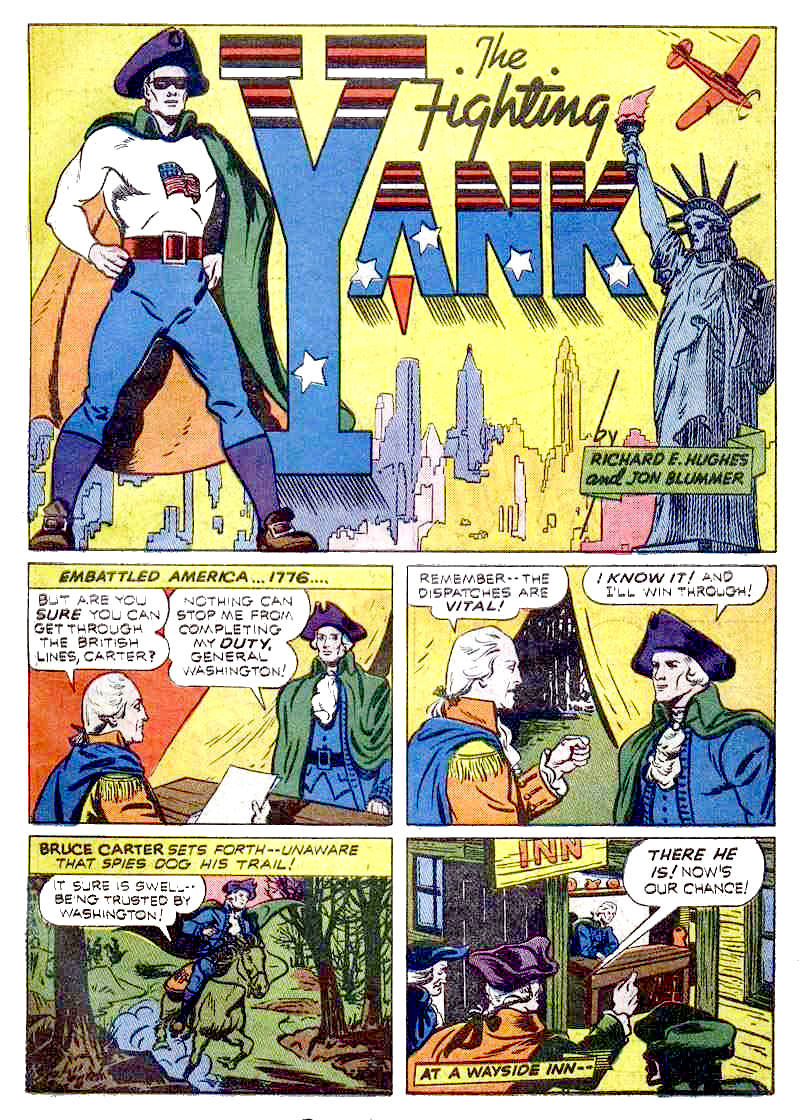
Number 2324: Enter the Fighting Yank!

The origin of Fighting Yank was published in 1942, the year that America entered the war. Patriotic heroes were popular, so Startling Comics editor, Richard E. Hughes, wrote the origin story, and it was drawn by Jon L. Blummer. The story, which has a supernatural cause for Bruce Carter’s powers as Fighting Yank, is fairly typical for the time; patriotic hero goes after Nazis. The character went on for several years and several artists, including a run by Jerry Robinson and Mort Meskin in the late '40s, before Fighting Yank hung up his cape and hat.

I have been doing some thinking about all of the heroes introduced in the wake of Superman, before official hostilities were declared, and then after the war began. Who bought all of these comic books that continually repeated themes? Despite much criticism, comic books had certainly come into their own, and they enjoyed huge sales. Kids bought comic books, or their parents bought comic books for them. Some of it was the convergence of the comic books with America’s entry into the war. Paper rationing was instituted, so each publisher had a paper allotment. With thousands of troops being drafted the comics sold extremely well in PX's. What I have read is that anything that was printed was sold. Publishers were encouraged to stay in the business because comic books were money in the bank...10¢ at a time. At least until the end of the war, when tastes changed from what had been traditional in comic books. My feeling is that troops were attracted to reading material that even for the less literate servicemen, could be “read” by looking at the pictures.

The comics were good for morale, the war was good for the comics.

The story is from Startling Comics #10 (1942):


Wednesday, November 29, 2017

Number 2135: The High Moderator vs the Mad Imperator

From http://www.herogoggles.com/DC-goldenAgeHeroes.html comes this about Gary Concord, the Ultra-Man:
Ultra-Man: 1939All-American Comics #8. When Gary Concord loses his parents in WWI, he vows to wipe out war. By 1950, he has created a chemical that is so powerful it would frighten mankind to peace. However, another war breaks out and in a bombing raid in the U.S., his lab is blown up and Gary is chemically thrust into suspended animation. He wakes in 2174 to a world engulfed in war. Gary has undergone a transformation as well, taller than most men and superior strength. He uses his knowledge and new talents to bring about peace. His son, Gary Jr., inherits his father's stature and strength, becomes caretaker of his father's formula and continues the fight for peace as Ultra-Man.”
I like that Gary is the High Moderator of the United States of North America, which is a distinguished title. The villain of the tale is Tor, who also has a title, the Mad Imperator. If nothing else, the writer-artist, Jon L. Blummer, gets thumbs up from me for such important sounding offices, even if one is “Mad.”

“The Miasma of Death!” — something of a stinker of a tale, ho-ho — is from All-American Comics #14 (1940). and is credited with writing, penciling and inking by Jon L. Blummer. All-American Comics was the flagship title from publisher Maxwell Gaines, future publisher of EC Comics, and father of William M. Gaines, who went on to publish Mad comics and magazine. The editor of All-American was Sheldon Mayer, who was in his early twenties at the time, but already an accomplished cartoonist (“Scribbly”) and future creator/artist of the long-running Sugar and Spike comic book for DC


Wednesday, July 26, 2017

Number 2080: Brink of the jabbering panic

 We know we are reading a pre-Comics Code story from the American Comics Group when the evil force tries to talk his victims to death. Such is the case in “Terror in Black Hollow,” where the evil entity describes the victims of “jabbering panic,” when it is he who is doing the jabbering. (Dictionary note on the word jabber: to speak rapidly or excitedly with little sense.)

Our hero and heroine, like most ACG couples, overcome the evil by blundering through the situation, yet with intuition know what to do to combat the supernatural force threatening them.

What I can say positive about the story is that I like the artwork by Jon L. Blummer, another early comics journeyman who showed many times in these comics that the story may not make much sense, but his artwork is atmospheric and eerie. Blummer, who had drawn for pulp magazines, was another artist who had a history in illustration before going to work in comic books. He had also drawn a couple of syndicated comic strips in the thirties, including The Lone Ranger, and Hop Harrigan. Unfortunately, Blummer, born in 1904, died young at age 51.

From Skeleton Hand in Secrets of the Supernatural (whose title was almost longer than its lifespan of six issues) #3 (1953):


Friday, December 27, 2013

Number 1497: It’s up to yew! Ghost-hunter and the Roman curse.


This is one of those supernatural stories that resolves itself at the end by dragging in some power over ghosts of which we readers have not been apprised. In this case it’s the ghost-hunter, Christopher Fenn, who “just remembered” what will defeat the ghosts before they are about to kill him. Note to writers of supernatural stories: Introduce said spell or power early in the story, then use it later. It's storytelling 101.

Despite that glaring flaw in “The Case of the Roman Curse” I like the art. It's drawn by Jon L. Blummer and comes from Adventures Into the Unknown #7 (1949).