Artist Johnny Craig joined the EC gang early on, like fellow artist Graham Ingels, editor/writer/artist Al Feldstein, and of course, William Gaines, who had inherited the job as owner/publisher when his father died in 1947.
Later on, as EC grew in popularity and sales, biographies were published of the individual artists. The biography of Johnny Craig on the last page of “Colorado Rose” looks to be a warm-up for the later biographies. (I can’t tell you if this was the only one from the early, pre-horror comics EC, because I am too lazy to look it up. How is that for not doing my homework?)
Craig was a good artist, but according to even Craig himself, he was slow. Later on he both wrote and drew, showing his talent at both, and even took over as editor of The Vault of Horror. Except for the sharp illustrations, “Colorado Rose” seems like a standard early EC story, which followed the trends of the rest of the comic book industry with a Western comic to go along with a couple of crime comics and even a love comic.
I appreciate the artist biographies more now, because those were the days when comic books were under siege by Dr Wertham, teachers and parents, and later even the Congress of the United States. Guys like Johnny Craig, as well as the rest of the gang, could have chosen to remain anonymous, but they signed their work. Considering the times, I think Craig and his fellow artists were brave.
From Saddle Justice #5 (1949):
Translate
Showing posts with label Johnny Craig. Show all posts
Monday, October 12, 2020
Friday, August 10, 2018
Number 2218: Johnny Craig: Tugboat and treasure
Johnny Craig came back to comics a few years after leaving the field in the mid-fifties. But happy as I was to see his work, it wasn’t the same to me as what I was used to in his time with EC. In the case of “The Treasure of Bad Luck Point,” from Unknown Worlds #47 (1966), I wondered what Craig, a writer himself, thought of this story by ACG editor/writer Richard E. Hughes. The backstory of the pirates takes 7 pages, and the hero of the tale doesn’t appear until page 8. It’s another of Hughes’s underdog stories, which asks the question, can a poor tugboat owner win a rich girl? Well, no. He has the girl’s love, but does not have permission from her father to marry her. That took me back. The story takes place in modern days, and in 1966 that attitude was a few decades old, at least. Dad could express his displeasure, but he could not keep her from marrying anyone. Yet his daughter doesn’t fight for her boyfriend. I am sure, like her dad, she was thinking of a lower standard of living if she did marry the guy. She also might have thought she’d earn the nickname of Tugboat Annie.* [SPOILER ALERT: It’s only when, despite being guarded by a ghost, he finds the pirate treasure, that her dad agrees to her marriage. Avarice wins again! [END SPOILER]
That pseudonym of Craig’s, “Jay Taycee” didn’t fool me, but in 1966 I didn’t think of the reason behind it. Craig’s day job was in an advertising agency. Coming back to the comic book industry, and then not wanting to put his real name on his work, showed there was still a stigma attached to being a comic book artist.
The copy of Unknown Worlds #47 which I found online, is missing pages 4 and 5. I found a copy of a blackline Australian reprint from 1970, Tales of Torment #1, to fill in the missing pages.
*If you don’t know who Tugboat Annie is, look here.
Wednesday, November 09, 2016
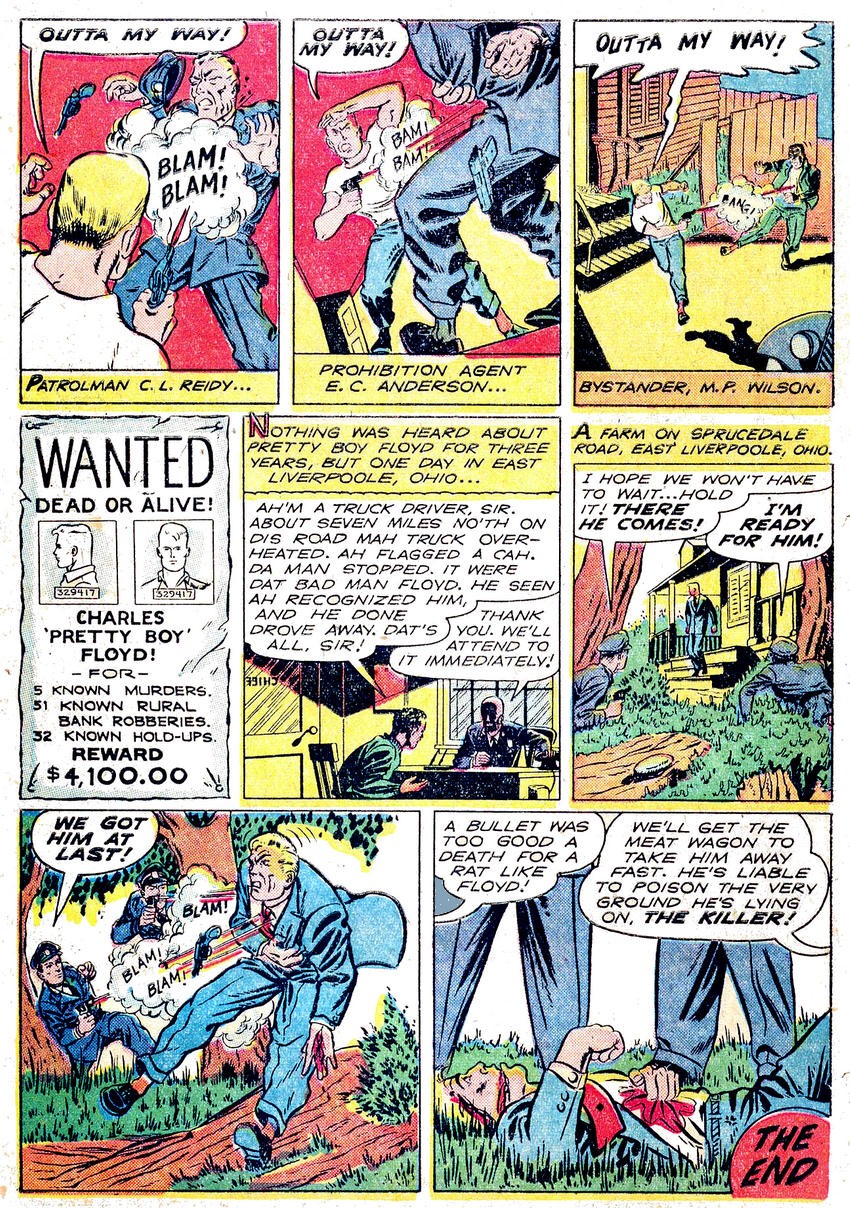
Number 1969: Johnny Craig and Pretty Boy
Artist Johnny Craig did this version of the life of “Pretty Boy” Floyd for the 1948 ME one-shot, GUNS of Fact and Fiction. Before he became a major talent for the (in)famous EC Comics crew Craig was like the rest of them, free-lancing amongst the comic book publishers of the day. (“Ghastly” Graham Ingels drew the lead story of the issue.)
I don’t verify the truth in this comic book version of the gangster’s story. Floyd ended up shot down in a field and then he entered American bad guy immortality. Pretty Boy is celebrated for his place in the gaggle of gangsters of the early-to-mid 1930s, roaming the country robbing banks and thumbing their noses at law enforcement. The only truth I can verify is my appreciation for Craig’s clean-cut artwork, beautifully staged, crisply drawn and inked.
Friday, March 01, 2013
Number 1324: “Go West, young bad man!”
This is the fourth and last posting of our Pappy's Crime Wave week. Today we travel back to the Civil War era, with two stories about William Quantrill and his guerrilla force that sacked Lawrence, Kansas, in 1863.
It was only natural that crime comics would use the Wild West as a source of stories. Comics followed trends. Western movies were very popular at the time. A lot of Western comics were published, with some thinly disguised crime comics set 100 years ago. It wasn't uncommon for different comics to draw upon the same bad men, and multiple stories were done on the most famous outlaws. All “true,” of course (see Monday's post).
Compare these two stories. “Will Quantrill, General of an Army of Murderers” is drawn by Bob Fujitani, from Crime Does Not Pay #64 (1948), and “Quantrill, the Killer’s Killer” is from Fox Publications’ Western True Crime #4 (1949), drawn by Johnny Craig. The latter story goes into some heavy moralizing: Quantrill is so evil the devil is afraid of him, so he wanders as a ghost! It probably seemed like a good idea at the time, but that kind of preachiness is over the top and didn’t fool the anti-comics people.
Subscribe to:
Posts (Atom)