Translate

Showing posts with label Fred Guardineer. Show all posts

Monday, November 11, 2019

Number 2412: Big Bird goes bad!

My jaw damn near hit the floor when I saw the panel of a talking bird with what looks like a machine gun. It reminds me of a current trend by American psychopaths, taking weapons of war and shooting up schools, churches and businesses. I am not making light of those terrible recurring atrocities, but they are the first things I thought of.

The story is drawn by Mr Precision, Fred Guardineer, with his fine examples of careful drawing and inking comic book pages. It is written by Gardner Fox. “The Harp of Death” is from the ME one-shot, Space Ace #5 (1952), a collection of reprinted Space Ace stories from the 1948 Manhunt comic books.


Wednesday, May 29, 2019

Number 2344: The Blue Tracer and The Thing

The Blue Tracer, created, written and drawn by comic book veteran and journeyman, Fred Guardineer, was a feature in Quality’s Military Comics. Guardineer had been in comic books since they began, and before that did illustrations for pulp magazines. During his career he did a wide variety of comic book characters, all done with his precision style of drawing. Guardineer’s work is easy to spot...just look for the lines that appear to be drawn by a machine.

Fred Guardineer quit comic books in about 1954, then went to work for the United States Post Office. They offered a pension. As a former freelancer for his years in comic books, the idea of a pension seemed good to him. As it was he lived a long time, and probably enjoyed that pension. Born in 1913, he died in 2002, just short of his 89th birthday.

There are some racial insults hurled at the Japanese in this story. It is representative of feelings toward America’s enemies in World War II. But the story also has a giant robot called The Thing, and giant robots I cannot pass up. It appeared in Military Comics #12 (1942).


Monday, July 31, 2017

Number 2082: Poisoning as a career

Let me, a retired person, say something about careers. I played it safe and stayed over 30 years with a job that provided me a pension. It worked for me. But that was my choice, which has provided me the opportunity to spend my golden geezer years providing Golden Age comics to you. I would never tell you what I think you should do for a career, but I strongly advise against the career path William Palmer took, which was poisoning people for money to finance a life lived in indolent comfort. Until the hangman caught up with him, that is.

There were several famous poisoners in 19th century Britain, and while Palmer was found guilty of one murder and subsequently hanged for it, his murder career went back years. It is detailed in this story from Crime and Punishment #5 (1948), drawn by the ever-so-precise Fred Guardineer.

Guardineer made a career choice, also. After years as a freelance comic book artist (he was from wayyy back, including Action Comics #1), in 1955 Guardineer decided he needed a job with a pension, so he went to the U.S. Postal Service where he worked until his retirement. He was able to continue drawing wildlife for a local newspaper, as opposed to crime comics and the wild life of crooks. It was his choice and it worked for him.


Wednesday, March 08, 2017

Number 2020: The Mad Dog Tri-State Terror

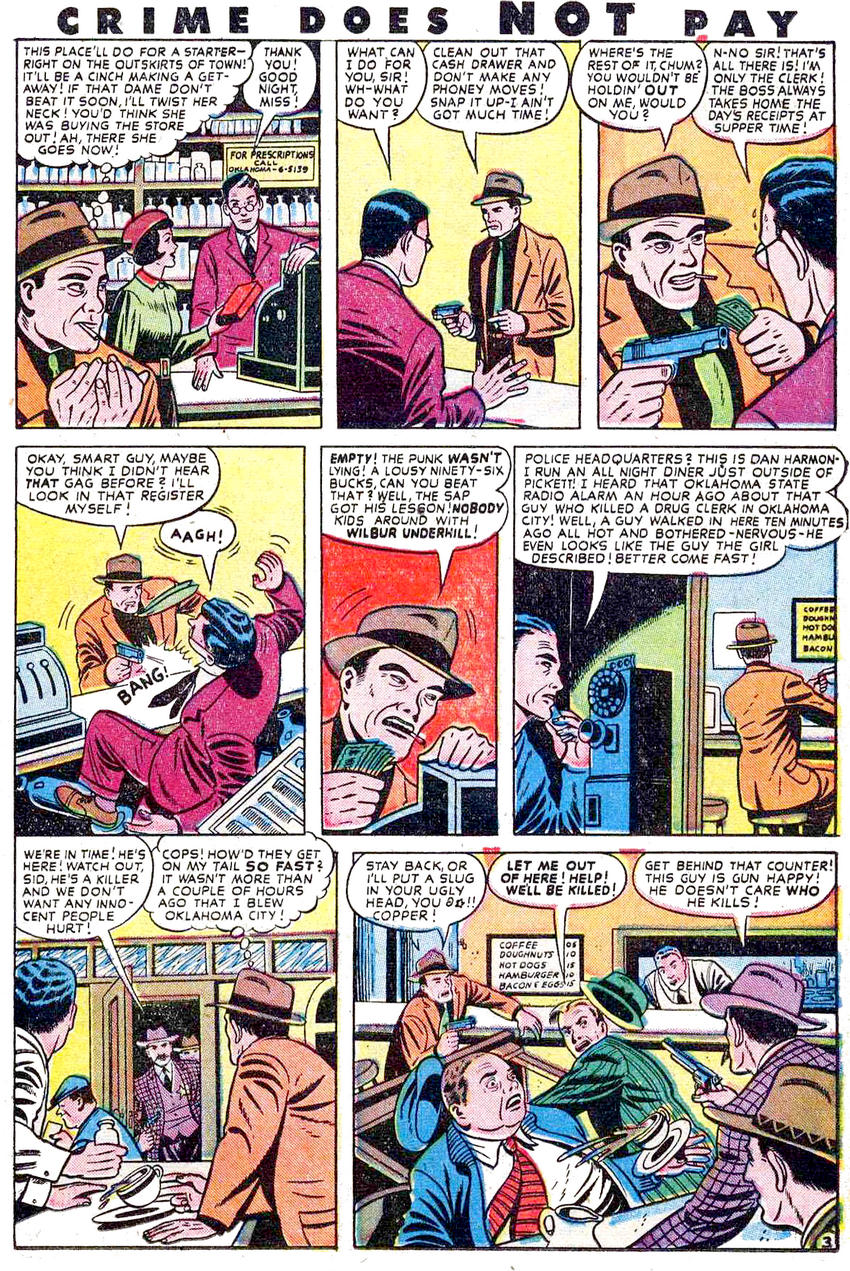
Wilbur Underhill, bank robber, escape artist and murderer, was yet another sociopath operating in the twenties and thirties. He died with thirteen bullets in him. His demise wasn’t exactly as portrayed in Crime Does Not Pay #63 (1948). Underhill lived for a week after being shot, and I doubt one of the cops who shot him moralized that “Crime does not pay!” as Wilbur croaked out his dying breath. But, that was the final line of many a crime comic book, in a futile effort to deflect criticism from their violent, bloody contents. The nicknames given by the press to Underhill, the “Tri-State Terror,” and “Mad Dog” are oddly missing from both stories of Underhill I am presenting today.

Underhill’s story was told a few times in crime comics, and even in the pulp magazine, G-Men, Vol. 4 Number 36 (1936), in a three-page comic-styled feature. The artist was anonymous, but the story was written by Henry Marcus, using the pseudonym Clayton Maxwell. Marcus is a guy who ended up in jail for publishing obscene literature. Who knows? Maybe he knew jailbirds like Underhill when he was in the joint.

The color version of Underhill’s story was drawn by Fred Guardineer.


Wednesday, April 27, 2016

Number 1885: The enemy of my enemy: the Blue Tracer and the Soviets

The Blue Tracer was a feature about a super tank, created and drawn by Fred Guardineer. The Tracer could do anything: it had weapons, it could fly, go underwater, on land...and it was built by two guys, “Wild Bill” Dunn and “Boomerang” Jones. The feature did not last too long, from Military Comics #1 (1941) through #16 (1943).

In 1975 Fred Guardineer re-drew the first episode. I showed it in 2009 from its appearance in Cartoonist PROfiles magazine. Just look for the link below.

This episode is from Military Comics #13 (1942). The Tracer is going up against a Nazi version of the supertank. Our heroes have the help of the Russians, who before the end of the decade became the bad guys. At this late date I'm still reading about differences we have with Russia.* Sheesh.


From Cartoonist PROfiles #31. Just click on the thumbnail.


*C'mon, people! Let’s work together!

Friday, April 08, 2016

Number 1877: Hang 'em low

As is true of many Western outlaws and gunmen, some of the tales that have grown up around Texan Bill Longley are exaggerated and false. Longley was a murderer, an army deserter, and all-around bad guy, but he was not saved from a lynch mob hanging by a stray bullet splitting the rope, as shown in this story from Desperado #1 (1948). I have said several times that “true” is a floating concept in crime comic books, and when matched up with legends, the legends usually take over. Much more visual, you know.

Longley killed people, but his own boastful nature, inflating his misdeeds, probably helped do him in. He was eventually sentenced to hang. The detail missing from the comic book version is more gruesome than anything shown. The gallows were built, but the sheriff miscalculated how long the rope needed to be. Bad Bill, a six-footer, hit the ground, then was dragged up and strangled by the noose. It took 11 minutes before a doctor could pronounce him dead.

The 1948 version, drawn by Fred Guardineer, was published decades before the eventual true outcome of Bill Longley’s story. His grave was located and his remains confirmed by DNA testing in 2001. That part of the story, with the science involved, is taken for granted by us nowadays, but in Bill Longley’s day would have been wilder and more improbable than any of the stories told about this Texan badman.