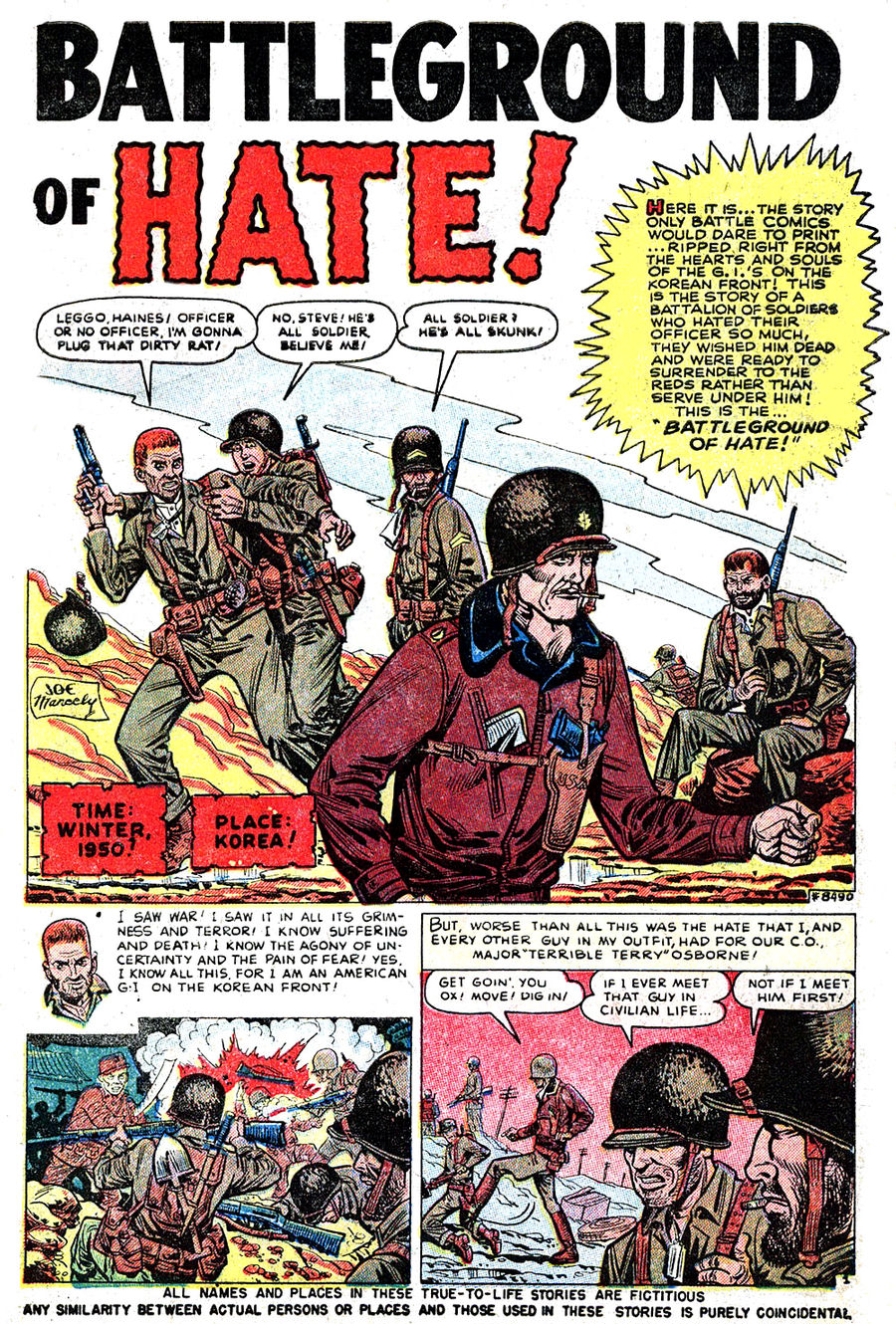
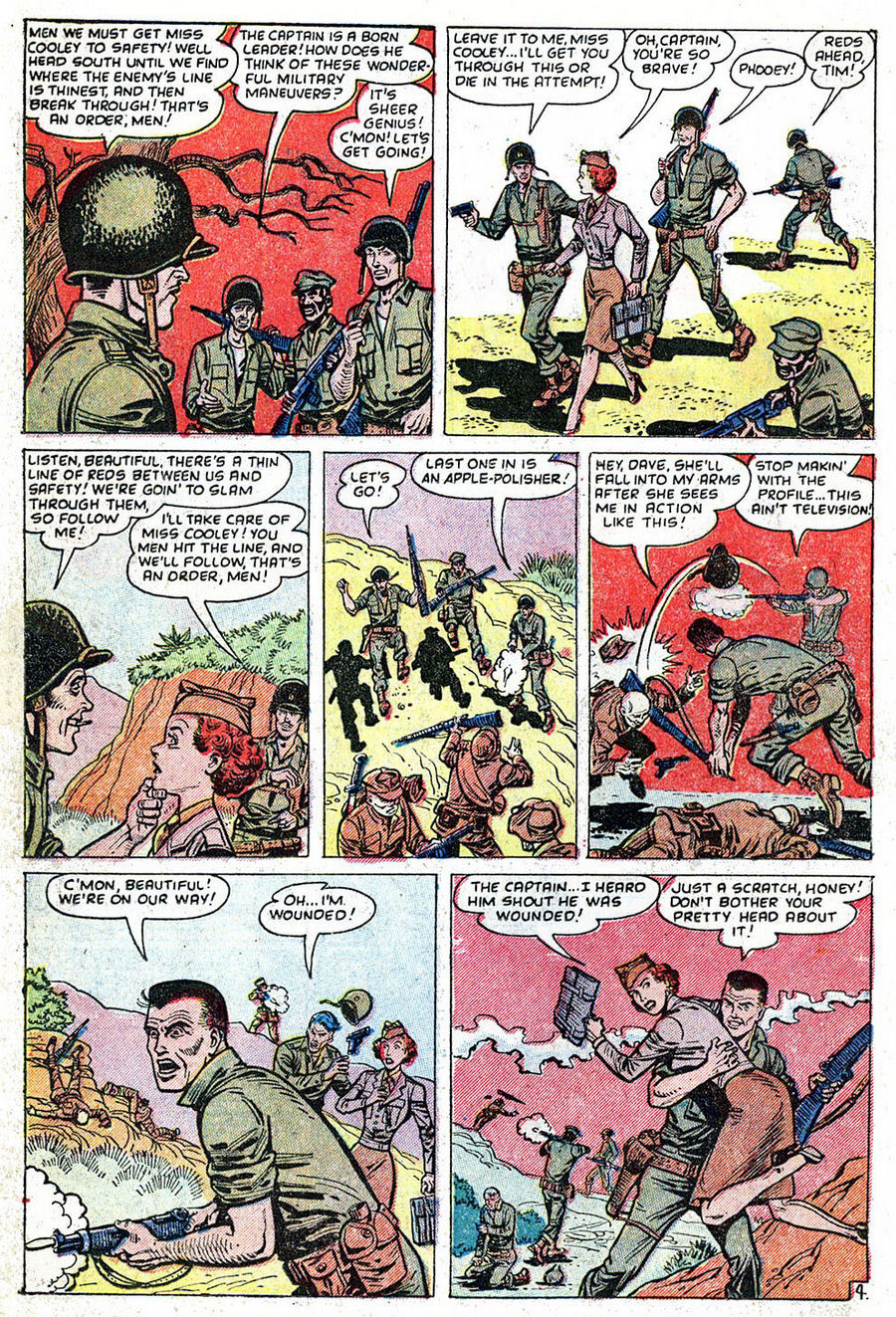
In Battle #4 (1951) from Atlas Comics, artist Joe Maneely is represented with a cover and two stories. The stories are different in tone. One is a light story about a horny soldier vying for a young woman, but outranked by a superior. The other story is about a tough major on the battlefield of Korea, and a young man he constantly rides. It has a surprise ending, yet I am sure I have read a version of the story long before reading this one. That wouldn't be surprising, because comic book stories are often swiped. “Battleground of Hate!” is an old tragedy.
The second tragedy is not a story, but real life. Joe Maneely, one of Atlas’s top artists, died young. Dying of natural causes, in war, or by accident like Maneely, at age 32, leaving a wife and young family, is always a tragedy.
In the same Wikipedia entry on Maneely, there is this: Marvel editor-in-chief Stan Lee opined in the early 2000s that had Maneely lived, "he would have been another Jack Kirby. He would have been the best you could imagine."
Translate
Friday, May 11, 2018
Wednesday, May 09, 2018
Number 2178: Captain Marvel Jr's “Multiplicity”
This 1943 Captain Marvel Jr tale reminds me of the 1996 comedy, Multiplicity, starring Michael Keaton, where multiple clones were made of the lead character. The Cap Jr story doesn’t use the word “clone,” but that word was in use in those days. It was taken from Greek in 1903 by plant physiologist Herbert J. Webber to “refer to the technique of of propagating new plants using cuttings, bulbs or buds.” (From NPR.org, and bless the Internet for providing the information.)
In the comic book story the cloning is done with a “cell divider,” a devilish contraption used by Nazi spies. As in the much later Multiplicity, it is mostly magic, since cloning doesn’t work like that. But in the comic book it is used to solve another problem for Cap Jr — that of being identified publicly as newsboy Freddie Freeman. It is like those Superman stories where Superman sends in a robot to fool the people who have figured out his secret identity. The result is the same for Cap Jr. Like Superman, there is chicanery, and Freddie protects his secret.
From Captain Marvel Jr #8 (1943). Artwork by Al Carreno.
Monday, May 07, 2018
Number 2177: “What you gonna do when they come for you?”
In their heyday of the late forties, most American crime comics stuck to the proven template: show the bad guy doing bad things, then in the last panel have him caught and on his way to prison, or being sentenced by a judge, or killed by police. There will always be some moralizing at the end. Remember kids, now that you’ve lived through nine pages of vicarious thrills, in the end Crime Does Not Pay! Kids and adults saw through that one.
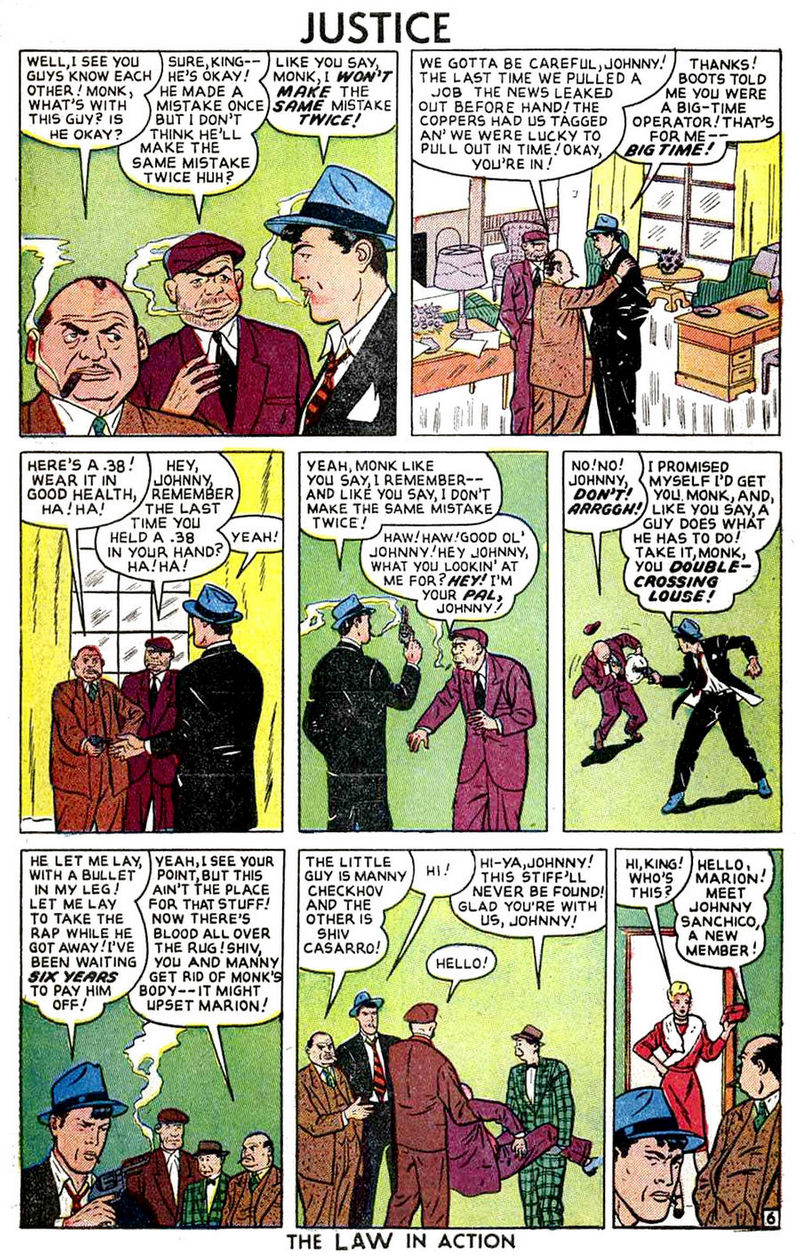
This issue of Justice Comics from Marvel Comics is no different: Johnny “the Gun” Sanchico is a typical criminal psychopath who blasts his way through the story, only to end up dead on the floor in the last panel. Well, serves that punk right! It is a good example of the objections made by some to comics sold to children (they sold to many adults, also, but they weren’t included in the strong criticism). What sets it apart — for me, anyway — is that it is an early example of John Buscema’s artwork. For a while Buscema worked in Stan Lee’s Marvel bullpen. I am always interested in seeing an artist’s early work. This story looks like Buscema needed some practice to get to be one of the industry’s top professionals. I did not recognize this story as being by Buscema, depending on the expertise of Jim Vadeboncoeur Jr, who identified it for Atlas Tales and the Grand Comics Database.
From Justice Comics #9 (actual #3, 1949):
More crime from Buscema. Done in 1950 and 1953, it shows he came a long way in a short time.
This issue of Justice Comics from Marvel Comics is no different: Johnny “the Gun” Sanchico is a typical criminal psychopath who blasts his way through the story, only to end up dead on the floor in the last panel. Well, serves that punk right! It is a good example of the objections made by some to comics sold to children (they sold to many adults, also, but they weren’t included in the strong criticism). What sets it apart — for me, anyway — is that it is an early example of John Buscema’s artwork. For a while Buscema worked in Stan Lee’s Marvel bullpen. I am always interested in seeing an artist’s early work. This story looks like Buscema needed some practice to get to be one of the industry’s top professionals. I did not recognize this story as being by Buscema, depending on the expertise of Jim Vadeboncoeur Jr, who identified it for Atlas Tales and the Grand Comics Database.
From Justice Comics #9 (actual #3, 1949):
More crime from Buscema. Done in 1950 and 1953, it shows he came a long way in a short time.
Friday, May 04, 2018
Number 2176: Citizen Spirit
Years ago I read something that Will Eisner, or someone associated with him, said. He and some fellow artists went to the movie Citizen Kane several times to study it. I assume they were looking at camera angles and shadows and those things that could be used effectively in comic art. So when I read this Spirit story from the Spirit newspaper Comic Book Section, I thought this must be a result of those hours spent in a theater watching the work of Orson Welles. But this story was published on May 18, 1941, and it was usual for Sunday comics to be completed and in the hands of the engravers at least six weeks before printing. In this case probably sometime around the end of March, 1941. In checking I found out that Citizen Kane was released May 1, 1941.
It means this story, with some rich shadows and camera angles (a couple of those birds-eye views from the ceiling make the room look three stories tall), was apparently not influenced by the movie, but by Eisner’s own desire to vary his panels and add drama. I don’t know what Welles could have taught Eisner that he didn’t already know.
Wednesday, May 02, 2018
Number 2175: Commie spy and Yankee robot
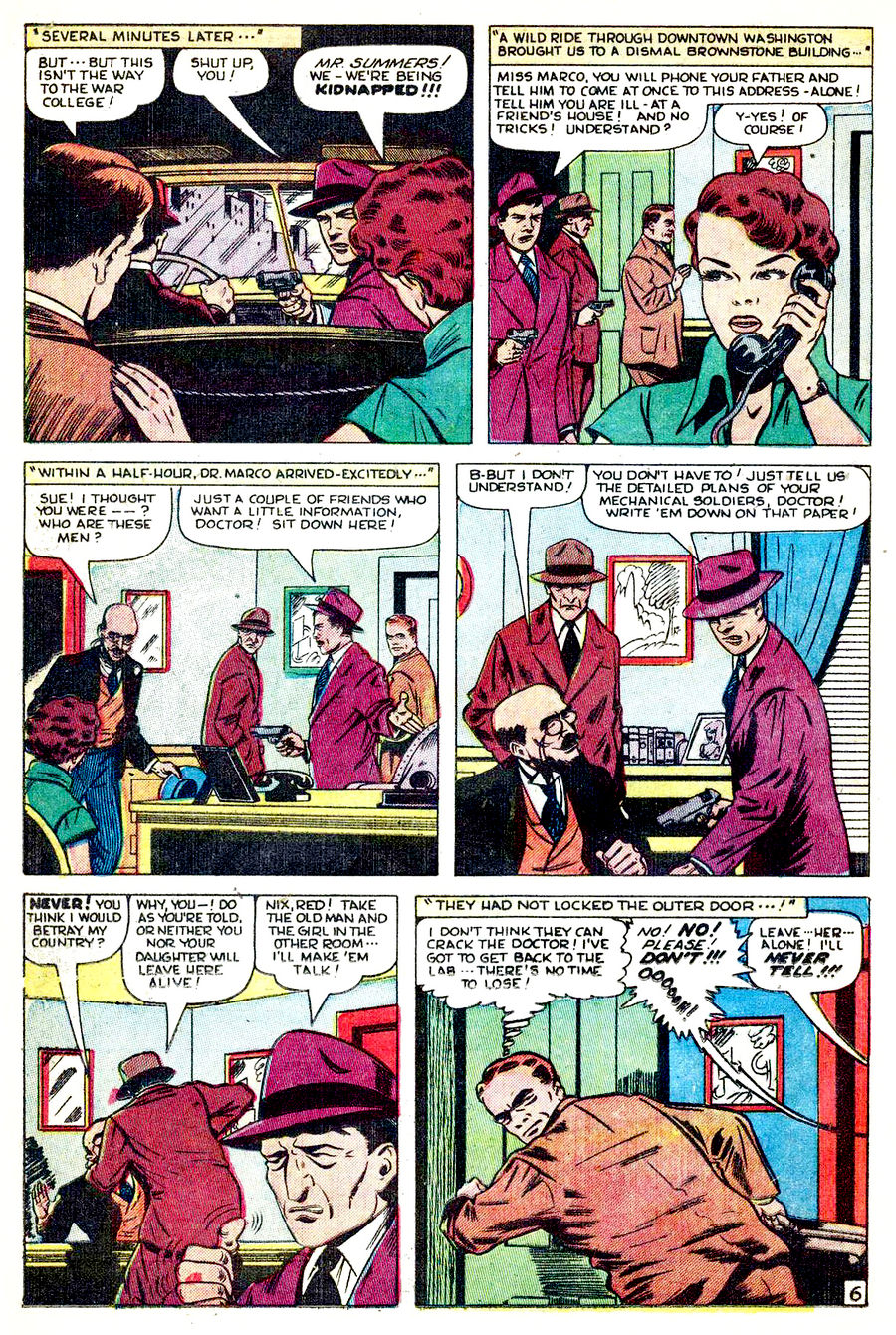
Those sneaky communists! The Russians send a spy to infiltrate some top secret American military secret stuff involving robots with artificial intelligence. The spy’s name is Joe Stalinov, and that familiar sounding name doesn’t cause any concern for the Americans. As a matter of fact, they hire Joe the spy as an engineer to work on the robot project.
Americans act dumb in this story. We have been hearing for a while about Russian interference in the American elections. It isn’t so hard to do if we make it easy for them. That’s what I think of them for falling for Stalinov’s story. I give one guy, Jon, credit. He doesn’t like Stalinov because “he looks too foreign.” Normally I’d shout, “Discrimination!” — but Jon is intuitive, and seems to be the only smart one in the room.
Bill Everett, a smart artist, did “I Deal in Murder!” for Atlas Comics' Suspense #6 (1951).
Americans act dumb in this story. We have been hearing for a while about Russian interference in the American elections. It isn’t so hard to do if we make it easy for them. That’s what I think of them for falling for Stalinov’s story. I give one guy, Jon, credit. He doesn’t like Stalinov because “he looks too foreign.” Normally I’d shout, “Discrimination!” — but Jon is intuitive, and seems to be the only smart one in the room.
Bill Everett, a smart artist, did “I Deal in Murder!” for Atlas Comics' Suspense #6 (1951).
Subscribe to:
Posts (Atom)