Translate

Friday, November 10, 2017

Number 2126: “Good American muscle”

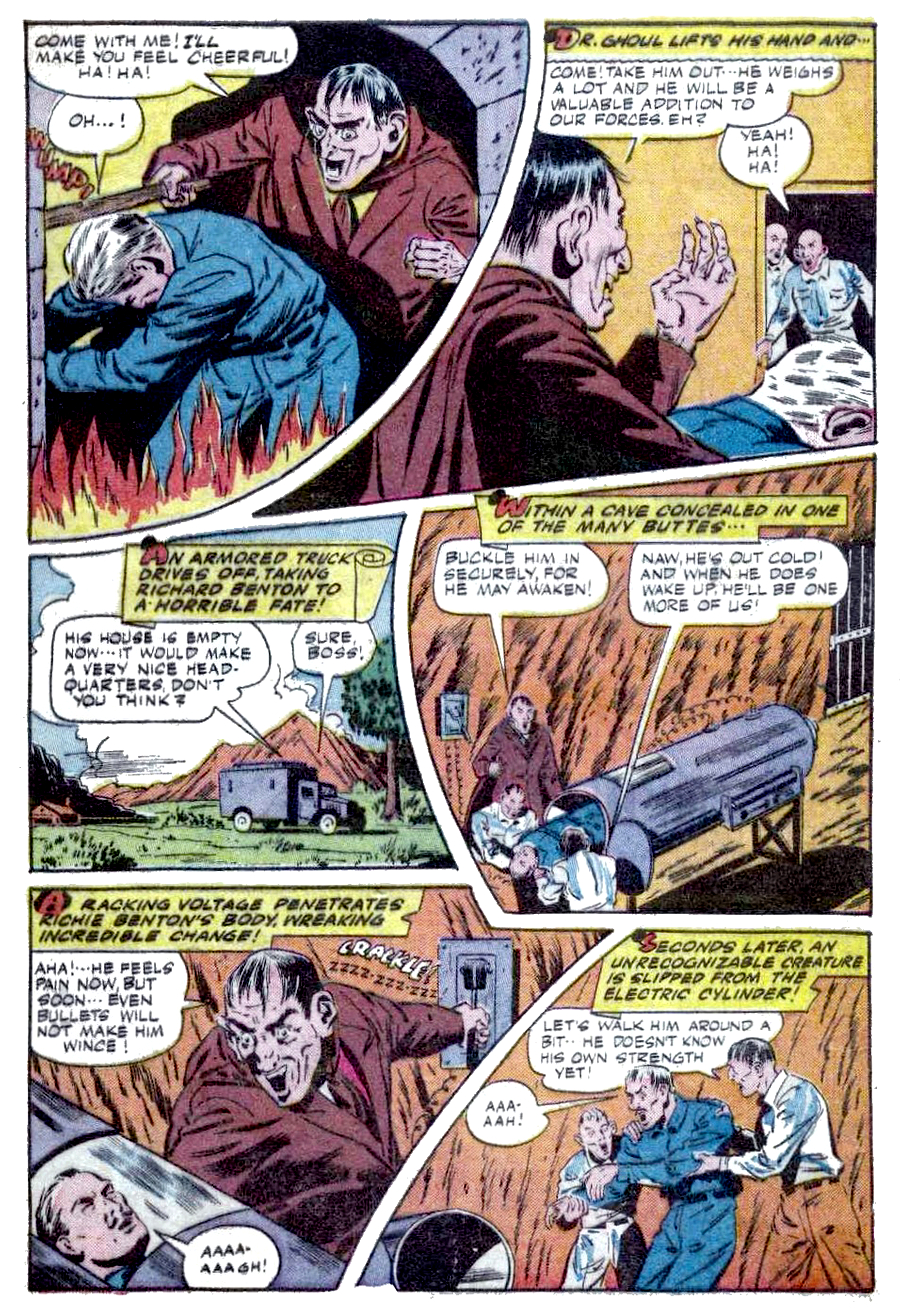
Things look slow at pharmacist Bob Benton’s shop. Slow enough he can shut down the store and take off for Wyoming to visit his uncle Richard’s ranch. Bob takes along his young assistant, Tim, and his girlfriend, Jean. Tim isn’t too happy about Jean coming along. A couple of days ago I spoke of underage pals of grown men in the superhero business, and here we are again. Tim probably needn’t have worried about Jean intruding, since Bob sends Jean into the next room of the ranch while pointing out that he and Tim will be staying together.

The story itself is some hokum about a villain called Dr Ghoul who kidnaps people to turn them into his gang members. I am vague on the motives of Dr Ghoul’s gang. All I took from the story is Dr Ghoul aims to steal Uncle Richard’s ranch payroll. I wouldn’t think it would require such an elaborate setup to make a gang by placing kidnap victims in what looks like an iron lung and dosing them with electricity.

As the Terror Twins are about to be put into the machine Black Terror warns Dr Ghoul not to waste his time, because he and Tim are made of “good American muscle!” He failed to mention the reason for his own powers (super-strong, bullets bounce off) is he ingested some drug with “formic ethers.”

The Grand Comics Database lists Ed Moritz and Ed Hamilton as artists. Ed Hamilton is not Edmond Hamilton, science fiction writer and also scripter for Batman and Superman. The GCD doesn’t guess at a writer. From Black Terror #12 (1945):


Wednesday, November 08, 2017

Number 2125: Three men, a dead uncle, and a mysterious artist

Uncle Theodore was not only a maker of ingenious (and huge) toys, he was diabolical as well. From beyond the grave he directed his three nephews through various death traps to find their inheritance. Even though dead, Theodore wasn’t going to make it easy for the guys to inherit his wealth. The unanswered question was did he want them to succeed or fail? One of the characters asks that in the last panel. Readers are left with an unanswered question.

“The Riddle of Hazard Isle” is a mystery story from House of Secrets #27 (1959). Stories in the mystery anthologies from DC could be screwy, but illustrated in such a style that even the silliest story had the full illustrative treatment. Bill Ely drew the story; the writer is unknown.

Ely is something of an elusive person; there is a shortage of online information. We know that Ely drew comics from the 1930s through the 1960s. His birth year is given as 1913 and his year of death is 1993. I like Ely’s solid style. Ely took enough pride in his work that he usually signed it, even in the days when being a comic book creator meant artists and writers were anonymous unless they chose to include a signature.

If any of Ely’s relatives, children, nephews and nieces, et al., are reading this, I would appreciate them contacting me to tell me what they know about Bill Ely.


Monday, November 06, 2017

Number 2124: TNT and Dan the Dyna-Mite give us a charge!

Tex N. Thomas, a teacher, and Dan Dunlop, a student, are a team of superheroes whose powers are brought out by touching their rings together. The feature, which appeared in Star-Spangled Comics from DC, didn’t have a long lifespan, just 17 episodes during the early days of World War II. It's filler. What is interesting to me is the cliché of having a grown man running around with a young (very young) boy. Tex is a teacher, for cryin' out loud. Maybe that sort of relationship didn’t set off alarm bells nearly 80 years ago as it does today. I am not sure if Robin was the first kid sidekick, but I understood the reason for attaching him to Batman (as a “ward” no less) was so kids could identify. Jules Feiffer, in The Great Comic Book Heroes, made a point of saying as a kid how much he hated Robin. Robin was what he, Jules, should be like. The better fantasy for Feiffer was allowing himself to grow to adulthood and become Batman, rather than have to immediately become the young, athletic Robin. And Dr Wertham had something to say about Batman and Robin, also, that he saw the relationship as being kinky.

There is also the element of danger kid sidekicks were subjected to in superhero comics. The idea was common in comic books. I was interested to read what the late Don Markstein had to say of TNT and Dan in his Toonopedia listing for the pair. He mentions that Star-Spangled Comics #23 was the last appearance, and: “TNT and Dan weren't seen again for decades, and even then, underwent only a slight revival. The fact that they got included in the '80s All-Star Squadron scarcely counts, since practically every DC-owned 1940s costumed character did that. Of slightly more significance is that Dan subsequently allied himself with Merry, the Girl of 1,000 Gimmicks, and several other former young superheroes, to form Old Justice — an activist group, devoted to keeping children from being endangered by superhero work, as Dan had allowed himself to be endangered during his own youth.”

This is a tale of Tex and Dan, exposed to danger, in the world of sandhogs, from Star-Spangled Comics #13 (1942), artwork credited to Louis Cazeneuve.


Friday, November 03, 2017

Number 2123: “Show thyself, monster serpent of legend!”

Over the years I’ve shown lots of jungle girl stories, but, except for Tarzan, not many jungle guys. So, beefcake fans, rejoice. Here is Jo-Jo, Congo King, originally created in 1947 for Victor Fox’s sleazy comic books. Fox brought his comics line to a halt in 1949, but Jo-Jo lived on, and made occasional appearances in comics from Star and Skywald. In 1971 Skywald published three issues of Jungle Adventures, a 25¢ squareback comic, featuring mostly reprints from Avon and Fox, and a new jungle guy, Zangar, in stories drawn by Jack Katz. All three issues featured Jo-Jo reprints. This Jo-Jo episode appeared in Jungle Adventures #3 (1971). The story’s original appearance was in Jo-Jo Comics #23 (1949). Like some other characters published by Fox, Phantom Lady and Blue Beetle among them, the artwork and scripts were done by the Jerry Iger shop.

Jo-Jo wandered the jungle with his girlfriend, Tanee (who looks a lot like Rulah the Jungle Girl). Tanee’s job in Jo-Jo stories, based on what I have read, is damsel in distress. She even whimpers in one panel, “Ohh [sic], why does Jo-Jo not come to rescue me?”

Not since a time long before this story was originally published in 1949 (like, say, the Victorian era) has there been such corny dialogue written for characters as it is written in this story. Aiieee!


Wednesday, November 01, 2017

Number 2122: Putting the comic in comic book

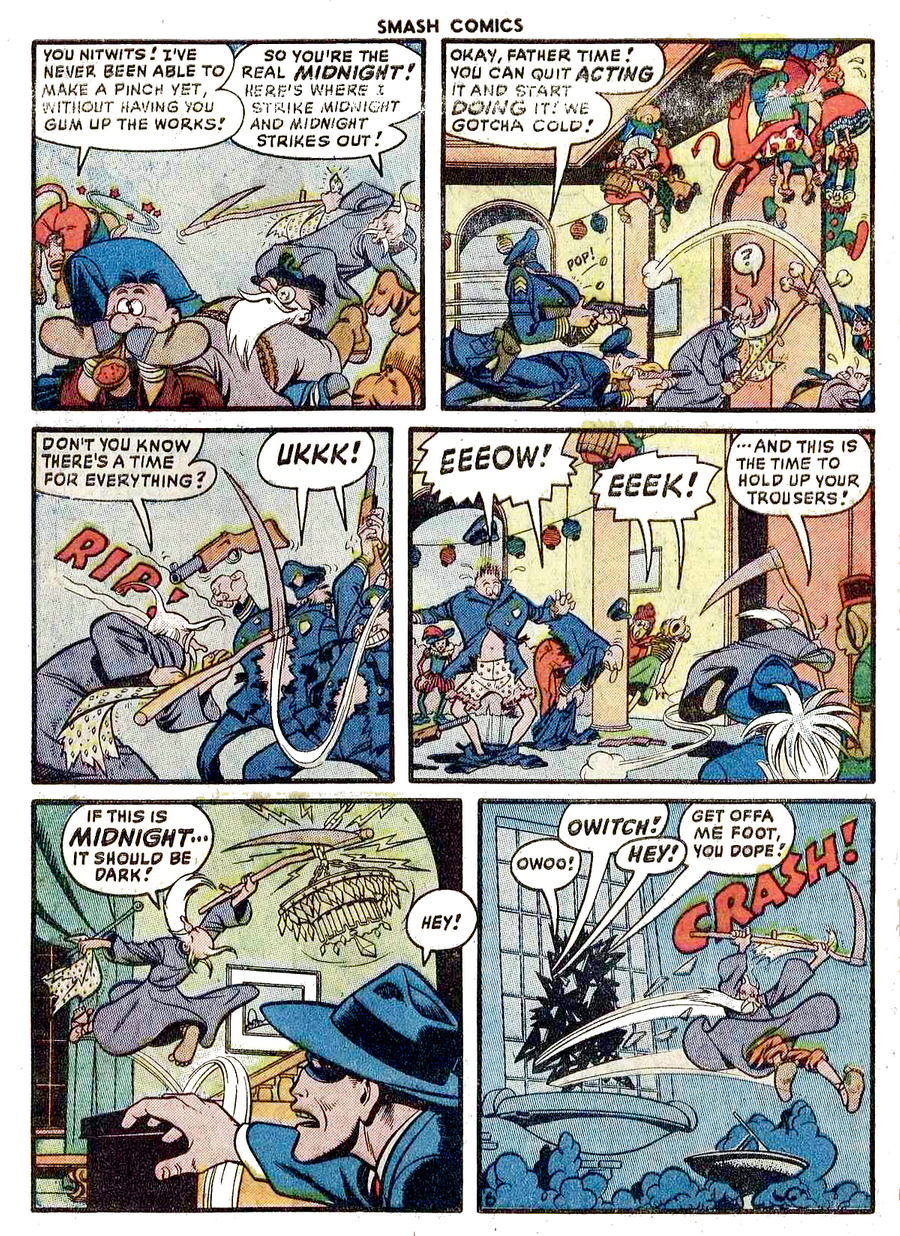
This Midnight story, from Smash Comics #84 (1949), is a superb example of Jack Cole’s gift for comic exaggeration and slapstick. Virtually every panel, including the cover, has some funny, frenetic action going on.

Besides all the funny business, in the story Doc Wackey invents a photocopy machine. Xerox Corporation introduced its first office copier in 1949. It is a gag meant for just one plot point, but with its application by Doc (making copies of invitations to the Diamond Cutters Ball), hints at how important the technology would become in the future.