Translate

Friday, February 16, 2007


Number 94


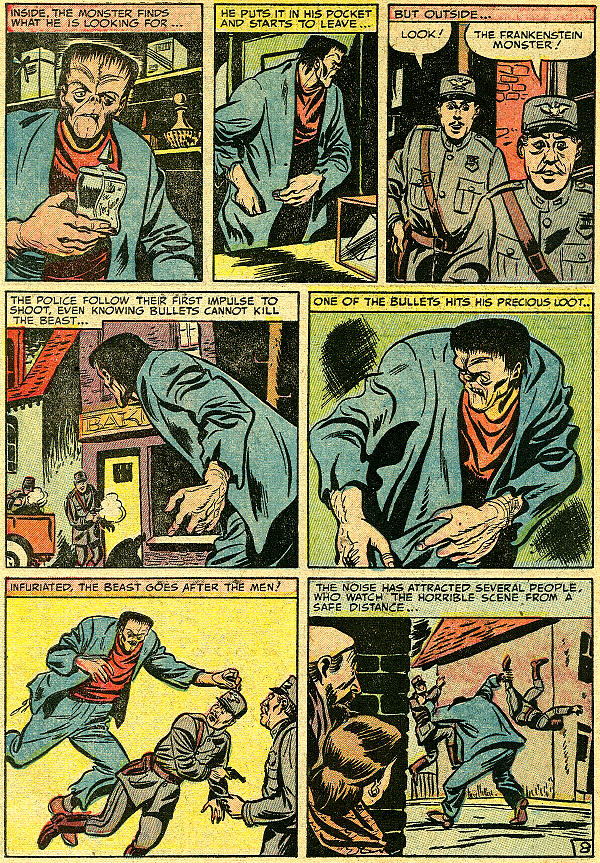
Frankenstein Friday: Death O'Clock!


This is the second-to-last story from the Monster Of Frankenstein series, written and drawn by Dick Briefer. It was published in Frankenstein #33, October-November 1954. That was the last issue, probably because the Comics Code was about to be instituted. Frankenstein likely wouldn't have passed the rigid censorship in the earliest days of the Code.

So far as storytelling goes, it relies too heavily on captions, some of which tell us what we're already seeing (a common error with captioning in comic books), but the plot is good, the characters are interesting and the art is well done, especially for this series.

While competently drawn, I wonder if Briefer's heart was into this more serious cartooning style after the years he spent with his funny Frankenstein character.


Wednesday, February 14, 2007


Number 93


Airboy Dazzled and Duped By A Dame!


I've been wracking my brain trying to figure out what I could do to commemorate Valentine's Day for you. I never got around to collecting love comics, so I dug around and found this story of how Airboy found--and lost--love.

When Airboy was created by Charles Biro and premiered in Air Fighters Comics #2, he was a boy. By the time this unnamed story was published, in Airboy Comics Volume 5 Number 4, May 1948, Airboy had grown into a young man, maybe 20-years-old or so. When he was younger his special plane, Birdie, was his first love. But by this story Airboy shows he could be dazzled by the opposite sex, just like all of you horny jokers out there reading this.

Fred Kida was the artist. In the late 1940s the art of Milton Caniff on Terry And The Pirates and then Steve Canyon was very influential with other artists. Some artists pulled off the Caniff look better than others. Kida was one of the best. Every page here is a primer in how to draw in that style: naturalistic figure drawing, bold inking, great camera angles and composition, not to mention the use of interesting and exotic backgrounds.

Kida also drew a very nice looking babe in Laura. We can see why Airboy was so taken by her.

Oh, did I mention? The story is interesting, too.


Monday, February 12, 2007


Number 92


Secret Origins and Sky Bird #2


June, 1961 was a good month for me. On June 22 I got Superman Annual #3, and on June 29 I bought the first Batman Annual, which I thought was excellent, and still do! But a couple of weeks earlier, on June 15, I waited impatiently at Sunnyside Pharmacy for Gus the pharmacist to put out that week's comics, pouncing on the one special squarebound issue I'd been waiting for, Secret Origins. I'd been primed for it since seeing the ads in some DC Comics.

I was 12-years-old, would be 13 in less than a month. A teenager! Time to put childish things like comic books behind,* but not just yet. I just had to have something called Secret Origins.
After all, it promised to show me the origins of the Superman-Batman team, which I followed in World's Finest Comics, Adam Strange, a terrific strip from Mystery In Space, Flash (one of my favorites), Green Lantern, and even lesser super-heroes like Green Arrow and J'Onn J'Onzz, the Martian with the stupidest name ever. I could have skipped the Wonder Woman origin, but I was especially interested in the Challengers Of The Unknown, by a "new" favorite artist, Jack Kirby.

I took the book home and with shaking hands started to read, only to find by the last page that I'd been screwed. It wasn't at all what I wanted or what I'd hoped it would be.


Apparently Jim Harmon, who wrote the issue of Sky Bird#2 devoted to just that subject, felt the same way.

I showed you Sky Bird #1 back in Pappy's #26. Number 2 is a five-page fanzine produced like the first issue on a spirit duplicator. The cover artist, Ronn Foss, was a talented amateur who was expected to go places in comics. As it turned out he didn't--not the way he had planned, anyway--because by the time Ronn was ready for comics they weren't ready for him. Comic book companies by 1961 were closed shops; they had all the artists they needed or could keep busy. Ronn worked on fanzines, taking over The Comicollector and Alter Ego from Jerry Bails, and published his own 'zines for several years.

Jim Harmon wrote the book, The Great Radio Heroes, and was one of the first writers to take popular culture of the 1930s and '40s seriously. At the time I read this issue of Sky Bird** with its critique of Secret Origins I said a loud, "Amen!" in agreement. In the 46 years since I've softened my opinion. For its time the editors published what they felt was the most commercially viable material. They probably thought that no one would be interested in the early 1940s comic books.

I pulled out my original copy of Secret Origins (I still have it, along with the other DC squareback annuals I bought that month) and re-read it. I should say I skip-read it, since the stories were familiar enough to me. I agreed with Harmon in his original assessment of what should have been included, but neither he nor I had any idea that by the mid-1960s we'd see The Great Comic Book Heroes by Jules Feiffer, reprinting several great stories, which in turn begat book after book of comics archives and reprints. (That's not to mention the Internet and Pappy.)

In 1961 neither Harmon nor I could have dreamed that within the next few decades we'd be seeing all of the things that we wanted for Secret Origins and much, much more.


*I'm still reading comics nearly five decades later. So much for outgrowing them.

**Incidentally, I scanned Sky Bird #2 before selling it a few years ago on eBay for the outrageous winning bid of over $200. I'm still shaking my head over that one. It made me wish I'd held on to more of the old fanzines, which I thought were interesting, but to which I assigned no value either personally or financially.

Friday, February 09, 2007


Number 91


Frankenstein Friday: The Monster's Mate!


Pity the poor Monster. As Don Rickles used to say, "So lonely. I gotta find a broad."

In this pathos-heavy story, a mute and mutilated 7' circus woman wanders into the Monster's life, and he suddenly finds friendship and some sort of monsterly fulfillment in her companionship. Too bad the stupid and superstitious villagers--as all European villagers apparently are, according to old movies and comic books--don't see anything good about the Frankenstein Monster and 7' woman palling around together. They go after them with the usual tools of European villagers: rakes, clubs, torches…even some guns.

The story comes from The Monster Of Frankenstein #23, February-March, 1953.

Click on picture for full-size image.

In his transition from funny Frankenstein to the Monster of Frankenstein, with a style change from comedy to horror, our favorite creature has perhaps forgotten he was once married. That story was posted in Pappy's #27. Unfortunately, the Monster's new girlfriend, with whom he shacks up in a cave, isn't much better looking than his ex-wife. The guy can't catch a break.

Next week: The next-to-last Frankenstein Friday: "Death O'Clock!"


Wednesday, February 07, 2007


Number 90


Bob Powell's The Man In The Hood!


The truly great Golden Age comic book artists were the artists of whom it could be said, "that guy could draw anything.*" Bob Powell could draw anything, and he drew anything extremely well. It didn't matter the genre: crime, science fiction, jungle, western, horror, romance, super-heroes…he could draw it.

My favorite period of his is in the mid-to-late Golden Age, circa 1947 to 1954. Powell never worked for the biggest of the bigs in the publishing industry. During his time in the 1950s he was active with four publishers, mainly Magazine Enterprises (ME), Fawcett, Harvey and St. John. My favorite stories of Powell's from this early 1950s era are his horror stories. He did some fine ones. Luckily some of the original art from those stories still exists, found in a warehouse for Harvey Comics.

I'm posting a story scanned from original art (courtesy of Heritage Auctions, to whom I am grateful) that I think is topnotch Powell. The story, "The Man In The Hood," from Chamber Of Chills #13, 1952, is a gruesome story set in the period of the French Revolution, involving the guillotine and the executioner, a man who stays safely inside his mask.


The artwork in this story is superb. Powell did use assistants--he'd have had to or he'd never have been able to produce as much work as he did in those years--and they did a wonderful job, but he had the control. The art always looks like Powell.

A characteristic of Powell's artwork was to give the color artist a light blue watercolor wash in areas he wanted emphasized with color. I'm sorry that wash doesn't reproduce better in my scans.


*Or, well, almost anything. One of my all-time favorite artists, Jack Davis, couldn't draw love comics. He could draw everything else, though.