It has been noted before (many times) that original Wonder Woman stories featured bondage. This tale, from Wonder Woman #24 (1947) is no exception. In this one WW and a modern Aztec queen, Azta, are chained to a torpedo. Wonder Woman thinks she can break the bonds and free herself and Azta, but then realizes she will break Azta’s wrist in the process. Ouch! One wonders if breaking a wrist is preferable to a horrible death by explosion.
Some people see tying someone up as erotic. I am not one of them. But we live in a different world than that of 1947. This sort of activity is more out in the open now. William Moulton Marston (alias Charles Moulton), creator of Wonder Woman, would have had ulterior motives for showing a tied-up Wonder Woman and any other female in the plot. It would go over the heads of most young readers of 71 years ago.. Those readers who were in the know would have known that Marston was kinky, and they might’ve been kinky, also.
“The Curse of Montezuma” begins with something of a history lesson about the conquistadors conquering Montezuma and stealing gold to ship back to Spain. In this version Wonder Woman’s mother, Queen Hippolyte, intercedes. You probably don’t need me to tell you that part of the lesson is fictional, but being me I must say it anyway. Something I find interesting is Diana Prince’s “mental radio,” which is a means of communication with her mother. It is not fiction, but prophecy. Today we would call it Facetime or Skype.
Grand Comics Database gives credit for writing to Marston, and pencils and inks to H.G. Peter, assisted by “Arlene.” Arlene (no last name) is listed in Jerry Bails’s Who’s Who.
Translate
Showing posts with label Wonder Woman. Show all posts
Friday, December 21, 2018
Monday, May 01, 2017
Number 2043: Wonder Woman finds her Amazon plane
A few weeks ago* I promised to show this story of Wonder Woman’s plane. The origin story is unusual, since Wonder Woman has to find the plane in three parts. At least we don’t have to watch how hard it is, even for Wonder Woman, to put together a transparent plane.
We are also left with the question of what fuels this plane? Amazon magic, I guess. It seems a bit less magical 60 years later in the computer era. The plane has a Siri-like quality of answering to Wonder Woman’s voice and obeying commands. Unlike Siri it doesn’t answer back. My gosh, that would make this tale weird.
H. G. Peter did the artwork and Robert Kanigher both wrote and edited. It is one of three equally bizarre tales in the issue.
From Wonder Woman #80 (1956).
*Pappy's Number 2023
We are also left with the question of what fuels this plane? Amazon magic, I guess. It seems a bit less magical 60 years later in the computer era. The plane has a Siri-like quality of answering to Wonder Woman’s voice and obeying commands. Unlike Siri it doesn’t answer back. My gosh, that would make this tale weird.
H. G. Peter did the artwork and Robert Kanigher both wrote and edited. It is one of three equally bizarre tales in the issue.
From Wonder Woman #80 (1956).
*Pappy's Number 2023
Wednesday, March 15, 2017
Number 2023: Wonder Woman: Duke of Deception’s Dream Dooms
I don’t know if there was a legal arrangement made after Wonder Woman’s creator, William Moulton Marston, died in 1948. H. G. Peter, who was 61 when he began drawing Wonder Woman in 1941, continued as artist until his retirement in 1957 at age 77. (See link below for Peter’s last job as Wonder Woman’s artist, which appeared in 1958.) For some time when Wonder Woman was a big seller Peter had a studio where assistants were employed to help him with the artwork. I don’t know if he was still using assistants when Robert Kanigher took over editing and writing chores.
Peter’s distinctive artwork seemed more quaint as time went on. “The Dream Dooms” was published in Wonder Woman #81 (1956), the same year the Silver Age was born, with the revival of the Flash in Showcase #4, cover dated October, 1956. Kanigher may have been obliged to use Peter for the art chores until Peter chose to quit, but he chose a more contemporary style for the covers. The cover of #81* was drawn by Irv Novick.
Kanigher used two of Marston’s original characters, Paula Von Gunther, and the Duke of Deception, in this story.
*GCD entry for Wonder Woman #81
H.G. Peter’s last job as Wonder Woman’s artist was Wonder Woman #97 (1958). Just click on the thumbnail.
Peter’s distinctive artwork seemed more quaint as time went on. “The Dream Dooms” was published in Wonder Woman #81 (1956), the same year the Silver Age was born, with the revival of the Flash in Showcase #4, cover dated October, 1956. Kanigher may have been obliged to use Peter for the art chores until Peter chose to quit, but he chose a more contemporary style for the covers. The cover of #81* was drawn by Irv Novick.
Kanigher used two of Marston’s original characters, Paula Von Gunther, and the Duke of Deception, in this story.
*GCD entry for Wonder Woman #81
H.G. Peter’s last job as Wonder Woman’s artist was Wonder Woman #97 (1958). Just click on the thumbnail.
Monday, August 31, 2015
Number 1781: Bound to be popular: the original Wonder Woman
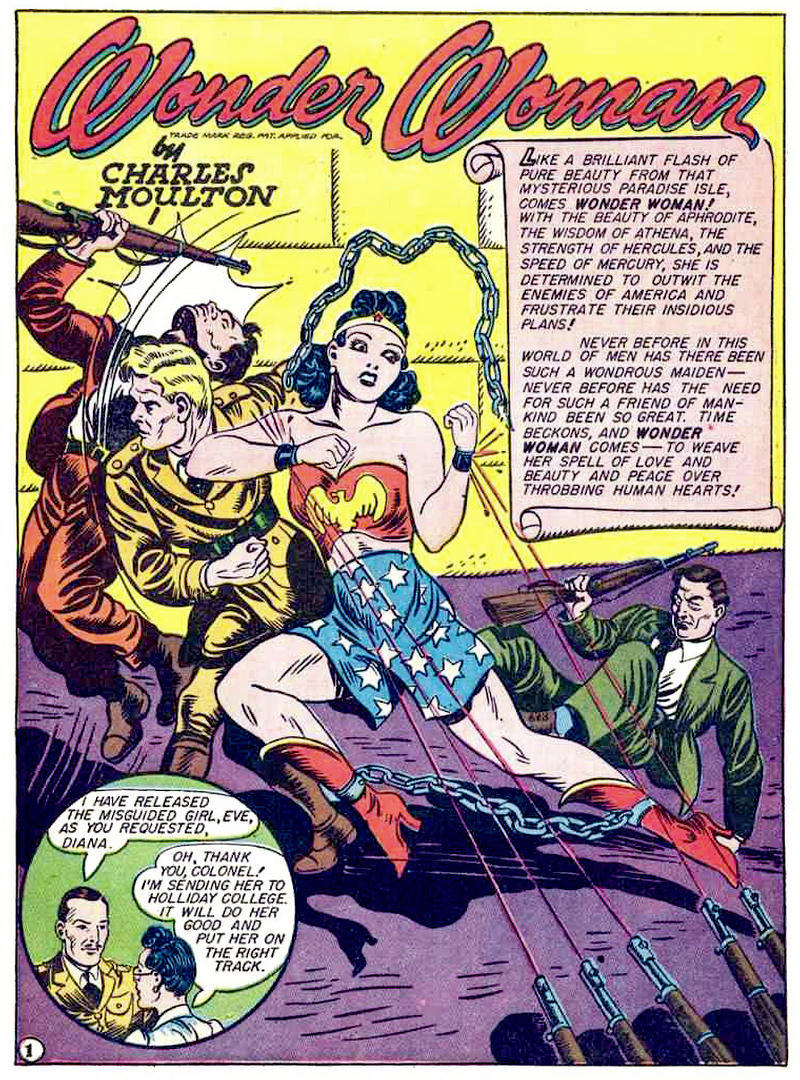
The creation of Wonder Woman was one of the most successful achievements of William Moulton Marston’s career, helped in no small part by the women in his life. Jill Lepore’s excellent book, The Secret Life of Wonder Woman, is an education in the early years of the women’s rights movement, Marston’s polygamous living arrangements with two women and their children, and Marston’s background as a psychologist, inventor, and self-promoting huckster.
As has been mentioned before, Marston was into bondage, domination and submission. It was the key plot element in many of the early Wonder Woman stories. When challenged, he used his psychology training to defend it. He claimed that the chains that held Wonder Woman were symbols: she was being shown breaking the chains with which men had bound women for centuries. He may not have passed his own lie detector test telling that whopper. The old boy liked seeing girls tied up, and used symbolism as an excuse.
This story is from Sensation Comics #4 (1942), which would be the fifth published Wonder Woman adventure (number one was in All Star Comics.) Slavery with bondage is a major story device. It also introduces the German spy and dominatrix, Baroness Paula Von Gunther. The haughty baroness became Wonder Woman’s first recurring villain.
As has been mentioned before, Marston was into bondage, domination and submission. It was the key plot element in many of the early Wonder Woman stories. When challenged, he used his psychology training to defend it. He claimed that the chains that held Wonder Woman were symbols: she was being shown breaking the chains with which men had bound women for centuries. He may not have passed his own lie detector test telling that whopper. The old boy liked seeing girls tied up, and used symbolism as an excuse.
This story is from Sensation Comics #4 (1942), which would be the fifth published Wonder Woman adventure (number one was in All Star Comics.) Slavery with bondage is a major story device. It also introduces the German spy and dominatrix, Baroness Paula Von Gunther. The haughty baroness became Wonder Woman’s first recurring villain.
Monday, October 20, 2014
Number 1646: Wonder Woman’s hot feet
Wonder Woman stories written by her creator, Charles Moulton (William Moulton Marston), seldom disappoint. They have elements that elevate the character above the run-of-the-mill super-doer. This delightfully oddball tale is set in Mexico with a beautiful eight-foot-tall señorita, bandits with bandoleros, Wonder Woman’s invisible plane, chains, bondage, and even Wonder Woman in bare feet walking over hot coals. Wow.
This Mexican melange is drawn by H.G. Peter, and is scanned from Sensation Comics #45 (1945).
More wonderful wacky Wonder Woman. Click on the thumbnail.
The New Yorker for September 22, 2014, had a fascinating article by Jill Lepore on the character and Marston. Click on the thumbnail.
This Mexican melange is drawn by H.G. Peter, and is scanned from Sensation Comics #45 (1945).
More wonderful wacky Wonder Woman. Click on the thumbnail.
The New Yorker for September 22, 2014, had a fascinating article by Jill Lepore on the character and Marston. Click on the thumbnail.
Subscribe to:
Posts (Atom)