Translate

Showing posts with label Hangman. Show all posts

Friday, December 15, 2017

Number 2142: Man and Hangman

I feel that Bob “Fuge” Fujitani was the Hangman artist. The dark character originated when he stood in for his murdered brother, the Comet, created by Jack Cole. Fujitani’s art has a mood of its own, and in this particular episode from Pep Comics #47 (1944), the drama is heightened by his camera angles and dynamic figure drawing. He worked early on with the Eisner-Iger Shop and you can see the Eisner influence in his inking. At some point he left the shop to work directly for Quality Comics. He worked for many comics publishers over the years, and did a lot of work with Dan Barry on the Flash Gordon daily comic strip. Over time his style changed from the Eisnerish look of this story to a more illustrative style seen on this cover drawing of the Hangman, which he did in 2002:


According to an interview in Alter Ego #28 (2003), Fujitani joined the U.S. Navy during World War II. but he was kicked our because his father was Japanese. He was also issued a less-than-honorable discharge. When I hear stories like that I have a sense of outrage. I was relieved to read that a few years later, after an appeal, he was given an honorable discharge, which made him eligible for veteran’s benefits.

I am writing this in October, 2017, and the biographies I read online about Fujitani don’t mention whether he is still alive. He was born in 1920, so he will be 98 in 2018. He is one of the very last of the original comic book men who came into the industry in its early days.


Friday, August 03, 2012

Number 1203: Sign of the Hangman


The Hangman (Bob Dickering) had an interesting gimmick. When he cornered the guy he was after the shadow of the gallows fell on the felon's face. I wondered how he did that...then I watched one of those “reality” shows where we’re not supposed to think about a platoon of cameramen, lighting techs, sound guys, etc., following these “real” people around in their “real” daily endeavors. Maybe Hangman had a lighting guy who stood over his shoulder, and when the time was right would hold up a tiny gallows in front of a powerful light. Okay...so it’s a comic book and they don't have cameramen. I just needed to get that out, because Hangman's gimmick always bugged me, and if they explained it in any of the Hangman stories I've missed it (or forgotten).

This story, which comes from Pep Comics #34 (1942) is a good example of the series. Bob Fujitani, working in his early style with overtones of Will Eisner’s influence, drew some very dynamic and dramatic pages. There's even a scene of a guy getting shot through the head, which wasn't exactly typical of these stories, but gory stuff did happen. M.L.J. Magazines, Inc., publishers, was into the action, violence and horror that appalled parents and grownups across America. They also sold to servicemen who were more likely to handle this sort of thing, but it was the kids everybody worried about. After a time the line began concentrating on their teenage comics and out of bloody M.L.J. cleancut Archie Comics was born. Well, cleancut compared to this episode of Hangman. I remember some sexy stuff going on in Archie, but no one got a bullet through the brain.

I'm including a page on editor Harry Shorten. Shorten did comics, paperback book publishing, a comic strip (“There Oughta Be A Law” with Al Fagaly) and then comics again in the sixties with T.H.U.N.D.E.R. Agents. All of that was ahead of Shorten when this biography was written, but you can see from it that Shorten took to the industry early on.


Wednesday, January 25, 2012


Number 1094


Hangman in the future


If the Hangman was an answer on the TV quiz show, Jeopardy, the question would be, "Who was the slain Comet's brother?"

Hangman was Bob Dickering, who took over when his superhero brother John was killed, and like many a vigilante character before him (and after him, too; see Dexter) swore vengeance on murderers. When the Hangman caught his prey, the criminal had the shadow of a noose cast upon him and then met a fitting end to his murderous career.

In this particular science fiction offering of the popular MLJ feature, published in The Black Hood #10, Spring 1944, Hangman goes after the villain by being sent 100 years to the future. It's a future much more enlightened than the world of 1944, one in which the death penalty has been abolished, and you can tell that because the news is on a big billboard.

Bob Fuje (Fujitani), who drew this episode of "Hangman," was one of the best artists to come out of the Golden Age. His work changed over the years from this Will Eisner lookalike to a more illustrative style, and he stayed active until at least the mid-1980s. As far as I know Fujitani, who was born in 1920, is still living at age 91.


Sunday, January 31, 2010


Number 676


Hangman hung up


"Gallows Ghoul," expertly illustrated by Bob ("Fuje") Fujitani for the Fall 1943 issue of Hangman Comics #8, is a morbid murder tale partially rewritten, probably because it was too morbid. The clumsy re-lettering in certain captions and speech balloons looks like a last minute attempt to mitigate the horrors of a man killing his wife and then throwing his young son out the window of a tall building. I'm reading between the lines, but changing the murdered woman to a "half-sister" of killer Ed Jennings, and the boy into the half-sister's son doesn't make sense. Just do what I did and substitute the word "wife" for "half-sister." I don't think killing one's half-sister is any more acceptable than one's wife, but it appears that somebody had second thoughts about this story and made the changes before this issue went to press.

The stereotype of mental illness is pretty sickening, also, but it isn't untypical of the era in which it was published.

Hard to believe that MLJ Comics, which published some of the more lurid and sensational comic books of its era, did an about-face and went with the much less objectionable Archie characters. I'm sure a character like Hangman, and stories like "Gallows Ghoul," put the company under scrutiny by censorious types. MLJ made the right choice, since Archie has sustained them to this day.


Sunday, August 09, 2009


Number 572


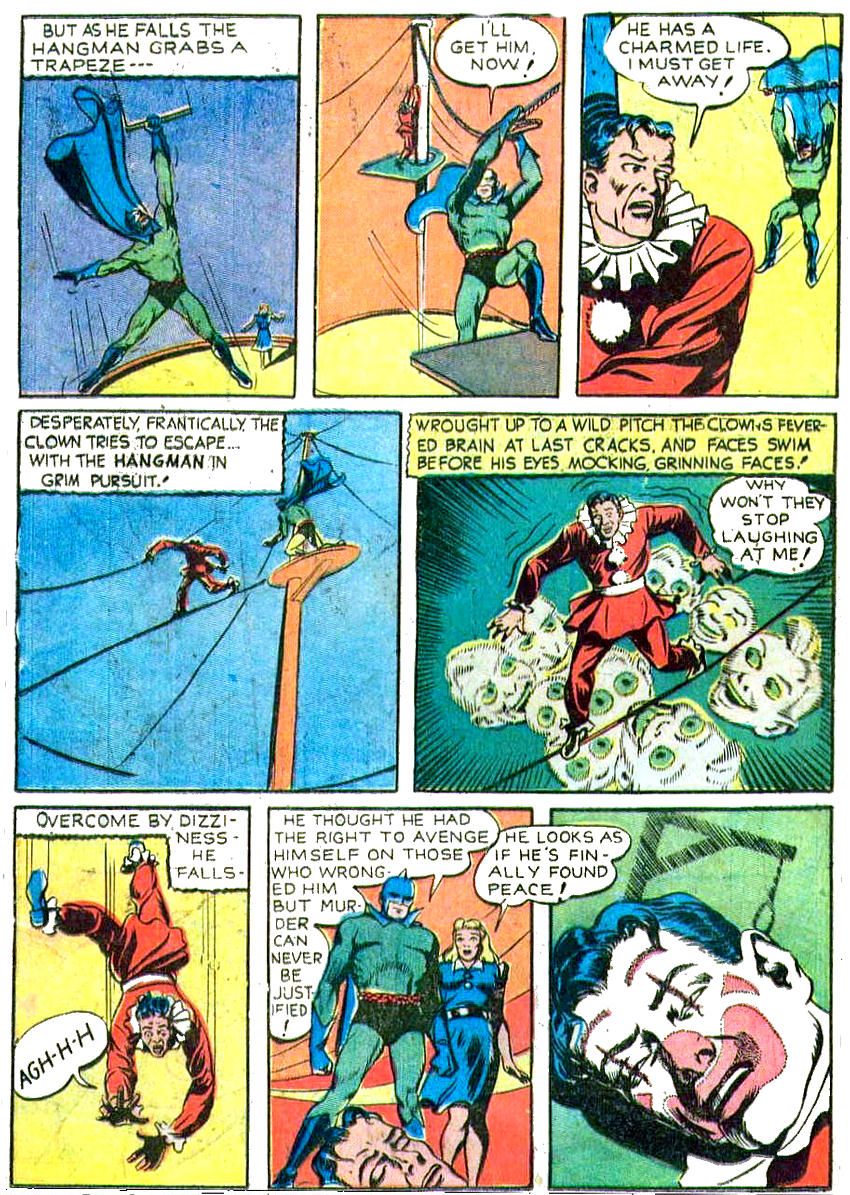
Are you afraid of clowns?


What is it about clowns, anyway? Was it Robert Bloch who creeped us out with the story of the clown at midnight? We laugh at the clown in the circus, but what if we were to open the door at midnight and there is the same clown, bathed in moonlight...booooohahaha.

OK, OK...stay on the subject, Pappy...the mind wanders. This story, "Hangman Special Case #2" is from Special Comics #1, from 1942, which is a one-shot, actually the first issue of Hangman Comics, a lurid MLJ title from the war years. In case you don't remember, the Hangman was the Comet's brother, and sought vengeance after his brother was killed.

Harry Lucey is credited with the artwork. Lucey had a long career in comics, with MLJ, and then when the company became Archie Comics. He worked up through the 1970s, and died in the 1980s.