Translate

Showing posts with label Harry Lucey. Show all posts

Monday, December 20, 2021

Number 2585: The uplifting story of Ginger and Ickky

In the splash panel of today’s story Ginger seems not too hot on buying a pair of spike heels, but a couple of pages later we see her in platform shoes. Her boyfriend, Ickky, feels threatened by her added height, and has to do something about it. It reminds me of an old advertising campaign for Adler Elevator Shoes, whose shoes could add 2 inches to a guy’s height. The slogan was, “Now you can be taller than she is.” They don't mention, “Unless she is wearing 3" or 4" heels or platforms, that is.”

Ginger was published, as you have probably noticed, by those folks who gave us the Archie comics dynasty. Ginger lasted only 10 issues from 1952 to 1954. The artwork here is by Harry Lucey.

“Shoes Your Partner” is from Ginger #6 (1953):


Friday, December 11, 2015

Number 1826: Satan is a lady two ladies

It isn’t hard to see that the writers who created both Madam Satan and Lady Satan thought of women as devilish. In the case of Madam Satan, she is married to the Prince of Darkness himself, and Lady Satan is a “master (sic) of black magic," which has connotations of Satanism.

Ah, but they make good characters, even if both of these Satanic females were not the stars of the comics in which they appeared. Both were short-lived. Madam Satan, appeared in a handful of stories for MLJ during its pre-Archie years as a publisher with a line-up of characters sure to displease parents, teachers and the censorious types looking at them. The Lady Satan shown here is actually the second of two characters with that name, the first having fought the Nazis in France, this Lady Satan fighting supernatural menaces in the post war era. This lady also had a short-lived comic book career, appearing in comics published by Harry "A" Chesler.

These two episodes of Madam Satan were published in Pep Comics #18 and #19 (1941), with artwork credited by the GCD to Harry Lucey. The werewolf story starring Lady Satan appeared in Red Seal Comics #17 (1946), The artist isn’t identified. Lady Satan had her mask whited out when the story was rewritten and published as “The Werewolf Howls” for St. John Publishing’s  Weird Horrors #1 in 1952.


Monday, June 23, 2014

Number 1595: Aces up my sleeve

Today we begin a theme week, “Aces Up My Sleeve” week, featuring some very early (1940-41) stories from Ace Publications. Ace, a pulp publisher, entered the comics fray early on with the usual titles devoted to the usual superheroes. In the story today, Magno, the magnetic man.

What jumps out at me with this very early entry for Magno, from Super-Mystery #2 (1940), is not the Harry Lucey artwork, which is very good, but the eye-popping primary colors. Other publishers of the time also used bright colors (Quality and Fox come to mind), but I think this job rises above them, with its imaginative use of colors for an earth-boring machine (page 12). The colorist must have been having fun.


Sunday, June 30, 2013

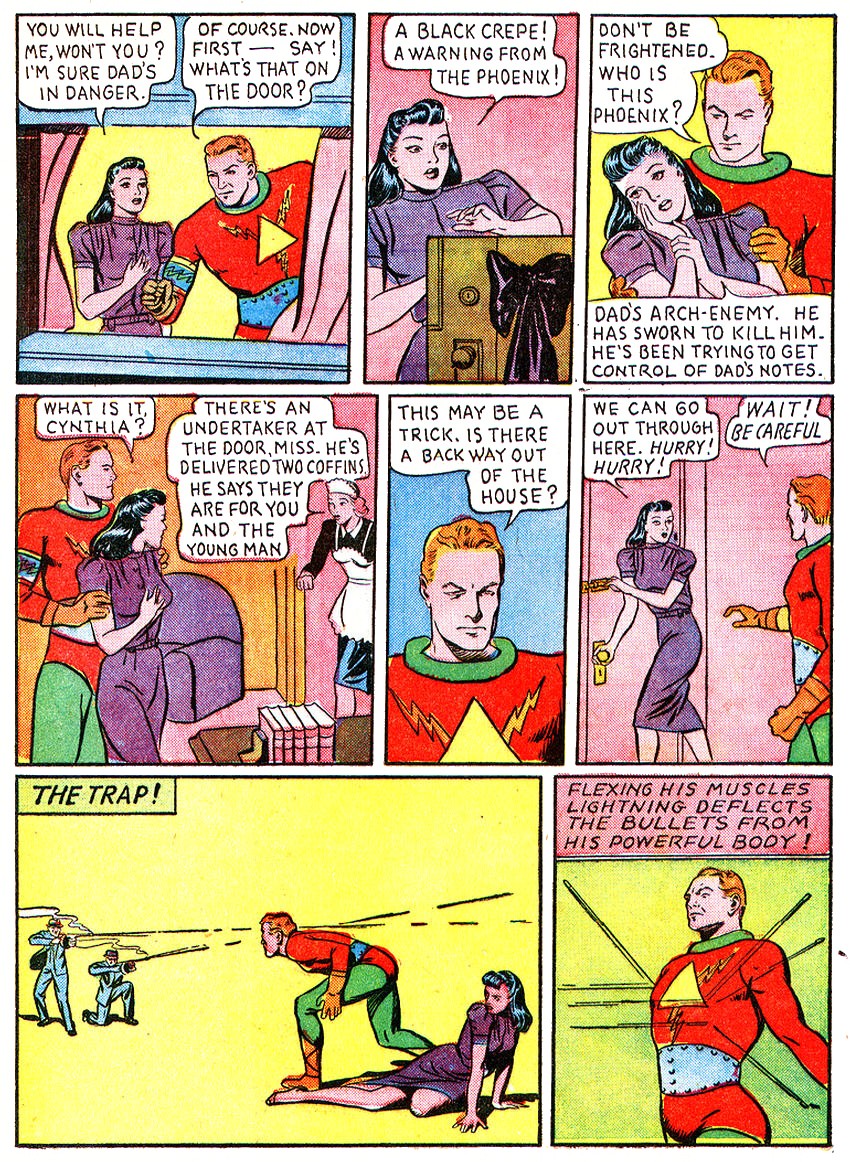
Number 1393: “This guy ain’t human!” Introducing Flash Lightning

Flash Lightning was born of the “mysterious East.” We find out the bare bones of his origin on page 1 of his introduction in Sure-Fire Comics #1 (1940), published by Ace. He was trained in Egypt. Whatever gave him his powers, by 1940 superheroes were basically old hat and the origin was just a means to an end. And the end was action, action, action! That’s exactly what happens to Flash as he goes right to work rescuing a beautiful girl’s dad from a life of slavery.

The Grand Comics Database lists Robert Turner as writer. There is an indexer note that the story is based on the May 1938 pulp magazine, Captain Hazzard. A lack of originality in the story is matched by swipes from Alex Raymond’s Flash Gordon by artist Harry Lucey. A year or so later Flash’s name became Lash Lightning, and while I can’t find official information on the reason for the change, it’s likely DC Comics’ character, the Flash, had something to do with it. Another name change came with the comic book title, which after four issues as Sure-Fire Comics became Lightning Comics. Like many other superheroes born in the wake of Superman, Flash/Lash Lightning disappeared shortly after the end of the war. Had I been in charge of him in 1946 I might have taken away the super powers and made Lash Lightning a private eye with a whip. He couldn’t be a cowboy, because Lash LaRue was already whipping up bad guys in the Western B-movies in which he starred.