Translate

Showing posts with label Daredevil Comics. Show all posts

Wednesday, March 06, 2019

Number 2308: Real American #1

“Real American #1” — aka “Bronze Terror” — was the son of an Apache chief, and went after some bad white men. This story is the origin story from 1941, in Daredevil Comics #2. The feature lasted another 10 issues before disappearing.

It was created, written and drawn by Dick Briefer, who created several characters for the comics, but is best known for his long string of Frankenstein stories which he kept up until late 1954 when the Comics Code came in. Briefer then left comics. Some biographical sources tell about Briefer’s comic strip work for the Communist Party USA newspaper, The Daily Worker. If he intended a call for racial justice with this presentation then I think the synthetic nature of comic book heroes kept that from happening. The story contains stock clichés about Indians, giving the story a false sincerity.

Jeff Dixon is the chief’s son (...and where did he get the the name “Jeff,” or for that matter “Dixon” from an Apache father who wears full native regalia?) Jeff is patterned after the famous real-life Native American athlete, Jim Thorpe (aha! Another American-sounding moniker!) For better or worse, Indians in comic books were not that uncommon, but some representations of their lives and culture were more accurate than others, including this one.


Friday, November 16, 2018

Number 2260: The Claw, one-man chain gang

Ah me...I showed the prior chapter of this story last August. If anyone thought I was building suspense, it was more that I just forgot. If curious, you may swing back to August 22, 2018 and see the Claw from Pappy’s #2223.

The Claw, big fellow that he is, is held captive with a large chain. He gets slipped some pills (you know they are for him because the name “The Claw” is on the pillbox) and is mysteriously free of the chains. What th--?! At the risk of spoiling it for you, the mystery of the disappearing chains is not solved, but we are told in the last panel that police are looking for “the Orientals who dropped mysterious pills into [the Claw’s] mouth — making his escape possible!”

Another cliffhanger. Now I must find Daredevil Comics #5 and continue the story. If I were you I would not hold my breath waiting, because when it comes to this blog and my memory, nothing is as certain as uncertainty.

Byline credit for Bob Wood, published in Daredevil Comics #4 (1941).


Monday, September 24, 2018

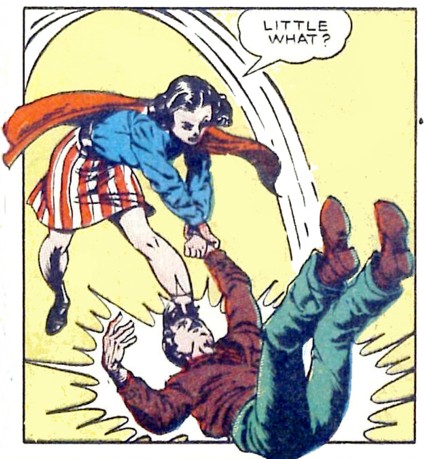
Number 2237: Pat Patriot: Women can fight, too!

I have told this story before, but it seems time to dredge it up tell it again. In the early '70s I helped my wife with an essay for a class she was taking. Her paper was on patriotic comic book heroes of World War II. It was the era of anti-war protests, and while I was definitely anti-war, I was also a veteran and writing about WWII comic books was hard to resist (it still is). The teacher liked it so much he had her read to the class. When she got to the name Pat Patriot her classmates exploded in laughter.

I subsequently found out that Pat Patriot’s name was Patricia Patrios, and she was introduced in Daredevil Comics #2. Some character in the origin story misspelled her last name and she became Pat Patriot. It was a short-lived series, lasting only until Daredevil #11. But what I like about it is its portrayal of a female character who is without super powers, but who can fight. That was considered fanciful 80 years ago, but then as now some women kick butts as well as a man.

The Grand Comics Database has questions about who wrote and drew this story from Daredevil Comics #3 (1941), Pat’s second appearance. They guess it was written by Charles Biro and Bob Wood, and also guess at artists Frank Borth and Reed Crandall. I see a couple of panels I believe are by Crandall, but I would not be able to identify anything by Borth.


Monday, July 09, 2018

Number 2204: The Claw; the missing Dick!

Dick Hopkins is one of 2000 soldiers — a whole troop-train full — falling prey to the “World’s Worst Villian” [sic]. Said villian, errrr, I mean villain,* is the Claw, another in a long line of sinister, murderous “Orientals” falling into the genre called the Yellow Peril, a whole bunch of racist pulp literature, movies, et al, popular for far too long. The most (in)famous example would be Sax Rohmer’s Fu Manchu.

At 25 feet tall the Claw stands out, yet is allowed to roam the American landscape with what looks like hundreds of henchmen, without being caught by the American military. In these stories it is usually a lone white man, in this case Dick Hopkin’s brother, Bill, who defeats the Claw and his army, if only until the next issue.

Signed by artist/co-editor Bob Wood, and originally published in Daredevil Comics #2 (1941).


*Weird also misspelled “wierd.”

Monday, April 09, 2018

Number 2165: London and Nightro during wartime

London was created for Charles Biro’s Daredevil #2 by Jerry Robinson, as was Nightro, drawn by George “Inky” Roussos. Both Robinson and Roussos were courted by Biro because they worked for Bob Kane. Robinson came up with London, Dick Wood and Roussos did Nightro. Biro probably thought he could get some sales spillover from some of the talent behind Batman, but no. The strips created by these two men for Biro both disappeared within a short period of time.

The no-boost-from-Batman last London strip can be seen by going to the link below today’s strips.


London’s last appearance in Daredevil #11, is here. Just click on the thumbnail.


Wednesday, June 21, 2017

Number 2065: Daredevil aces the spinning chair

After his symbolic appearance in the splash page, Daredevil doesn’t show up in this story until page 10. The story is mostly about Daredevil’s secret identity, Bart Hill, joining the Air Corps and learning to fly. He survives the Air Corps physical, shown as a spin in an office chair (page two). On a training flight he even takes out a Japanese sub!

This story appeared in Daredevil Comics #10, cover dated May, 1942. It was written and drawn shortly after the attack on Pearl Harbor. Patriotic fervor was high in those days.