A couple of days ago I linked you to a circus story by Ghastly Graham Ingels. Here is a story by Ingels, before he became Ghastly.
Ingels joined the EC Comics crew early on, working for Bill Gaines and Al Feldstein on the comics they produced before they set off a bomb under the industry with their horror comics line.
“The Gentleman Gunman” is an expert safecracker who earns a lot of money with his nefarious endeavors. He also shoots anyone who stands between him and escape. He chooses to spend the stolen money on the good life and with the good life come women. Uh-oh. Distraction caused by sex is a good way to get a thief caught or killed. Not that I would know, heh-heh. I never stole anything in my life (too afraid of punishment). I was distracted by girls, but I got my money for a social life the old-fashioned way: My dad, Big Pappy, put me to work in his warehouse!
No writer is listed for this story. It appeared in Crime Patrol #12 (1949):
Translate
Showing posts with label Crime Patrol. Show all posts
Friday, August 24, 2018
Monday, March 05, 2018
Number 2150: Nell from hell, and Dr Maggot’s ape
So called “Pre-Trend” EC Comics — those published before the popular EC New Trend, could be a mixed bag. They published some standard fare, crime and love comics, after EC founder Maxwell Charles Gaines died in 1947 and his son, William M. Gaines, took over as publisher and editor. Story quality could vary widely, even in the same issue of a particular title. Two stories from Crime Patrol #12 (1949) are good examples. “Nell Baker,” written and illustrated by Al Feldstein, is a straightforward crime story, typical of the genre. Was there a real Nell Baker? I don’t know. The story isn’t claimed to be true despite the cover blurb of “Real Stories from Police Records!” Nell was a stereotype of the female criminal in crime comics, tougher than most men, and more bloodthirsty.
There is an inside joke on page 7, where William Gaines, publisher, is introduced as William Seniag, police artist.
On the other hand, “The Hanged Man’s Revenge” mixes genres, a crime story with a horror story. Most horror comics had crime as the basis for the plot, but this story is a horror in another way. It is not well written. It is by an anonymous writer, and for a good reason. I’m showing it because I like Howard Larsen’s artwork, and I am a sucker for ape/gorilla stories, as longtime readers know. No matter how tepid the plot, I am showing it for purely selfish reasons. Besides the ape, I like the names of the bad guys, Dr. Maggot and Fench.
Here is a 2012 posting from Crime Patrol. Just click on the thumbnail.
There is an inside joke on page 7, where William Gaines, publisher, is introduced as William Seniag, police artist.
On the other hand, “The Hanged Man’s Revenge” mixes genres, a crime story with a horror story. Most horror comics had crime as the basis for the plot, but this story is a horror in another way. It is not well written. It is by an anonymous writer, and for a good reason. I’m showing it because I like Howard Larsen’s artwork, and I am a sucker for ape/gorilla stories, as longtime readers know. No matter how tepid the plot, I am showing it for purely selfish reasons. Besides the ape, I like the names of the bad guys, Dr. Maggot and Fench.
Here is a 2012 posting from Crime Patrol. Just click on the thumbnail.
Sunday, December 09, 2012
Number 1277: The crimes of F.C. Aljon
I love original art; I especially love original art from EC Comics, and love to share it. Well, I need to clarify that...the original artboards for these two stories don't belong to me. They were sold by Heritage Auctions, who — bless their Texas-sized hearts (they are headquartered in Dallas) — provide these excellent scans. I give them a tip of my 10-gallon Stetson in recognition of their (unwitting) contribution to Pappy’s blog. Thanks, pardners!
Now, on to the art. Johnny Craig and Al Feldstein did some collaborating during their early days working for Bill Gaines at EC Comics. In these two stories for Crime Patrol #13 (1949), signed by “F.C. Aljon” their styles sharply contrast. The first story, “I Fight Crime,” is credited by the Grand Comics Database as being penciled by Feldstein, and supposedly inked by Craig, and the process is reversed for the second, “Edna Sunday.” But in looking over both of these stories I see them differently. “I Fight Crime” is mostly drawn by Feldstein, pencils and inks, with a few panels by Craig. “Edna Sunday” is mostly drawn by Craig.
But really, is it all that important? Well, sure it is to those of us wonkish comic book guys who like to get the credits right, even though early comic book credits are often a lot trickier to pin down than we think.
The other thing of interest is the change of name and splash panels for “Edna Sunday” which covered over a violent panel with an innocuous portrait of the title character, and the title, “Hate,” There could be a practical reason for this, including concern over criticism of crime comics by Fredric Wertham, M.D. (his major attack against crime comics, the article that would grow into his 1954 book, Seduction of the Innocent, appeared in The Ladies Home Journal in 1948), and groups of bluenoses who were organizing comic book drives to feed bonfires. A year before this issue of Crime Patrol the Alfred Hitchcock movie, Rope, starring James Stewart, opened on a close-up of a man being strangled with a garrotte. Hitchcock could get away with it...maybe Bill Gaines didn't think in that climate of comic book criticism he could do the same. A couple of years later he challenged the critics, but in his early days as publisher he may not have been so brave.
I think it’s a great comic; Karswell told me the idea was to use stories that he had not featured in his blog, but even if they had used those stories it wouldn't have mattered to me. I’m old-fashioned enough to believe having something available only in a non-tactile, digital form such as a blog is not the same as having it in print, on paper. (And yes, that includes the blog you’re reading now.)
Haunted Horror #2 is out, with a fine line-up of stories from a variety of publishers: Fawcett, Superior, Harvey, Standard and two stories from Ace by two of their top artists, Ken Rice and Lou Cameron. My personal favorite story this issue is from Adventures Into Darkness #6, drawn by the great George Tuska, “Corpse Convention.” The splash panel reminds me of checking into the hotel in the early days of the San Diego Comicon!
Karswell is presented as a horror host, and Craig Yoe, with his instantly identifiable hairstyle, is “Forelock the Warlock.”
It’s all great fun in that special way these old comics were fun, reviving the spirit of the forbidden, when kids read these under the covers with flashlights so their parents wouldn't know they were scaring themselves silly. And silly some of the stories are, but that’s their charm. For $3.99 you can’t miss with Haunted Horrors. And while you’re at it, go to Yoebooks.com or Amazon.com and check out the other titles in Yoe’s hardcover series...Christmas quickly approaches, and you know someone wants a gift suggestion for you.
...and speaking of great books, this just in...
I got Yoe’s latest book, Comics About Cartoonists, just yesterday, and have spent some enjoyable hours paging through, admiring how many comic book stories there are with references to cartoonists and comic book artists. It seems a natural — cartoonists live in a pretty insular world, often working from home or a studio. Their art becomes their own self-contained universe. I remember stories like this when I was a kid and loved them, because it was the artist stepping through that “fourth wall,” coming off the page to let us readers know that yes, there was a person involved in producing the comic book.
The book is credited to Yoe as editor and designer, and his wife, Clizia Gussoni, as producer. I admire this book very much, and will give a more thorough review when I’ve had the chance to actually sit down uninterrupted and read it. Until then, I’m recommending it based on the eye-popping visuals, because of the quality of all of the books from Yoe’s studio, and because I provided the copy of Weird Science Fantasy #22, from which Craig got the scans for Wallace Wood’s story, “My World.” As one of the most famous of the comics about cartoonists stories, it’s fitting that Craig used it to end the book.
Now, on to the art. Johnny Craig and Al Feldstein did some collaborating during their early days working for Bill Gaines at EC Comics. In these two stories for Crime Patrol #13 (1949), signed by “F.C. Aljon” their styles sharply contrast. The first story, “I Fight Crime,” is credited by the Grand Comics Database as being penciled by Feldstein, and supposedly inked by Craig, and the process is reversed for the second, “Edna Sunday.” But in looking over both of these stories I see them differently. “I Fight Crime” is mostly drawn by Feldstein, pencils and inks, with a few panels by Craig. “Edna Sunday” is mostly drawn by Craig.
But really, is it all that important? Well, sure it is to those of us wonkish comic book guys who like to get the credits right, even though early comic book credits are often a lot trickier to pin down than we think.
The other thing of interest is the change of name and splash panels for “Edna Sunday” which covered over a violent panel with an innocuous portrait of the title character, and the title, “Hate,” There could be a practical reason for this, including concern over criticism of crime comics by Fredric Wertham, M.D. (his major attack against crime comics, the article that would grow into his 1954 book, Seduction of the Innocent, appeared in The Ladies Home Journal in 1948), and groups of bluenoses who were organizing comic book drives to feed bonfires. A year before this issue of Crime Patrol the Alfred Hitchcock movie, Rope, starring James Stewart, opened on a close-up of a man being strangled with a garrotte. Hitchcock could get away with it...maybe Bill Gaines didn't think in that climate of comic book criticism he could do the same. A couple of years later he challenged the critics, but in his early days as publisher he may not have been so brave.
***************
Haunted Horrors is a reprint comic, an anthology of the pre-Comics Code, non-EC horror comics of the early 1950s. It’s co-edited by Karswell of the popular blog, The Horrors Of It All. Craig Yoe is the other horror-meister. He has published some great hardcover books from what is called “The Chilling Archives of Horror Comics” — they've been so well received the bi-monthly comic was launched.I think it’s a great comic; Karswell told me the idea was to use stories that he had not featured in his blog, but even if they had used those stories it wouldn't have mattered to me. I’m old-fashioned enough to believe having something available only in a non-tactile, digital form such as a blog is not the same as having it in print, on paper. (And yes, that includes the blog you’re reading now.)
Haunted Horror #2 is out, with a fine line-up of stories from a variety of publishers: Fawcett, Superior, Harvey, Standard and two stories from Ace by two of their top artists, Ken Rice and Lou Cameron. My personal favorite story this issue is from Adventures Into Darkness #6, drawn by the great George Tuska, “Corpse Convention.” The splash panel reminds me of checking into the hotel in the early days of the San Diego Comicon!
Karswell is presented as a horror host, and Craig Yoe, with his instantly identifiable hairstyle, is “Forelock the Warlock.”
It’s all great fun in that special way these old comics were fun, reviving the spirit of the forbidden, when kids read these under the covers with flashlights so their parents wouldn't know they were scaring themselves silly. And silly some of the stories are, but that’s their charm. For $3.99 you can’t miss with Haunted Horrors. And while you’re at it, go to Yoebooks.com or Amazon.com and check out the other titles in Yoe’s hardcover series...Christmas quickly approaches, and you know someone wants a gift suggestion for you.
...and speaking of great books, this just in...
I got Yoe’s latest book, Comics About Cartoonists, just yesterday, and have spent some enjoyable hours paging through, admiring how many comic book stories there are with references to cartoonists and comic book artists. It seems a natural — cartoonists live in a pretty insular world, often working from home or a studio. Their art becomes their own self-contained universe. I remember stories like this when I was a kid and loved them, because it was the artist stepping through that “fourth wall,” coming off the page to let us readers know that yes, there was a person involved in producing the comic book.
The book is credited to Yoe as editor and designer, and his wife, Clizia Gussoni, as producer. I admire this book very much, and will give a more thorough review when I’ve had the chance to actually sit down uninterrupted and read it. Until then, I’m recommending it based on the eye-popping visuals, because of the quality of all of the books from Yoe’s studio, and because I provided the copy of Weird Science Fantasy #22, from which Craig got the scans for Wallace Wood’s story, “My World.” As one of the most famous of the comics about cartoonists stories, it’s fitting that Craig used it to end the book.
Wednesday, January 05, 2011

Number 873
The good line
Johnny Craig is featured in day three of our EC theme week.
Craig was a slow artist, working and reworking his drawings, which limited his production. But what you saw when it was published was as good as he could do, and that was good indeed.
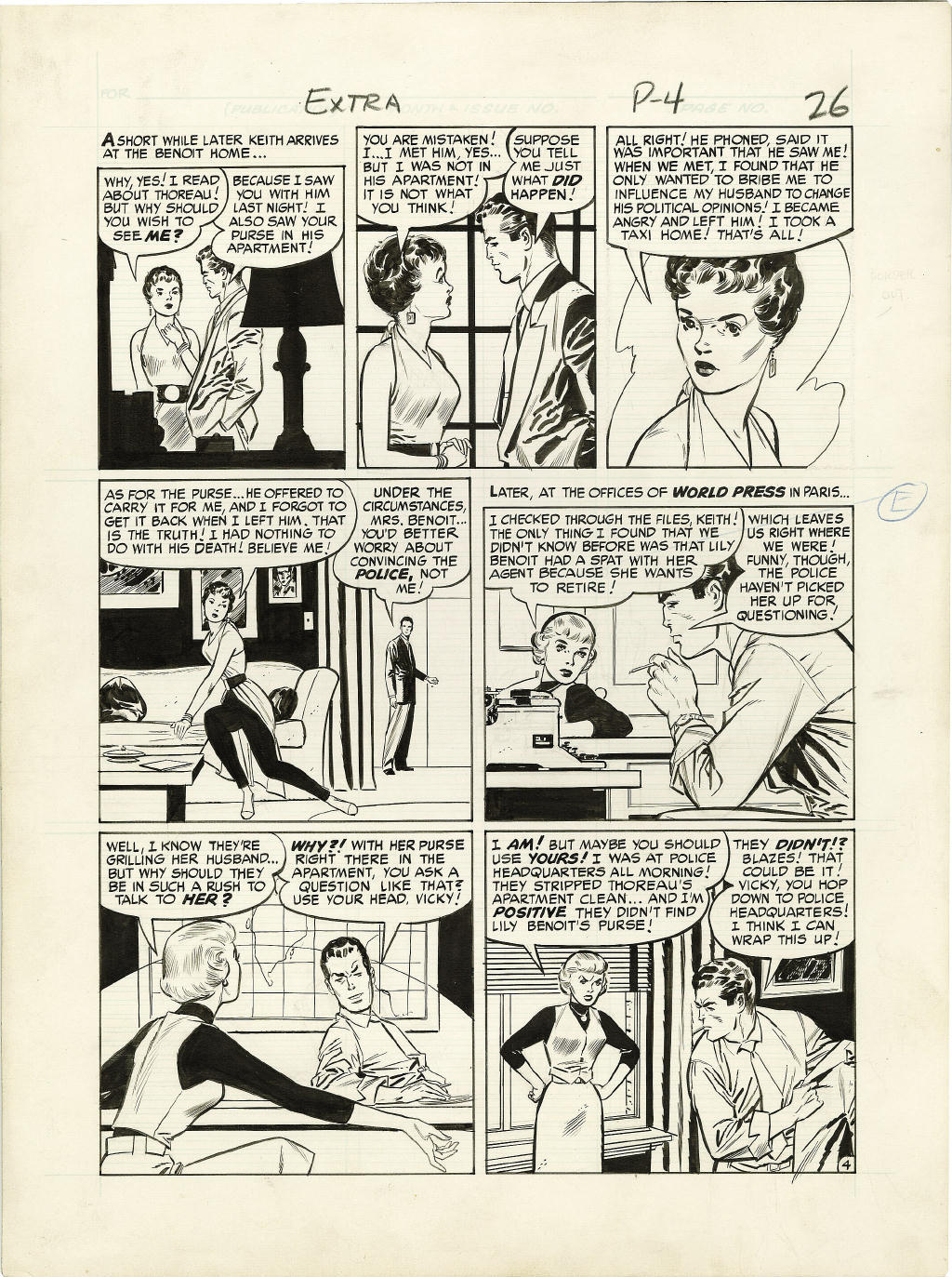
I've scanned an early 1949 story by Craig from Crime Patrol #14, which shows him as an artist still working toward his best. The story is fairly routine for a crime comic, and his art is better than the script. I've also included one of his later EC jobs for Extra #3, a 1955 New Directions title. I believe the original art (four pages originally posted by Heritage Auctions) and the last two pages, scanned from Russ Cochran's hardbound Extra collection, shows much more sophistication in his style.
For the purpose of this posting I looked at quite a bit of Craig art, including his Warren art, and his contributions to ACG. He re-entered the comic book field part-time in the 1960s after he had left comics and gone into advertising.
Johnny Craig, during his EC years, gave everything he drew a very polished look; Max Allan Collins, in the hardbound Extra volume, says of Craig that his art ". . . clearly comes out of the Caniff/Sickles school . . . a more illustrative Raymond/Foster influence creeps in later . . . Craig is probably at his best when the cartoonist and illustrator in him are collaborating. His best work . . . has elements of both." What I like best about Craig is usually in those EC Comics published between 1949-50 and 1955, and many of those stories, to me, are exceptional.


Subscribe to:
Posts (Atom)