Translate

Friday, November 02, 2007


Number 212


Three Mouseketeers


DC had two sets of characters called Three Mouseketeers. The first was introduced in Funny Stuff #1 in 1944, and was a takeoff on Alexandre Dumas' famous literary characters. The second set was introduced in 1956, drawn by Sheldon Mayer, who had edited the first series. It was more contemporary, featuring a sort of Tubby and his Clubhouse Pals, mouse style. The characters, Fatsy (also called The Captain), Patsy and Minus were the Mouseketeers.*

This unnamed story is from Funny Stuff #6, Fall 1945. At the time it was published by Max Gaines' former division of DC Comics, All-American. By Funny Stuff #7 All-American and DC had kissed and made up, then reunited. From there Max Gaines went on to create EC Comics.

The fine artwork is unsigned, although the Grand Comics Database credits it to Ron Santi, who signed the "Bulldog Drumhead" strip in the same issue as R. Santi . "The Three Mouseketeers" episode seems a morbid story for a kids' funny animal comic book, but then as now, murder is entertainment. At least in this story the murder victim wasn't really a victim, or even murdered.


*We're also all aware of Disney's TV Mickey Mouse Club and the Mouseketeers.

Wednesday, October 31, 2007


Number 211


Witch's Cauldron


HAPPY HALLOWEEN!


I thought for this special day you might like a really early comic book horror story. It even has a witch.

The story comes from MLJ's Blue Ribbon Comics #22, March 1942.


I did a little research and saw that the feature, "Tales From The Witch's Cauldron," began in Blue Ribbon #20, and was continued in Zip Comics, because #22 was the last issue of Blue Ribbon. I believe it comes from the same source as the EC horror comics of a few years later, the original radio program, The Witch's Tale.

To me the most horrible thing about the story is the lead character lets a doctor listen to his chest, then tell him he has three months to live…and the dope doesn't get a second opinion!

The Grand Comics Database tells us that Joe Blair wrote the script and Sam Cooper did the artwork.

Have a great Halloween and keep your hands out of the kids' trick or treat bags. As for me, well, I'll be busy on Halloween day wrapping Ex-lax in Hershey wrappers for the arrival of the little kiddies. They usually stop at Pappy's Putrid Palace, a crumbling and ancient, cobwebbed mansion…but once is enough. They never come back! Bahahaha!


Monday, October 29, 2007


Number 210


The all-American bullet-headed Saxon mother's son


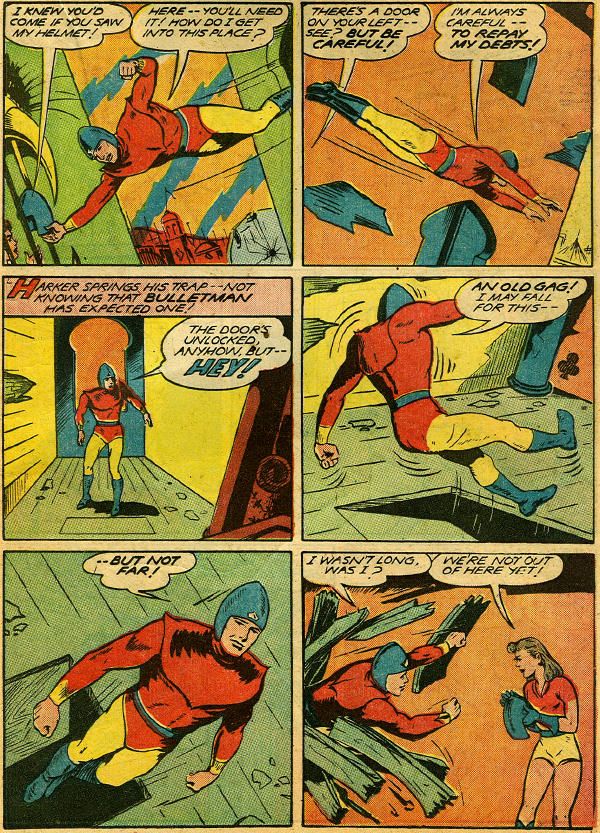
Bulletman was created by Bill Parker, who also created and wrote the early adventures of Captain Marvel. The artwork for this story, "Bulletman Fights the Gagman," from Master Comics #40, July 1943, is by the Jack Binder comic art shop.

Jack was brother to Otto Binder, who did the bulk of the writing chores on the Captain Marvel stories. At the time Jack and Otto were valuable contributors to the success of Fawcett Publications. This story seems pretty good considering it is a shop job, worked on by several hands.

The Gagman might've gotten his arsenal of weapons from the Johnson Smith Company, the mail order novelty business that advertised in most comic books of the day. Maybe those ads inspired the character.

Bulletman, and his gal pal, Bulletgirl, wear anti-gravity helmets, which is why they look like Coneheads. I wonder why anti-gravity helmets wouldn't cause disruptions, make them light-headed, or cause Bulletgirl's hair to float rather than stay down.

Finally, this blog tells you G.I. Joe fans that this Bulletman isn't the G.I. Joe Bulletman.


Friday, October 26, 2007


Number 209


Hanging around with Dick Ayers


Here's a gruesome little tale, taken from Ghost Rider #10, 1952. Dick Ayers was at the peak of his powers in this story. His storytelling and drawing ability were at their best during the early '50s, in my opinion. It's obvious that Ayers loved the subject material he drew, whether it was western, or horror, or both, like this story.

Ayers drew a guy hitting the end of a rope really well. If you don't like gruesome pictures, then don't look. Showing a hanging was one, amongst many, of the things that got comics in trouble. Twenty years later, in a freelance job for the non-code Eerie Publications, he drew another gruesome hanging scene, this time with popping eyeball.

ME Comics didn't publish horror comics, so Ghost Rider was the closest they got to the horror comics genre. However, "The Hangman," not part of the official Ghost Rider canon, is a good example of a horror comic story. Take away the western setting and it would fit right into an Atlas horror title.


Wednesday, October 24, 2007


Number 208


No return from Davy Jones!


This well-illustrated story appeared in a magazine called Monsters and Things #2, dated April, 1958. No credits are given.

Monsters and Things was a 25¢ magazine I remember from the magazine stands, spending time loitering, looking at this sort of thing. It was made up of monster movie stills and three of four text fiction pieces. At the time I wouldn't have dared bring home a magazine devoted to monsters. My mom would have tossed it. I was already on shaky ground for buying Mad and its imitators. While I remember this issue of Monsters and Things from its appearance on the stands, I didn't find this copy until 1980 or so. The cover and a couple of full-page interior illustrations are by Bob Powell.

The comic story appears to be a black and white reprint of a pre-code horror story. "Curse Of The Living Crossbones" is of the variety of horror story where a young attractive couple gets drawn into the supernatural. The story title doesn't bring anything up in the Grand Comics Database, but it is apparently reprinted from an Ace Comics title.

It is a pretty good pirate yarn, ye swabs. Yarrrr.


Monday, October 22, 2007


Number 207


Locked Up!


This story is scanned from Crypt Of Shadows #4 (1973). It was reprinted from Atlas Comics' Adventures Into Weird Worlds #9 (1952). Carmine Infantino drew it, Sy Barry probably inked it, Hank Chapman wrote it. The ending to the this story is totally off-the-wall, like a shaggy dog story. Or I should say, it's shaggy, just not a dog.