Translate

Monday, January 15, 2007

Number 82


The Dead Who Walk


Comic book companies usually try to capture readers' attention and get them to keep coming back to ongoing titles. This comic, The Dead Who Walk, under the imprint Realistic Comics, is an unnumbered, one-shot title.

The Dead Who Walk was released in 1952 as part of the horror comics boom of the era. It must've sold pretty well because it's not an uncommon title to find.

The artwork for The Dead Who Walk is credited by the Grand Comics Database to Joe Orlando, pencils and inks.

The story moves at a breakneck pace. For such a short story there are a lot of characters: Kent, his fiancĂ©e, Anne, her brother Jack, Dr.French, a "man of cold, scientific logic," and the evil brothers who are stealing bodies, George and Walt Bacon. That isn't even counting the named corpses animated by the pair of body snatchers: Juan Fernandez, Foley the mechanic, Torelli the importer…talk about packing a lot into a small space! The story, which concerns "egos," (i.e., "souls") jumping from body to body, reads like a weird menace pulp magazine tale of the 1930s and '40s, where plots like this were common. A Realistic Comic it might have been, but realistic it wasn't.


Saturday, January 13, 2007

Number 81


An Alter Ego For The 21st Century


The first comics fanzine I ever saw — the first fanzine I ever saw— was Mike Britt's Squatront #2 in 1959. It was produced on a spirit duplicator (a "ditto machine") in purple ink on white paper. It was an EC fanzine and yet I knew nothing about EC. It had articles on EC artists who were second-tier, like George Roussos or Sid Check. Never mind I really didn't even know anything about the first tier artists. It had an article on Jules Feiffer, a cartoonist I'd never heard of. (I found out in that article that Jules Feiffer didn't care much for Mad Magazine and he thought Harvey Kurtzman could have been a great cartoonist if he'd stuck to it.) I read and re-read that issue of Squa Tront to shreds and it's 40 years gone from my collection, but I've never forgotten it.

Fast forward a couple of years to 1961 and in the mail I got a complimentary copy of something called Alter Ego #1. It had some articles about some Golden Age comics called The Justice Society Of America, and a wonderful (to me, anyway) comic-style satire of The Justice League Of America called "The Bestest Society Of America," by a young teacher named Roy Thomas.

Along with the comics I was reading at the time those two fanzines led me down the path to today, sitting at the keyboard of my computer, writing this blog. The fanzines of today, many of them, like Pappy's, are produced in cyberspace, floating out there in some sort of Never-Never Land of technology I can't seem to completely understand.

The old fanzine style, the print fanzine, still lives in some form or another, though. I just bought a group of issues of the new Alter Ego, which is the spiritual, as well as the titular, descendent of that purple-printed fanzine I got in the mail 45 years ago. Roy Thomas, who was co-editor, with the late Jerry Bails, of the original Alter Ego, is an editor of this incarnation as well.

The two issues I was most interested in of the current series were numbers 61 and 62, both still available at the publisher, Twomorrows. I bought them because of their interesting and scholarly history of one of the more interesting comic book publishers of both the Golden and Silver ages of comics, ACG. Mike Vance, who created the comic strip, "Holiday Out," wrote the articles. They detail how the American Comics Group grew from the B.W. Sangor art shop, which packaged comic books for publishers.

Despite Bill Gaines' "admission" to the Senate Subcommittee hearings on comic books that he created horror comic books, ACG actually published the first line of horror comics with Adventures Into The Unknown, which ran for twenty years as both a non-code and then code-approved comic book. During that time many artists went through the company, but only one editor, and that was Richard E. Hughes. During the post-code era he wrote almost all, or maybe it was all, of the stories that appeared in both Adventures Into The Unknown and its companion, Forbidden Worlds.

The ACG comics hold a great deal of nostalgia for me, because at one point in the late 1950s they were my favorites, right before I got swayed to DC by that original ditto'd Alter Ego!

Current issues of Alter Ego are printed in black ink on newsprint paper. They aren't slick. They don't need to be. What's important to me is the information. I'm not exactly sure why, but I'm really interested in the kind of arcane knowledge this magazine gives me about the old-time comic book business. Maybe it's my obsessive compulsive disorder that gives me interest in the comic book business as well as comic book creators. Whatever. I'm very happy with these issues.

And they aren't the only issues that are great. You could just about pick one and find something of great interest to a Golden Age Comics fan.

Alter Ego and I have been companions a long time. You might say we've grown up together. And Alter Ego has aged much better than I.

Graphics are excellent. Every page is well-designed with lots of pictures for emphasis. After all, this is a visual medium they are reporting on. Click on pictures for full-size images.

Friday, January 12, 2007


Number 80


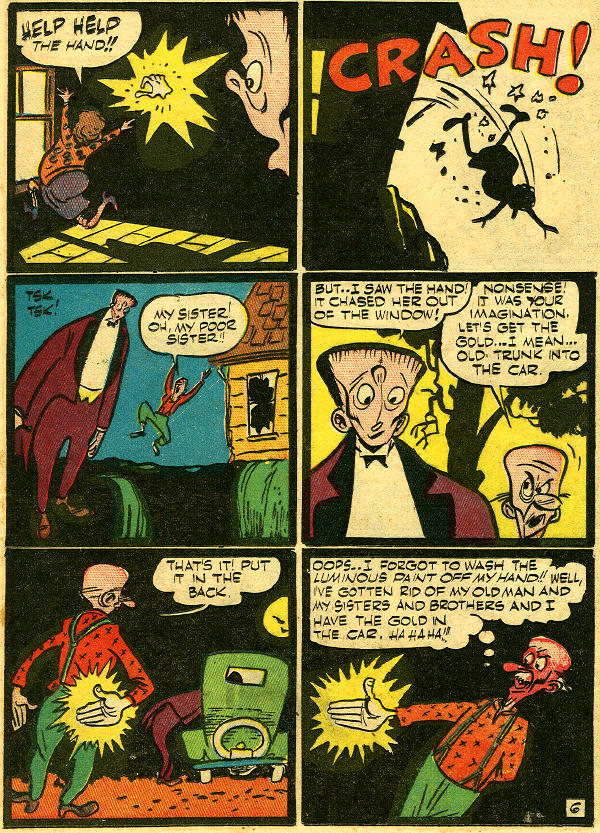
Frankenstein Friday: The Hand in the Night!


More Frankenstein lunacy written and drawn by Dick Briefer. The "Hand in the Night" is the third story from Frankenstein Comics #12, March-April, 1947.

Frankenstein is in the "advertising" business, and what he's advertising is part of the punch line to the story, which is actually the lead-in to an additional punch line about "Pancake Charlie." If you want to know what I'm talking about you'll have to read the story.


Tuesday, January 09, 2007


Number 79


Harvey Kurtzman and Will Elder present Elvis Presley in Jailbreak Rock!


Hey, happy birthday, Elvis. A day late, but happy birthday anyway.

Had Elvis lived he'd be 71. Wow. Who could imagine a gyrating, hip-swinging Elvis of 71? It'd be like Mick Jagger still rocking in his sixties, dancing around on stage. Whoops. Mick Jagger is still rocking in his sixties, so maybe if Elvis had lived past 40 he'd still be going, still throwing his weight around (ouch...that was mean) in Las Vegas.

In 1958 rock 'n' roll was still a mostly new phenomenon, although Elvis had been around for a couple of years and made his presence well known everywhere. Humbug, the little humor magazine owned by an artists cooperative consisting of Harvey Kurtzman, Jack Davis, Will Elder, Al Jaffee, Arnold Roth, et al., didn't miss a beat when it came to depicting Elvis. Jailhouse Rock was a huge hit, both as a song and as a movie, and this parody, short and succinct, captures both the look and feel of the movie and of Elvis' popularity.

Will Elder's artwork is great, even though it's hampered by the horrible printing Charlton Press did on Humbug. You can still see enough of it to see that a few years before Little Annie Fanny, he was still as great as he was in Mad. Every panel is as funny as anything he did for Mad, and as packed with gags as anything he ever drew. Check out the splash panel and the Teamsters band! Also check out the next to last panel of the story. The "band" consists of Jimmie Dodd and the Mouseketeers, Elvis has a copy of Mein Kampf by Adolf Hitler on his U.S. Army blanket, along with a copy of his draft notice. Pretty good for one small panel, and the whole story is like that!

The story is obviously written by Harvey Kurtzman. He didn't sign it but his signature style is all over it.

So, Elvis, wherever you are, hope you had a hunk-a, hunk-a birthday cake.


Saturday, January 06, 2007


 Number 78


George Evans And The Vanishing Hitchhiker


In a couple of Pappy's previous blogs we've shown some of the work that EC Comics' most revered artists did after the line folded. George Evans (1920-2001) found work in comic strips, but also did a stint at Gilberton for its Classics Illustrated line.

In 1960 when I picked up this issue of the Classics Illustrated World Around Us series, The Illustrated Story of Ghosts, I didn't know Evans' work. When I started collecting EC's and went back to this comic I put two and two together, that this was the same great artist. Evans' art is most easily recognizable by what fans spoke of as the "George Evans eyes." He used a mirror on himself to draw facial expressions, and apparently he had very expressive eyes.

When I read this comic originally it was the first time I'd encountered the story of the vanishing hitchhiker, which is one of the most venerable ghost stories in American folklore. As Page 7 of this story shows, the story has legs; it's been around a long time in many variant versions. Years later I read histories of the story in two great books, Things That Go Bump In The Night (1959), by the folklorist, Louis C. Jones, and The Vanishing Hitchhiker (1981) by Jan Harold Brunvand, a University of Utah professor who specializes in folklore. Both writers are excellent and I recommend these books for broad and very entertaining overviews of the story.


The Illustrated Story Of Ghosts version is told in a matter-of-fact narrative, without any excess dramatic flourishes. Its greatness lies in Evans' skill at illustration. His panels depicting a rainy night in a rural area are very evocative. You can feel the dampness and the cold. There are panels that tie into each other. In the top right panel of page 2 the girl and the doctor are both smiling, and yet in the final panel of the page they share exactly the same serious expression (presumably from Evans' mirror work). The girl's melancholy is easily read, and leads to the ultimate tragedy of the doctor's strange experience, as once again her parents are made to explain her death, just as they have done many times before.

Nineteen-sixties music fans will recognize a variation of this story as the basis of the song "Laurie (Strange Things Happen)" by Dickie Lee.

At the time this story was drawn Gilberton's pay rates were the about the lowest in the depressed comic book industry. Many artists (and at least a couple in this issue) took the easy road with little detail and unimaginative layouts, but George Evans probably couldn't draw that way. He gave it his best, and when George Evans was at his best hardly anyone was better.


Friday, January 05, 2007

Number 77


Frankenstein Friday: The Mold!


This story, the second from Frankenstein Comics #12, March-April 1947, is a slapstick story, light on dialogue with lots of sight gags.

The bilious looking mold reminded me of what happened when I replaced my kitchen cabinets and found toxic mold hiding behind them.

Makes you really want to read this story, doesn't it?

A mad scientist, looking for an evil form of penicillin (!!) turns himself, and most everyone around him, into mold. Which also reminds me. Are there any scientists in Golden Age Comics that aren't mad?

Enjoy the story…a real moldy oldie!


Sunday, December 31, 2006


Number 76


Ears Karpik: The killer who believed in divide and conquer!


I suckered in on this story, believing it was based on a true person, and true story. As crime comics go, it's fairly typical. It came from Atlas Comics' Justice #16 from 1950, and details the harsh life of a criminal right up until his end. In most cases in a crime comic the end came in the form of death, which was their "he got his just desserts" theme. This is no exception.

The sucker punch came when I encountered an ending so preposterous, so unlikely that I said a mental "Wha-----?" and looked at the splash page again. It says "Based on a true story," but in the type under the bottom tier of panels it says that this "true-to-life story" is fictitious, and the usual legal boilerplate that would keep them from being sued in case some real guy named Ears Karpik should get offended.

The art is serviceable, with no artist identified by atlastales.com.

What I like about the story is the criminal dialogue, which crackles along with slang like "playing chicky" (being a lookout) or "listeners" (for ears). Where it falls short is in its last two pages, when it tries for the surprise ending, and the unintended surprise turns out to be how far a plot can be stretched before it breaks apart.