Translate

Monday, September 08, 2014

Number 1628: Little Frankenclones

I love the little Frankenstein monsters created by a junkman using the notes of Dr. Frankenstein. But the little “clones” come with a serious flaw: prick them and they vanish!

This funny tale is cover-featured on Frankenstein #3 (1946). It’s by — who else? — Dick Briefer.

Briefer shows a magician named The Great Bruce. It is a caricature of Bruce Elliott, who helped Briefer write this issue. I don’t know a lot about Elliott except that he did some of the Shadow pulp novels, subbing for regular Shadow author Walter Gibson.

Briefer, who also did a comic strip for The Daily Worker, the Communist Party USA newspaper, takes a humorous dig at capitalism early in the story. Being a known communist in the postwar era would have presented a problem with the general public and certainly would have him on the FBI’s list. I don’t know if Briefer later changed his politics, nor do I know if his affiliation with the party was common knowledge amongst his peers or publishers.


Friday, September 05, 2014

Number 1627: “Om mani padme hum!”

We conclude our theme week, Heroes in Green, with a tale of Green Lama.

Don Markstein’s Toonopedia entry for Green Lama ends with, “To a comic book aficionado, however, The Green Lama will always be Mac Raboy's lithe figure gliding gracefully through the air, dressed in a streamlined version of a Tibetan monk's outfit.” Toonopedia goes into detail on the career of Jethro Dumont, wealthy playboy (like other superheroes) who was trained in Tibet (again, like other superheroes). Each of the 1940s incarnations of Green Lama, pulp magazine, radio, appearances in Prize Comics, had relatively short runs. The comic book version published by Spark, a small publisher, is, as Markstein said, known for the artwork by Emmanuel “Mac” Raboy, who had a clean and uncluttered style, and whose artwork adds much to any feature he worked on.

I have a question about this story. Why is Mr. Jerome, in Jerome Toys, serving drinks in his toy store? Is that a soda fountain or a bar we see?

From Green Lama #3 (1945):


Reader Darci went to Hakes and found a Green Lama decoder for that last panel. Here it is, and thanks, Darci!

Before I saw this a couple of other readers had figured it out on their own. Check the comments for the code-breakers’ results if you’re like me and too lazy busy to do it on your own.

Wednesday, September 03, 2014

Number 1626: I squid you not: the Green Hornet underwater

Number two of our theme week, Heroes in Green, presents a popular green guy, the Green Hornet. First popular as a radio program by the same folks who created The Lone Ranger, the Green Hornet spread his fame to comics, television and the movies.

Al Avison, another journeyman artist like Arthur Cazeneuve who drew Monday’s post, also worked in the Simon and Kirby gang. I believe Avison, like Cazeneuve, is a very underrated golden age artist. But there is at least one panel, page 12, panel 1, where either the word “octopus” was changed to “squid,” or maybe Avison didn't know the difference. What he drew in the panel is an octopus, not a squid. Here’s a giant squid:


That complaint observation out of the way, here is the soggy story from Green Hornet #31 (1946):


Here are two more Green Hornet stories. Just click the thumbnails.


Monday, September 01, 2014

Number 1625: How green was my hero

We’re having another theme week beginning today. I am calling it Heroes in Green Week, after costumed characters who use “green” in their names.

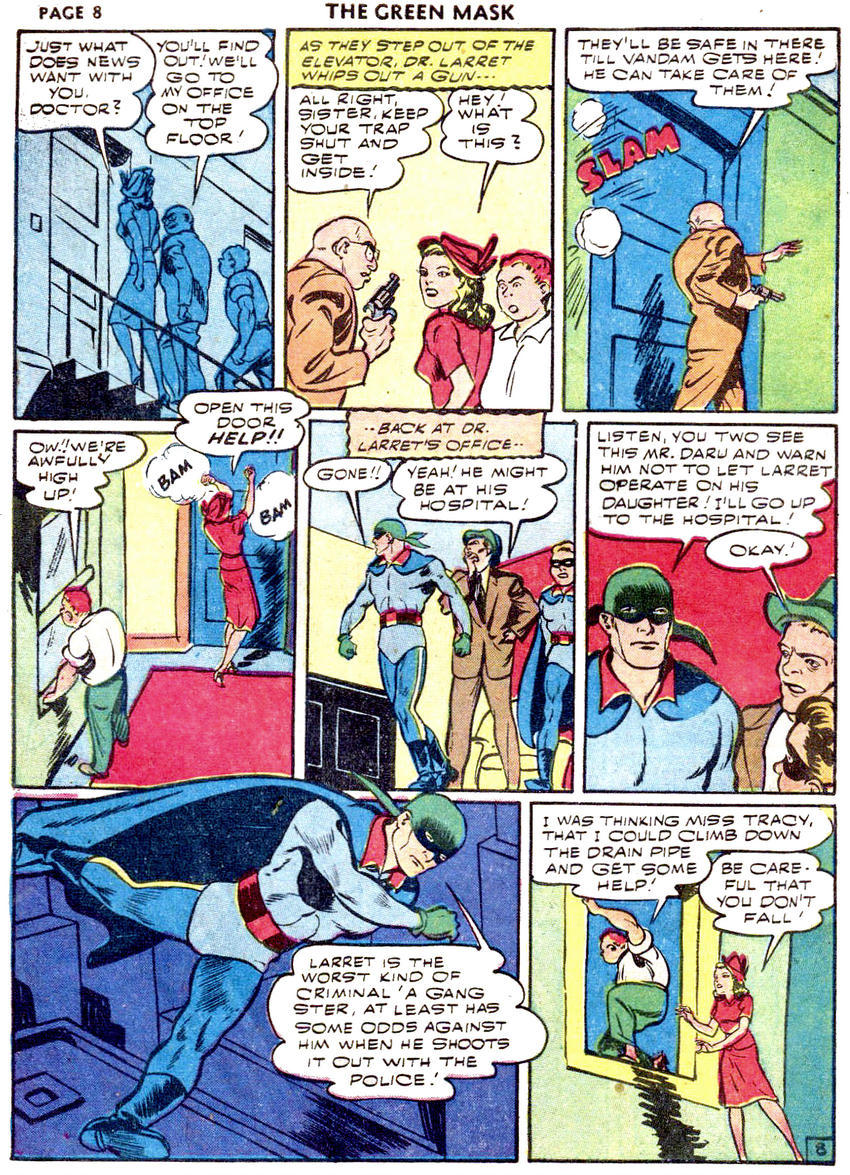
First up is Green Mask, who wears a green mask. By golly, that’s clever. He teams with “Domino, the Miracle Boy,” who wears a small domino mask. More cleverness!

The story, from Fox’s The Green Mask #9 (1942) is credited to Walter Frame. According to the Grand Comics Database the artist was Arthur Cazeneuve, another journeyman workhorse of the early comics. The GCD says Walter Frame was a pen name of Cazeneuve’s. But I believe that pen name came from the phonetic spelling of the name of the original artist, Walter Frehm.

I got an e-mail from reader, Darci, who let me know the following about the use of the pseudonym, Walter Frame:  “Comment #1 from Jim Van Dore 2015-02-01 --- Jerry Bails says Walter Frame is a Fox byline used for stories by several artists (including Frehm).  He also says Frehm was gone from this feature in
1940.  The blog notes that Frehm had earlier done the feature.”

Thanks, Darci, and thanks to Jim Van Dore.


Shown in February, a Green Mask story from Mystery Men Comics #3. Click on the thumbnail: