A couple of months ago I showed a post featuring a 1957 Mandrake the Magician continuity. That year my parents subscribed to a Seattle newspaper that featured the major King Features comic strips, including Flash Gordon Sundays by Emmanuel "Mac" Raboy. I don’t remember it specifically, but it was in the time frame I would have been reading it. And looking at Raboy’s artwork has a way of putting me back in touch with those gosh-wow feelings I had 60 years ago, when I would be the first one at the Sunday paper so I could read the comics.
These black line pages, courtesy of xxx Spax, who scanned them, were found on the Internet Archive. The sequence appeared on Sundays between September 8, 1957 and November 24, 1957.
Translate
Showing posts with label Mac Raboy. Show all posts
Sunday, June 18, 2017
Friday, January 01, 2016
Number 1835: Happy New Year from the haunted Captain Marvel Jr
As promised, you see above the new Pappy logo done by Jim Engel, a fantastic cartoonist and long one of my favorites. Thanks again go out to Jim for his generosity.
Now for our regular business:
Happy New Year. Wake yourself up this morning with hopes for a better, brighter future or dismay at a prospect of a grim year of more-of-the-same. And for better or worse, more old comics from Pappy!
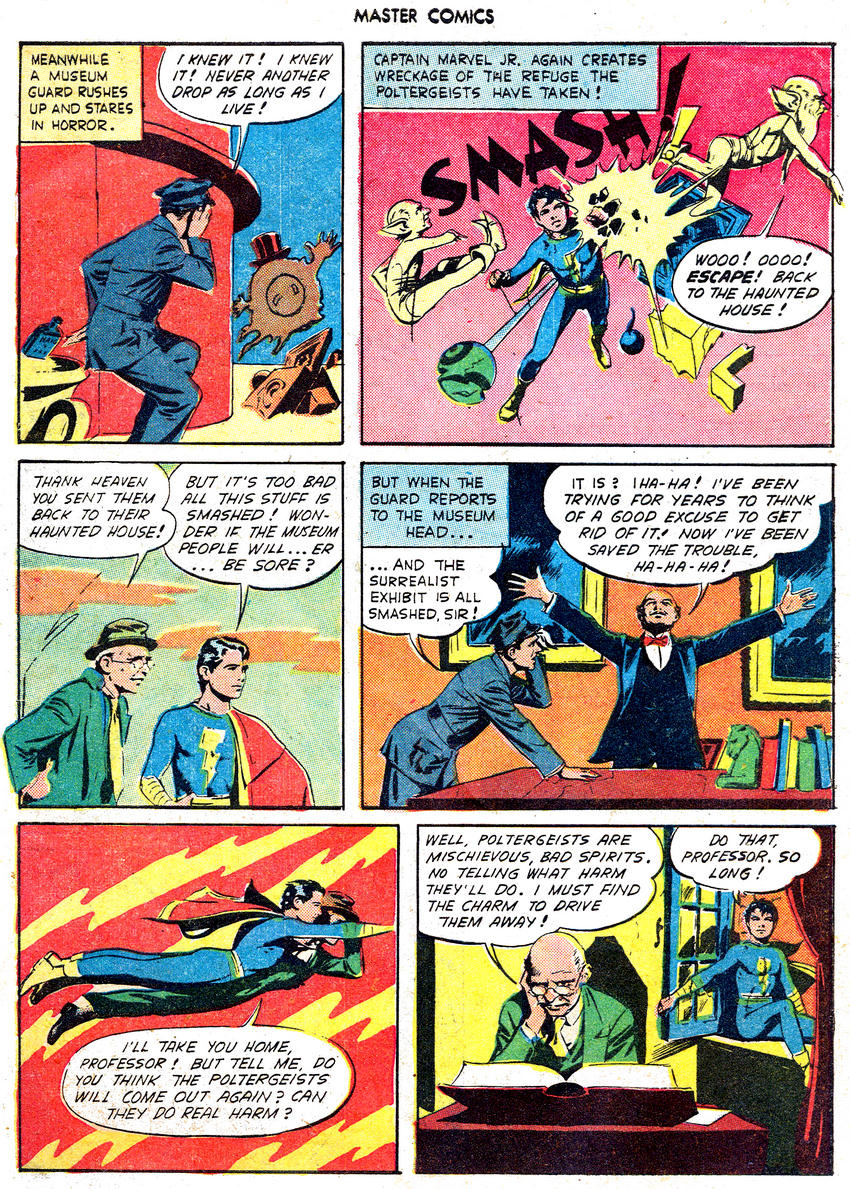
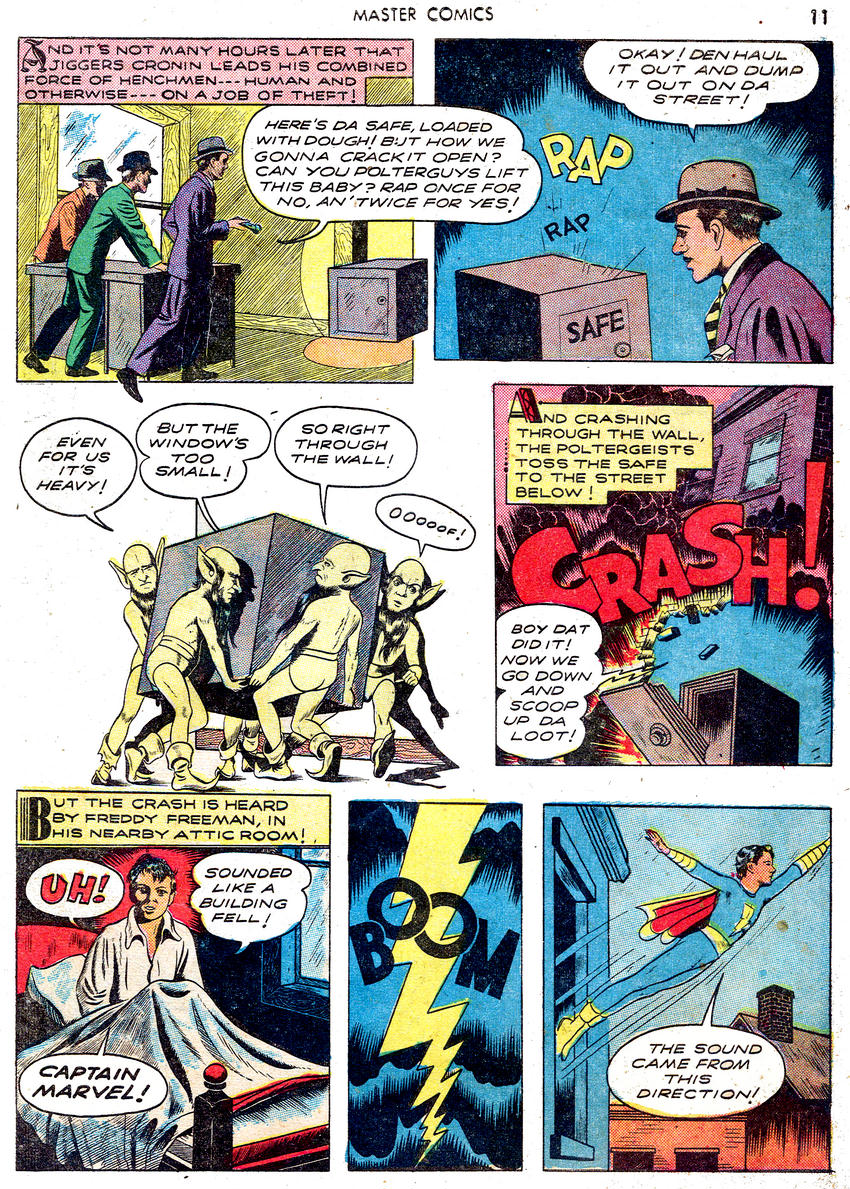
In the latter case, let us start out the year with Mac Raboy and Captain Marvel Jr. I showed this story, scanned from my copy of Master Comics #40 (1943), years ago, but recently re-scanned it. At the time of its original showing I opined that the look of the story seemed to back up what I read years ago (maybe in Steranko’s History of the Comics?) that Raboy was in the Navy, and drew comics in his spare time on board ship. He had so little room to draw that he drew the pages the same size as they were printed. If true, he did an excellent job in a difficult environment.
I also asked why there was an obvious paste-over on page 9, panel 3: “Dey say dis place is HANUTED!” Was “haunted” just misspelled, or was it intentional? No one ever offered an opinion. All these years later, as I still have no clue, it hanutes me, .
Now for our regular business:
Happy New Year. Wake yourself up this morning with hopes for a better, brighter future or dismay at a prospect of a grim year of more-of-the-same. And for better or worse, more old comics from Pappy!
In the latter case, let us start out the year with Mac Raboy and Captain Marvel Jr. I showed this story, scanned from my copy of Master Comics #40 (1943), years ago, but recently re-scanned it. At the time of its original showing I opined that the look of the story seemed to back up what I read years ago (maybe in Steranko’s History of the Comics?) that Raboy was in the Navy, and drew comics in his spare time on board ship. He had so little room to draw that he drew the pages the same size as they were printed. If true, he did an excellent job in a difficult environment.
I also asked why there was an obvious paste-over on page 9, panel 3: “Dey say dis place is HANUTED!” Was “haunted” just misspelled, or was it intentional? No one ever offered an opinion. All these years later, as I still have no clue, it hanutes me, .
Wednesday, September 09, 2015
Number 1785: The abominable snowbots
Sunday mornings, Bellevue, Washington, 1958...and the arrival of the Sunday newspaper. Mom takes the Women’s section, Big Pappy takes Sports, and I grab the funnies. Life is good. In that Sunday comics section: Prince Valiant, the Phantom, Mandrake, Blondie...and Flash Gordon.
At the time I was not familiar with Mac Raboy’s former work on Captain Marvel Jr or Green Lama, both for comic books. But a few years later when I encountered those Golden Age strips for the first time I knew instantly who Mac Raboy was. He was the artist who drew Flash Gordon, and he did it until he died at the young age of 53, in 1967.
I don’t usually show Sunday pages...I’m a comic book guy, after all, but I found these pages online. I wanted to share them, as well as thank the anonymous scanner who uploaded them. They appeared originally in newspapers from July 21, 1963 to November 17, 1963.*
*That was the Sunday before the John F. Kennedy assassination, on November 22, 1963. That is not pertinent to the comic strip, but when I see anything close to that date I place it in context of my indelible memories of that time.
At the time I was not familiar with Mac Raboy’s former work on Captain Marvel Jr or Green Lama, both for comic books. But a few years later when I encountered those Golden Age strips for the first time I knew instantly who Mac Raboy was. He was the artist who drew Flash Gordon, and he did it until he died at the young age of 53, in 1967.
I don’t usually show Sunday pages...I’m a comic book guy, after all, but I found these pages online. I wanted to share them, as well as thank the anonymous scanner who uploaded them. They appeared originally in newspapers from July 21, 1963 to November 17, 1963.*
*That was the Sunday before the John F. Kennedy assassination, on November 22, 1963. That is not pertinent to the comic strip, but when I see anything close to that date I place it in context of my indelible memories of that time.
Friday, September 05, 2014
Number 1627: “Om mani padme hum!”
We conclude our theme week, Heroes in Green, with a tale of Green Lama.
Don Markstein’s Toonopedia entry for Green Lama ends with, “To a comic book aficionado, however, The Green Lama will always be Mac Raboy's lithe figure gliding gracefully through the air, dressed in a streamlined version of a Tibetan monk's outfit.” Toonopedia goes into detail on the career of Jethro Dumont, wealthy playboy (like other superheroes) who was trained in Tibet (again, like other superheroes). Each of the 1940s incarnations of Green Lama, pulp magazine, radio, appearances in Prize Comics, had relatively short runs. The comic book version published by Spark, a small publisher, is, as Markstein said, known for the artwork by Emmanuel “Mac” Raboy, who had a clean and uncluttered style, and whose artwork adds much to any feature he worked on.
I have a question about this story. Why is Mr. Jerome, in Jerome Toys, serving drinks in his toy store? Is that a soda fountain or a bar we see?
From Green Lama #3 (1945):
Reader Darci went to Hakes and found a Green Lama decoder for that last panel. Here it is, and thanks, Darci!
Before I saw this a couple of other readers had figured it out on their own. Check the comments for the code-breakers’ results if you’re like me and toolazy busy to do it on your own.
Don Markstein’s Toonopedia entry for Green Lama ends with, “To a comic book aficionado, however, The Green Lama will always be Mac Raboy's lithe figure gliding gracefully through the air, dressed in a streamlined version of a Tibetan monk's outfit.” Toonopedia goes into detail on the career of Jethro Dumont, wealthy playboy (like other superheroes) who was trained in Tibet (again, like other superheroes). Each of the 1940s incarnations of Green Lama, pulp magazine, radio, appearances in Prize Comics, had relatively short runs. The comic book version published by Spark, a small publisher, is, as Markstein said, known for the artwork by Emmanuel “Mac” Raboy, who had a clean and uncluttered style, and whose artwork adds much to any feature he worked on.
I have a question about this story. Why is Mr. Jerome, in Jerome Toys, serving drinks in his toy store? Is that a soda fountain or a bar we see?
From Green Lama #3 (1945):
Before I saw this a couple of other readers had figured it out on their own. Check the comments for the code-breakers’ results if you’re like me and too
Subscribe to:
Posts (Atom)