Translate

Friday, July 12, 2013

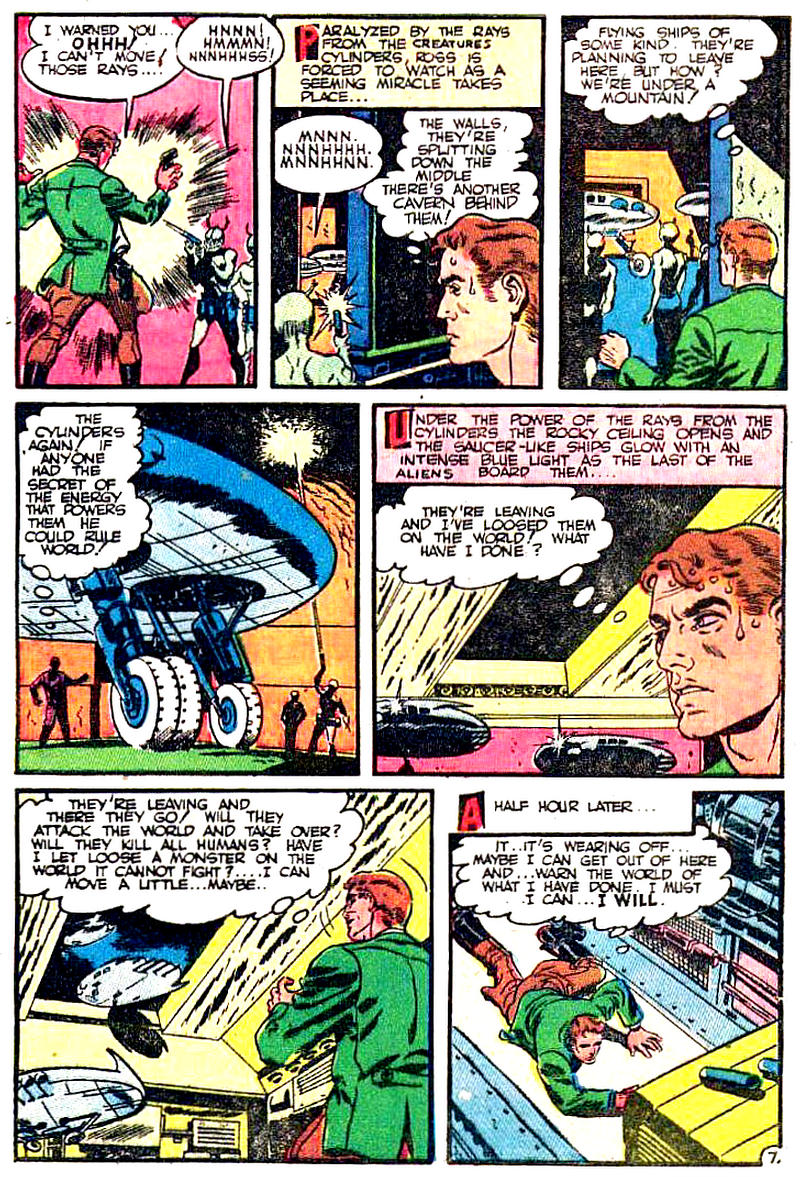
Number 1400: Wally Wood cracks the flying saucer mystery

I haven’t seen the book, Wally Wood Strange Worlds of Science Fiction, but I understand it reprints this 1952 Avon one-shot, Flying Saucers. It's a tale that I’ve seen reprinted elsewhere, also. You may have seen it. I don’t know about you, but when it comes to Wood, even if I’ve seen it before, I want to look at it again.

The story takes me back to the early fifties and speculation about the phenomenon of UFOs, then called flying saucers. The stories took flight (ho-ho) in 1947, when Kenneth Arnold, a salesman who piloted his own small airplane, spotted flying objects over the Cascade Mountains in Washington. The truth of what people are seeing has been up in the air (ho-ho-ho) ever since. It’s one of those fascinating enigmas that human beings lock onto, and has been the stuff of speculation and fiction ever since. The Avon comic reminds me of some of the things I read when I was a kid, and anxious to know what all the hubbub was about. There were many books and articles, and many of them gave their version of the “truth” about flying saucers. A few of the many “truths” I read:

The craft were piloted by beings from another world for the purposes of invasion, stealing our water or natural resources, protecting us from ourselves and our nuclear weaponry, or they were one of the lost tribes of Israel. Or flying saucers were not interplanetary: they were developed by the Nazis during World War II, or by the Russians, or secret weapons developed by our own country...

You could just about pick any theory and if it fit into your mindset you could claim it was the real secret of the flying saucers. All of the conflicting theories had their effect on me and the result was I quit reading them. If a UFO lands in the park close to my house and something alien steps out I'll believe. Until then I’ll just let fun stories like this entertain me without straining my brain.

The cover is credited to Gene Fawcette.


***********

More incredible early Wood. Just click the pictures.


Wednesday, July 10, 2013

Number 1399: Black Knight: hero or spineless lack-a-day?

Stan Lee portrayed the Black Knight’s alter ego, Sir Percy, in much the same way the alter ego of Zorro, Don Diego, was played by Tyrone Power in the 1940 movie, The Mark of Zorro. Foppish. Effeminate. The attitudes toward Sir Percy by the characters in the story are insulting, even physical. Modred whacks him with a glove (to which Sir Percy later says to Merlin, the one guy who knows he’s role-playing, “I’ll feel the sting of Modred’s glove till the day I avenge that insult.”) To Lady Rosamund Sir Percy is a “churl,” (I looked it up, it means a rude, boorish person, which Sir Percy is not, and I wonder if Stan threw it in because it looked good, no matter its meaning.) Earlier, in the Black Knight’s origin story (available by a link below this story), Lady Rosamund on first meeting Percy, is positively hostile: “How can you stay around here, like an old man or a woman . . .” (Emphasis mine.) I think you get my point. It was another era when it was okay to disrespect someone who was thought gay. Stan Lee may not have been aware that was what he was doing, or if he was he had no way of knowing it would be brought up by a churlish blogger nearly 60 years hence, forsooth (meaning “in truth.”)

Monday we featured an artist, Fred Fredericks, who could draw a variety of styles and genres, and at Atlas in the fifties that described Joe Maneely, a wonderful cartoonist who could draw anything, and was called upon by editor Lee to do so. Westerns to science fiction to humor, medieval knights to horror. All in a day’s work for Joe. One of the greatest tragedies of the golden age of comics is that Maneely died young, in an accident.

From The Black Knight #1 (1955):


**********

Here’s the other story from the comic, mentioned above. Click on the picture.


Monday, July 08, 2013

Number 1398: Herman Munster, Creepy Creature

Yesterday I featured a Mandrake comic drawn by Fred Fredericks; today even more by Fredericks.

Harold “Fred” Fredericks Jr was born in 1929 and became a cartoonist after the war. His work on The Munsters is some really fine work. Our knowledgeable friend, Alberto Becattini, who provides much information on Dell/Gold Key comics to the Grand Comics Database, credits Fredericks with not only the artwork, but the script and the lettering. About the only things not credited to Fred are the coloring and running the printing press. Fredericks is a man with several dimensions to his talent. Alberto also gives credit to him for the strip, “Liddle Wolfgang,” which is drawn in the style of Jay Ward’s Fractured Fairy Tales TV cartoons. I’m showing that three-page story, also. Fredericks had the gift for comic exaggeration, and it shows in both examples.

From The Munsters #4 (1965):