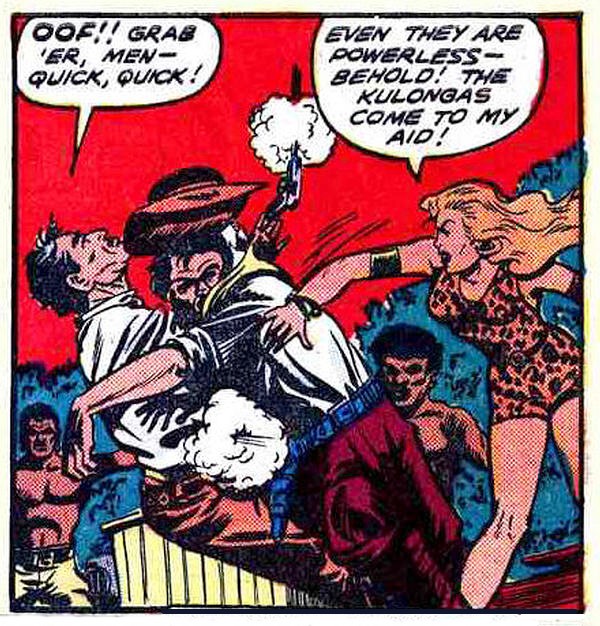
Sheena, Queen of the Jungle, was very popular during the 1940s. Fiction House, the publisher, aimed its comics at men, specifically young men, who liked looking at cheesecake artwork. They got that with Sheena, who was the first of many under-clothed, well-coiffed and shapely jungle women who followed her.
I have been looking for information on Robert H. Webb (who sometimes signed himself R.H. Webb or even Bob Webb), the artist during the greater part of Sheena’s comic book existence. I just can’t find out much, not even when Webb was born or died, or if he is still alive. What I found out in an online article here is that Webb did penciling and layouts, but did not draw the figure of Sheena. WHAT!? And here I have always imagined some comic book artist, not particularly well paid and yet working hard, finding satisfaction in being able to draw sexy females on every page. As the article explains, Webb worked for the Jerry Iger Shop, and the pages went through various artists’ hands for the drawing and then inker David Heames would, as the article states, “ink over the entire strip to obliterate any discernible differences in the different artist’s [sic] styles.”
The page also explains the comic book term “Good Girl Art,” or GGA. I first read the term in the '70s, and it can be read two ways: one, the pictures are of good girls, or two, the real meaning, is the artwork featuring girls is good, and in that case good means sexy. The term caught on, and it caught on because it was used to describe pin-up covers and artwork featuring women like Sheena.
Our story today is from Jumbo Comics #82 (1945).
Translate
Showing posts with label Sheena. Show all posts
Monday, July 02, 2018
Friday, May 27, 2016
Number 1898: Sheena makes her debut to American readers
Here is the third and last of our Jungle Jive week.
In an event best appreciated by Golden Age comic fans, scans of Jumbo Comics #'s 1-8 have been released by the Digital Comics Museum. In an introduction by Edward ‘Josh’ Petrie which accompanies the individual issues, the story (as much as is understood after 75 years) is told of Eisner and Iger's fledgling business, producing comics, and finding their first markets in Australia and the UK.
As the article says, Eisner was able to buy the printing plates for the issues published, and because of the large size, it made it necessary for Jumbo Comics to be larger than usual newsstand comic books. After those issues were printed, they went to a more regular comic book size. They also printed in one color, black, on a couple of different color papers. It was a bold experiment and luckily it worked. Jumbo was published until Fiction House went out of business in 1953.
Note: The first Sheena is printed on a bright orange paper, and it is hard on my old eyeballs. So I used my software and blew out the color, leaving just the black line on white background. If you want to see what it looks like, here is an example of page 31, the first Sheena page, as it appears in the comic book:
We are dropped into the Sheena story. A number in the first panel say “11” so are there 10 pages missing? Apparently Eisner wasn’t able to get all the printing plates, but it looks like the beginning of a storyline. The man who became Sheena’s “mate,” Bob, is introduced as he meets Sheena for the first time.
The issues of Jumbo Comics are very entertaining, and you can read them by going to the Digital Comics Museum’s Jumbo Comics pages. The art for Sheena is done by comics journeyman Mort Meskin.
In an event best appreciated by Golden Age comic fans, scans of Jumbo Comics #'s 1-8 have been released by the Digital Comics Museum. In an introduction by Edward ‘Josh’ Petrie which accompanies the individual issues, the story (as much as is understood after 75 years) is told of Eisner and Iger's fledgling business, producing comics, and finding their first markets in Australia and the UK.
As the article says, Eisner was able to buy the printing plates for the issues published, and because of the large size, it made it necessary for Jumbo Comics to be larger than usual newsstand comic books. After those issues were printed, they went to a more regular comic book size. They also printed in one color, black, on a couple of different color papers. It was a bold experiment and luckily it worked. Jumbo was published until Fiction House went out of business in 1953.
Note: The first Sheena is printed on a bright orange paper, and it is hard on my old eyeballs. So I used my software and blew out the color, leaving just the black line on white background. If you want to see what it looks like, here is an example of page 31, the first Sheena page, as it appears in the comic book:
We are dropped into the Sheena story. A number in the first panel say “11” so are there 10 pages missing? Apparently Eisner wasn’t able to get all the printing plates, but it looks like the beginning of a storyline. The man who became Sheena’s “mate,” Bob, is introduced as he meets Sheena for the first time.
The issues of Jumbo Comics are very entertaining, and you can read them by going to the Digital Comics Museum’s Jumbo Comics pages. The art for Sheena is done by comics journeyman Mort Meskin.
Wednesday, February 26, 2014
Number 1532: What about Bob?
Bob is some kind of unlucky guy, or maybe he’s just dumb...or maybe he plans it to prove Sheena’s love for him...but I’ll be damned if he doesn’t get in a lot of messes that force her to rescue him. In this case he’s being rescued from a witch doctor’s daughter who gives him a choice of being with her or being stomped by an elephant. I know what my answer in that situation would be, but Bob is more noble than that. Sheena is his woman, and besides, she rescues him at least every month in Jumbo Comics. Bob, who likes a strong woman, will stick with Sheena.
The witch doctor’s daughter appears to revive the dead, but she apparently also has the power to change her skin color. The splash page and end of the story show her as Caucasian, in the rest of the story she’s not. Did anyone check the colorist’s work before it went to the engraver? That is an editor’s job.
From Jumbo Comics #83 (1946), drawn by Robert Webb:
**********
More Sheena here. Just click on the thumbnails:
The witch doctor’s daughter appears to revive the dead, but she apparently also has the power to change her skin color. The splash page and end of the story show her as Caucasian, in the rest of the story she’s not. Did anyone check the colorist’s work before it went to the engraver? That is an editor’s job.
From Jumbo Comics #83 (1946), drawn by Robert Webb:
**********
More Sheena here. Just click on the thumbnails:
Sunday, November 03, 2013
Number 1465: Jungle royalty
Queen of the jungle and princess of the jungle are mighty highfalutin titles for women wearing abbreviated costumes and swinging through trees, wouldn’t you say? I guess it all started off with Tarzan, who was really England’s Lord Greystoke, and back home in Africa known as Lord of the Jungle. Sometime in the thirties when Sheena was created it sounded good to say “Sheena, Queen of the Jungle.” The name and title roll off the tongue. It wouldn’t sound right to have her called “Lady Sheena” or even a title like “Sheena, Duchess of the Jungle.” They just don’t have the same ring, do they?
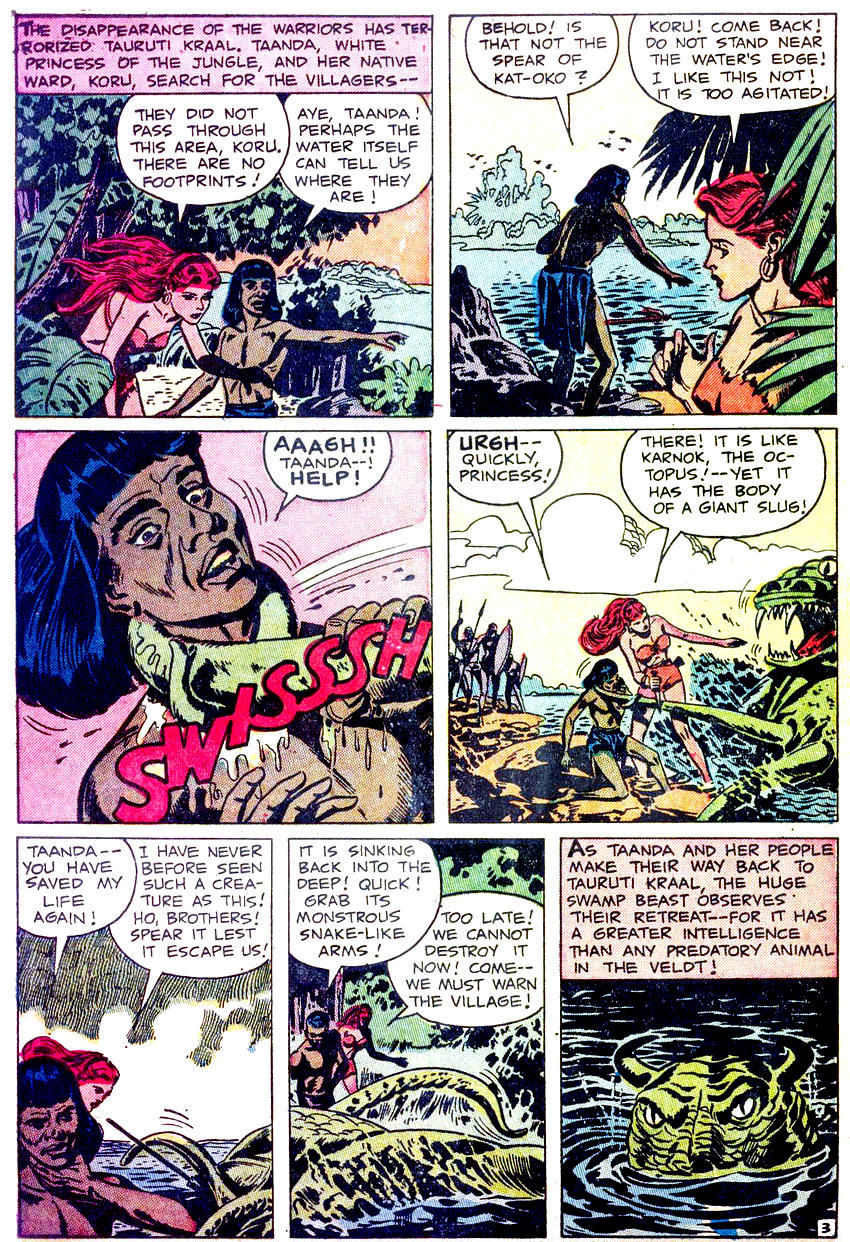
So Sheena was queen and Taanda, who came along later and could not be queen because Sheena was queen, was the white princess of the jungle. I’ve got stories featuring both of these royal jungle gals today.
Sheena’s story is from Jumbo Comics #101 (1947), and Taanda is featured in a cover story from Avon’s White Princess of the Jungle #4 (1952). The Sheena art is by Robert Webb, the Taanda artist is unknown by the Grand Comics Database.
So Sheena was queen and Taanda, who came along later and could not be queen because Sheena was queen, was the white princess of the jungle. I’ve got stories featuring both of these royal jungle gals today.
Sheena’s story is from Jumbo Comics #101 (1947), and Taanda is featured in a cover story from Avon’s White Princess of the Jungle #4 (1952). The Sheena art is by Robert Webb, the Taanda artist is unknown by the Grand Comics Database.
Wednesday, April 03, 2013
Number 1343: Sheena, I seen ya
This is the third entry in our Jungle Jive theme week.
When it came to blonde queens of the jungle, Sheena was the blondest and the queenest. She was the original, created by Will Eisner, with the beauty and attributes of female villains found in Eisner’s Spirit stories, wrapped in leopard-skins; a voluptuous woman holding court over her queendom of the jungle. Do not mess with Sheena, pal, because she will knock you out, then chase you off.
I wonder about her mate, Bob. I mean...Bob. My brother’s name is Bob. Bob is a perfectly good name, but to share a throne with a queen? Bob, King of the Jungle? I don’t think so. It’s no wonder Sheena keeps Bob kind of behind, under her protection. She is stronger, smarter and she has a wicked punch. She doesn’t need Bob to take care of the innumerable evil white men who invade her corner of the jungle. Unlike Greg, who is boyfriend to Lorna the jungle girl, whom we saw Monday, Bob isn’t a male chauvinist. He likes being submissive to his queen, and I’ve said this before: maybe a lot of guys who read Sheena during the '40s wished they had a big blonde woman to submit to. Perhaps a 6’2” Sheena could tuck me under her arm and swing me through the treetops. That wouldn’t be the worst way to spend a Sunday afternoon.
Drawn by Robert H. “Bob” Webb, from Jumbo Comics #127 (1949):
When it came to blonde queens of the jungle, Sheena was the blondest and the queenest. She was the original, created by Will Eisner, with the beauty and attributes of female villains found in Eisner’s Spirit stories, wrapped in leopard-skins; a voluptuous woman holding court over her queendom of the jungle. Do not mess with Sheena, pal, because she will knock you out, then chase you off.
I wonder about her mate, Bob. I mean...Bob. My brother’s name is Bob. Bob is a perfectly good name, but to share a throne with a queen? Bob, King of the Jungle? I don’t think so. It’s no wonder Sheena keeps Bob kind of behind, under her protection. She is stronger, smarter and she has a wicked punch. She doesn’t need Bob to take care of the innumerable evil white men who invade her corner of the jungle. Unlike Greg, who is boyfriend to Lorna the jungle girl, whom we saw Monday, Bob isn’t a male chauvinist. He likes being submissive to his queen, and I’ve said this before: maybe a lot of guys who read Sheena during the '40s wished they had a big blonde woman to submit to. Perhaps a 6’2” Sheena could tuck me under her arm and swing me through the treetops. That wouldn’t be the worst way to spend a Sunday afternoon.
Drawn by Robert H. “Bob” Webb, from Jumbo Comics #127 (1949):
Subscribe to:
Posts (Atom)