Translate

Showing posts with label Blonde Phantom. Show all posts

Friday, September 20, 2019

Number 2391: The cop and the kid and the Blonde Phantom

Wikipedia says of the Blonde Phantom: Louise Grant, born in Hoboken, New Jersey, was secretary to private detective Mark Mason. Enamored with her boss and wanting to help him break cases, she surreptitiously donned a black domino mask and a sexy, skintight, slit-leg red evening gown and high heels, and ventured out at night fighting crime. Highly athletic and seemingly trained in martial arts, the Blonde Phantom also carried a .45-caliber pistol. In a distaff echo of Superman and Lois Lane, Mason had a crush on the Blonde Phantom, but not on Louise.

In this story from Blonde Phantom #17 (1948), our heroine and a cop try to help a kid keep out of trouble. Juvenile delinquency was and is a problem. There have always been juvenile delinquents, but in the postwar world they were focused on, and some prominent adult observers blamed comic books for delinquency. It has been the experience in my lifetime that when young people commit crimes some “experts” look to popular culture for blame.

This story has no author listed by the GCD, but the artwork is credited to Syd Shores ? and Vince Alascia ? Those question marks mean the GCD does not know for certain. Nor do I.


Another Blonde Phantom story. Just click on the thumbnail.


Wednesday, August 06, 2014

Number 1614: Blonde Phantom and the two-person triangle

Blonde Phantom, the forties heroine from Marvel Comics, was one of those costumed types whose secret identity was in competition with her civilian identity. Blonde Phantom, Louise Grant and Louise’s boss, Mark, were the self-contained triangle. Unless Mark was just kidding about not knowing that Louise, even in glasses and buttoned up to the chin, was the sexy, evening-dress wearing Phantom.

Blonde Phantom was one of the postwar heroes created to sell comics in a rapidly changing market. Apparently she worked out for Marvel for about three years, and then was no more until a revival many years later, outside of the scope of this blog.

According to Don Markstein’s Toonopedia website, Black Phantom was created by Stan Lee and artist Syd Shores. The Grand Comics Database says this story was drawn by Allen Bellman. It appeared in All Winners Comics Vol. 2 No. 1 (1949), which was the last issue under that title.


Wednesday, June 26, 2013

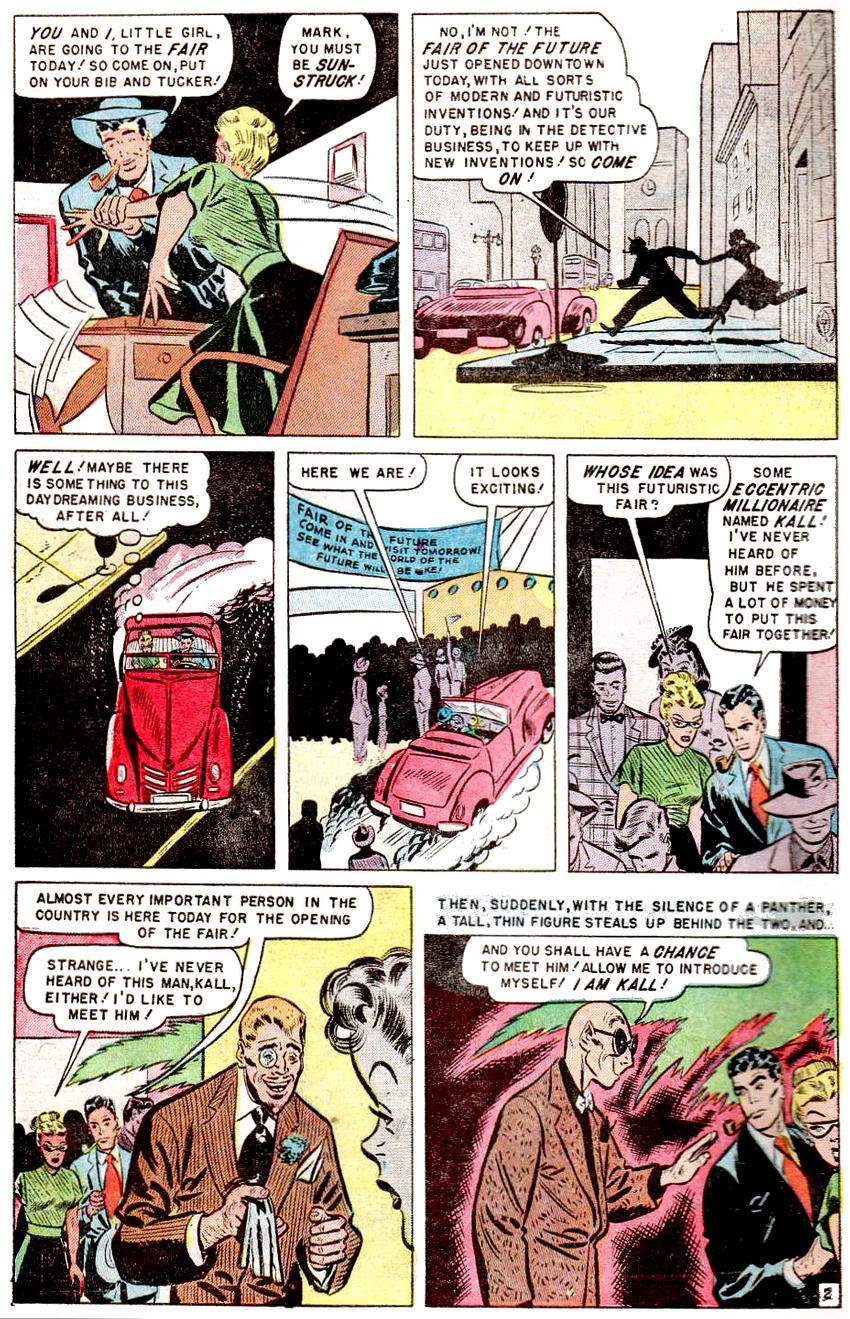
Number 1391: Kidnapped to the future!

Blonde Phantom, alter ego of mousy secretary Louise Grant, lusts after her boss, Mark. But like many comic book masqueraders, she finds herself in a love triangle with herself. Tsk tsk. My advice to Louise is to tell Mark — don’t keep secrets; they lead to mistrust. (Short lecture over.)

Louise and Mark are kidnapped by a group of future men who put them in a zoo to be studied by the thirtieth century citizens. If Louise had been a guy she would have just used brute force and whupped on the kidnapers. But Blonde Phantom uses her brain to overcome her adversaries...and she does it all in an evening dress and high heels. This entertaining story, from Marvel’s Blonde Phantom #21 (1949) is credited by the Grand Comics Database with art by Al Gabriele and Harry Sahle.


Sunday, November 07, 2010


Number 838


The man with the "S" on his chest


It's been too long since I posted a Bill Everett story, or a story about the character that got Everett started, Sub-Mariner. In this story Sub-Mariner is easy to spot, even in civvies, because he's got an "S" on his chest.

I notice that Namora wears no civilian clothes. She has a cloak which she wears over her sexy swimsuit. In the last panel Sub-Mariner is wearing a suit and tie, yet when being presented a medal Namora is still in her cloak.

It's obvious by looking at this strip from Blonde Phantom #17, Spring, 1948, that Everett had fun drawing. His villains are great. The "steward" at the bottom of page 3, and the bad guy with the piano teeth are very funny. His artistic approach in "The Case of the Deep Sea Swindle" leans toward comedic exaggeration, and I like it.