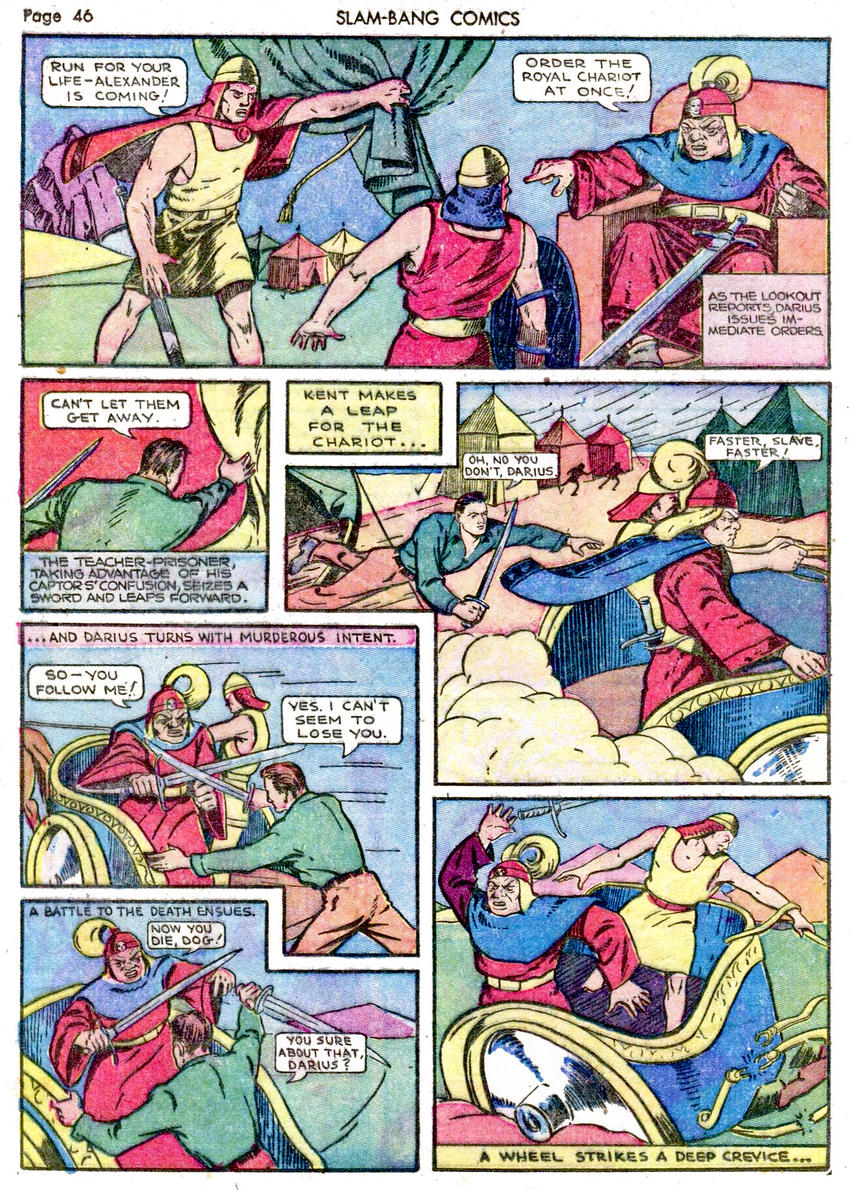
Mark Swift, no relation to boy inventor Tom Swift, is an orphan. He is taken care of by his elementary school teacher, Mr Kent, who just happened to invent a working time machine called the Time Retarder. Wow! Kent is wasting his time teaching. This was written and drawn in an era when it seemed okay to expose young children to danger. Mark, who looks about 10, and his “responsible” adult, Mr Kent, plop the Time Retarder down in the middle of a battle between King Darius of the Persians and Alexander the Great. I can only imagine what the Department of Child Services would have done if they had known that.
The feature was created by Jack and Otto Binder for Fawcett’s Slam-Bang Comics. Mark’s time (ho-ho) in comics was limited. Slam-Bang lasted only 7 issues, and after an inventory tale was published in Master Comics #7, Mark and his guardian zipped off to time and place unknown.
Grand Comics Database doesn’t guess at the artist or writer. From Slam-Bang Comics #6 (1940):
Translate
Wednesday, July 12, 2017
Monday, July 10, 2017
Number 2073: Too superstitious for love!
Jinx is aptly named. She is very superstitious and it makes her life a living hell of indecision and fear, especially when it comes to love. In some ways I am sympathetic to Jinx, having my own superstitions, but I was never superstitious about love. Superstition had nothing to do with relationships I sabotaged all on my own.
“Superstition Made Me Afraid to Love” is from Harvey Comics’ First Love Illustrated #3 (1949). (Those of you who read IDW’s Weird Love will recognize it as being reprinted in issue #13.) Comic art expert Jim Vadeboncoeur attributes the artwork to Tom Gill, who later got real lucky and landed the account to draw the Lone Ranger for Dell Comics.
Friday, July 07, 2017
Number 2072: Flash and the Spider-Men of Mars
A couple of months ago I showed a Golden Age Green Lantern story, and got the Earth One and Earth Two stuff mixed up. The original Flash and Green Lantern are from Earth Two. correct? I was a kid in 1961, standing at the comic book spinner holding Flash #123 with trembling hands, gawking at both versions of the Flash, Golden and Silver Age, together on the cover. Considering how important “Flash of Two Worlds” became in retrospect, I should know my DC Comics 101: Earth Two=Golden Age, Earth One=Silver Age.
In this tale from Flash Comics #24 (1941), the Flash, Jay Garrick, races to catch up to a spaceship heading for Mars with “healthy families” kidnapped to set up a Mars colony. The story gets screwier from there. Gardner Fox, who wrote it, went on to become one of the most revered comic book writers of the Silver Age, but “The Spider-Men of Mars” seems more of a fever dream than a story.
Artwork by E (for Everett) E. Hibbard.
From a Pappy’s posting in 2011, a two-part 1947 Flash story. Just click on the thumbnail.
Wednesday, July 05, 2017
Number 2071: Little Jacky, who never grew up
Uh-oh. I can “see” some of you readers, and the puzzled looks on your faces. You are wondering what I am showing today. A strip by a kid? It was the same problem of many readers (including me, age 11 1/2) when first encountering the Sunday-only comic strip, Jackys Diary, in January 1959.
Jack Mendelsohn (age 32 1/2 at the time) drew the Sunday page, and a one-shot comic book from Dell Comics in 1960. Mendelsohn worked in comics (including EC Comics’ Panic) and animation (among other things, he worked on Yellow Submarine). He was a talented artist and writer. Don Markstein’s Toonopedia website has a concise history of Jackys Diary, which, for whatever reason, became Jacky’s Diary (with apostrophe), both for the one-shot and the beautiful 2013 coffee table book produced by Craig Yoe and Clizia Gussoni, reprinting the three years of the strip.* As Mendelsohn explained it in the book, a Sunday-only strip was more expensive to maintain than a daily/Sunday combination, so King Features canceled it.
Jack Mendelson, (age 90), died this past January.
Panel two, just below, is hard to read under the purple ink. I have divined the caption for you: "Jack got scared the giant would eat him also so he tried to not make any noise inside."
*Still available, as of this writing. Highly recommended by me.
Monday, July 03, 2017
Number 2070: The original patriotic hero
Pep Comics lays claim to the original dressed-like-a-flag costumed hero, the Shield. He was prewar, but the first in a line of guys who wore their patriotism as American heroes.
According to the caption in the splash panel, only one person knows that Joe Higgins is the Shield, and that is the head of the FBI himself, J. Edgar Hoover! The Shield is a G-Man, who works for the FBI. They must’ve had a superhero division in the FBI at one time. Plastic Man worked for them, too.
I showed the origin of the Shield back in 2009, and you can see it by clicking on the link below.
From Pep Comics #3 (1940). Art by Irv Novick.
An origin of the Shield was featured in Shield-Wizard Comics. Just click on the thumbnail.
Subscribe to:
Posts (Atom)