Here is my second Sunday Supplement. As I mentioned before, I will try to get at least one Sunday posting each month, but don’t hold me to it.
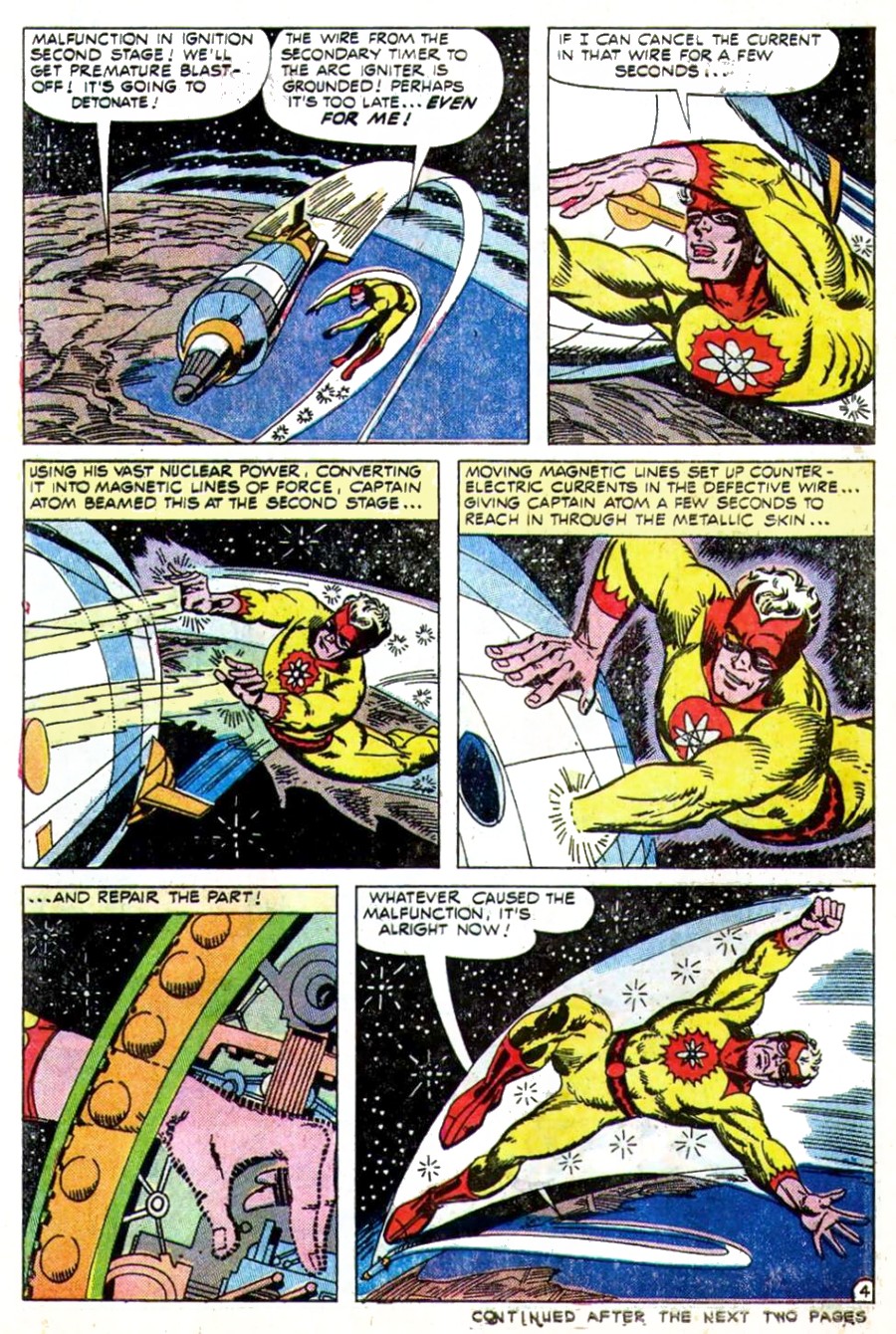
A few days ago I showed the origin story of Captain Atom, published by Charlton in 1960. It took over five years for the character to finally earn his own book. Captain Atom is actually Captain Adam, “a liaison between NASA and other government agencies.” In real time, then, Captain Atom was participating in the United States space program from the Mercury program to the Gemini program. Despite being a comic book fan, I recall those early days of space flight as being much more exciting than a superhero comic. In real life if astronauts got into trouble they didn’t have a superhero to rescue them.
The Marvel Comics house style had affected other comic book companies at the time, and the whimsical caption block at the bottom of page one of “The Gremlins from Planet Blue” reflects that. The story was written by longtime Charlton scripter Joe Gill, pencilled by Ditko, inked by Rocke Mastroserio, and lettered by Jon D’Agostino. But that is where the whimsy ends, and the rest of the story is straightforward science fiction superhero derring-do.
The three-page filler in the back of the book is by Ernie Bache, who was Dick Ayers’ assistant a decade earlier.
Captain Atom #78 is a continuation of
Strange Suspense Stories, so it is really issue #1, from 1965.