Translate

Friday, August 08, 2014

Number 1615: Dick Tracy, fit to be tied

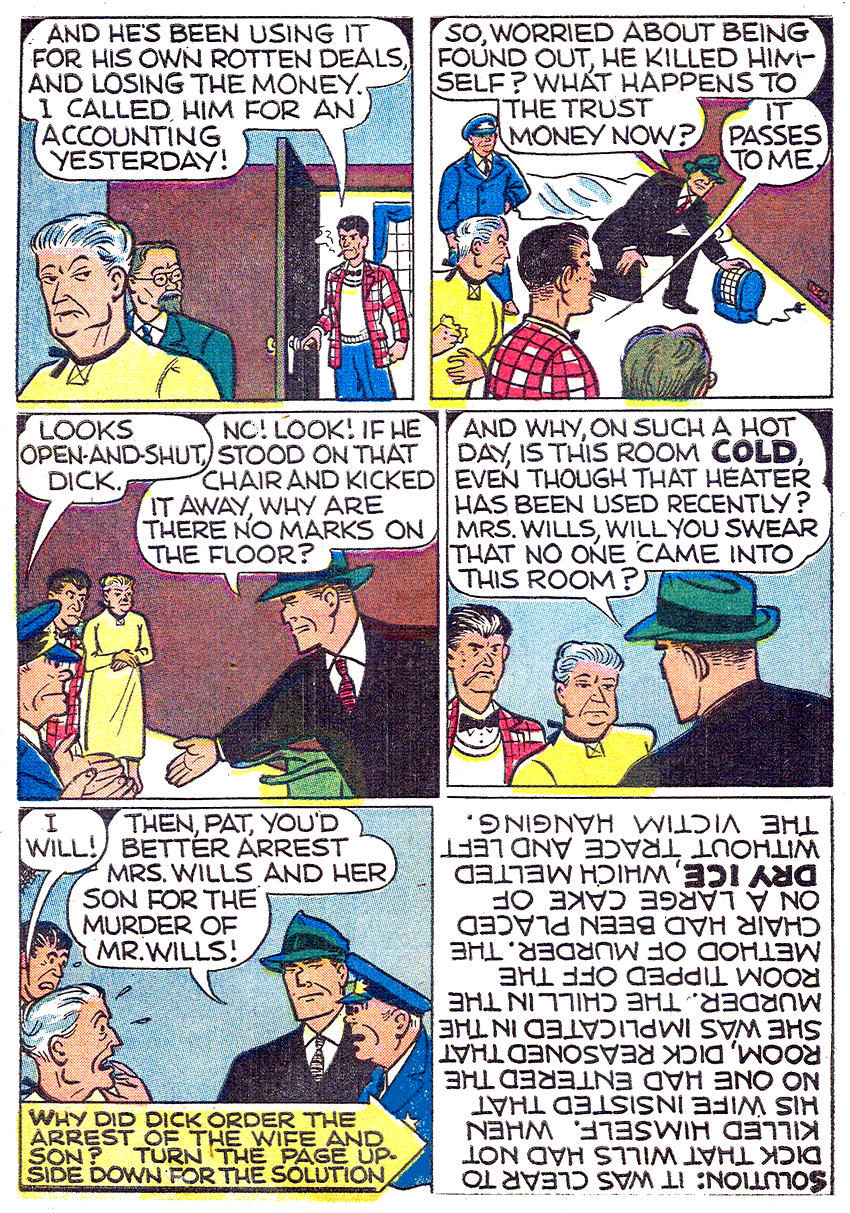
I like the Dick Tracy strips by Chester Gould, and even while following it for years in newspapers I was also catching up on past stories by reading reprints. There are a couple of things about the character, though, that bug me. Tracy is not very smart. He seems smart, maybe because his surrounding characters seem less smart, but his villains are smarter than Tracy. They catch him flat-footed (pun intended), and put him in death traps. The fact that Tracy escapes the death traps isn't because he’s smarter than the villain, it is because at that point the villain has some sort of mental lapse and decides a death trap is better than just shooting Tracy and getting him out of the picture permanently. (The legacy of the dime novel, no doubt, and cliffhangers of all types.) Of course by sparing Tracy the villain is soon dead. Justice in Dick Tracy’s world was doled out without lawyers, judges and courtrooms.

Dell had published Tracy reprints during the forties. In issue #19 of Dick Tracy Monthly they dropped the reprints and went with original self-contained stories written and drawn for the comic. This went on through issue #25, when Harvey Comics took over the license. Chester Gould, creator of Tracy, is not even mentioned. I find that incredible, but then, those were the days of the all-powerful syndicates, and apparently the Chicago Tribune Syndicate, which owns Tracy, did not think it was important to put Gould’s name on a story not by him.

The drawing seems to be from Gould’s studio, though. Like most successful cartoonists of the era Gould ran a stable of artists. I’ve never known of the exact division of labor, or if there was one. I assumed Gould had at least a hand in the writing, if not the whole process, and perhaps inked faces to keep a consistent look. “The Black Cat Mystery” is written and drawn anonymously.*

From Dick Tracy Monthly #20 (1949):


*The final three page story of “Sparkle Plenty,” is a humor feature. Sparkle, daughter of B.O. Plenty and his wife, Gravel Gertie, had been introduced in 1947, and was a licensing and merchandising joy for the syndicate. You can read a later Sparkle Plenty story in a Harvey Comics reprint. Just click on the thumbnail:


Wednesday, August 06, 2014

Number 1614: Blonde Phantom and the two-person triangle

Blonde Phantom, the forties heroine from Marvel Comics, was one of those costumed types whose secret identity was in competition with her civilian identity. Blonde Phantom, Louise Grant and Louise’s boss, Mark, were the self-contained triangle. Unless Mark was just kidding about not knowing that Louise, even in glasses and buttoned up to the chin, was the sexy, evening-dress wearing Phantom.

Blonde Phantom was one of the postwar heroes created to sell comics in a rapidly changing market. Apparently she worked out for Marvel for about three years, and then was no more until a revival many years later, outside of the scope of this blog.

According to Don Markstein’s Toonopedia website, Black Phantom was created by Stan Lee and artist Syd Shores. The Grand Comics Database says this story was drawn by Allen Bellman. It appeared in All Winners Comics Vol. 2 No. 1 (1949), which was the last issue under that title.


Monday, August 04, 2014

Number 1613: Frankenstein’s terror under trance!

You already know this, don’t you? If not, the funny Frankenstein character published by Prize Comics ended its run with issue #17 in 1949. A couple of years later the character was resurrected n a more serious version, more like the Karloff monster of the movies. In the latter version the Frankenstein monster is mute, shambles along from town to town, country to country, getting involved in local doings, supernatural and otherwise.

This story, the lead for Frankenstein #19 (1952), has the monster under hypnotic control. It is drawn by the versatile Dick Briefer, whose career as a journeyman comic book artist would end when Frankenstein ceased publication in late 1954. The specter of another monster — the Comics Code Authority — finally did to Frankenstein what no mob of torch-waving villagers could do.


Friday, August 01, 2014

Number 1612: The Marvel Man

Martan, who came to Earth for a honeymoon with his bride, Vana, decided to stick around. They had encountered another bunch of aliens who had attacked our planet, so Martan, called the Marvel Man, helped to fight them off.

Martan was yet another spaceborn type who landed on our planet, and out of all the countries ended up in America. He and his spouse decided to defend that country over all others. My fellow Americans...we have been really lucky that way in the comics, eh?

This character was part of a wave of superheroes in Dell Comics’ Popular Comics, which lasted for a couple of years until Dell decided to dump the super people and go to licensing funny animals and such. They did that so well that they got away without the usual superheroic contents of most comics of the era (1939-42 or so). In Martan and Vana’s case, they appeared in issues #44-71. The writer of the story is credited as G. Ellerbrock, and the artist is unknown. E. C. Stoner, who did the cover, was also part of the art movement known as the Harlem Renaissance.

From Popular Comics #59 (1941).