Translate

Wednesday, August 08, 2012

Number 1206: Captain Science and the Flower of Death!

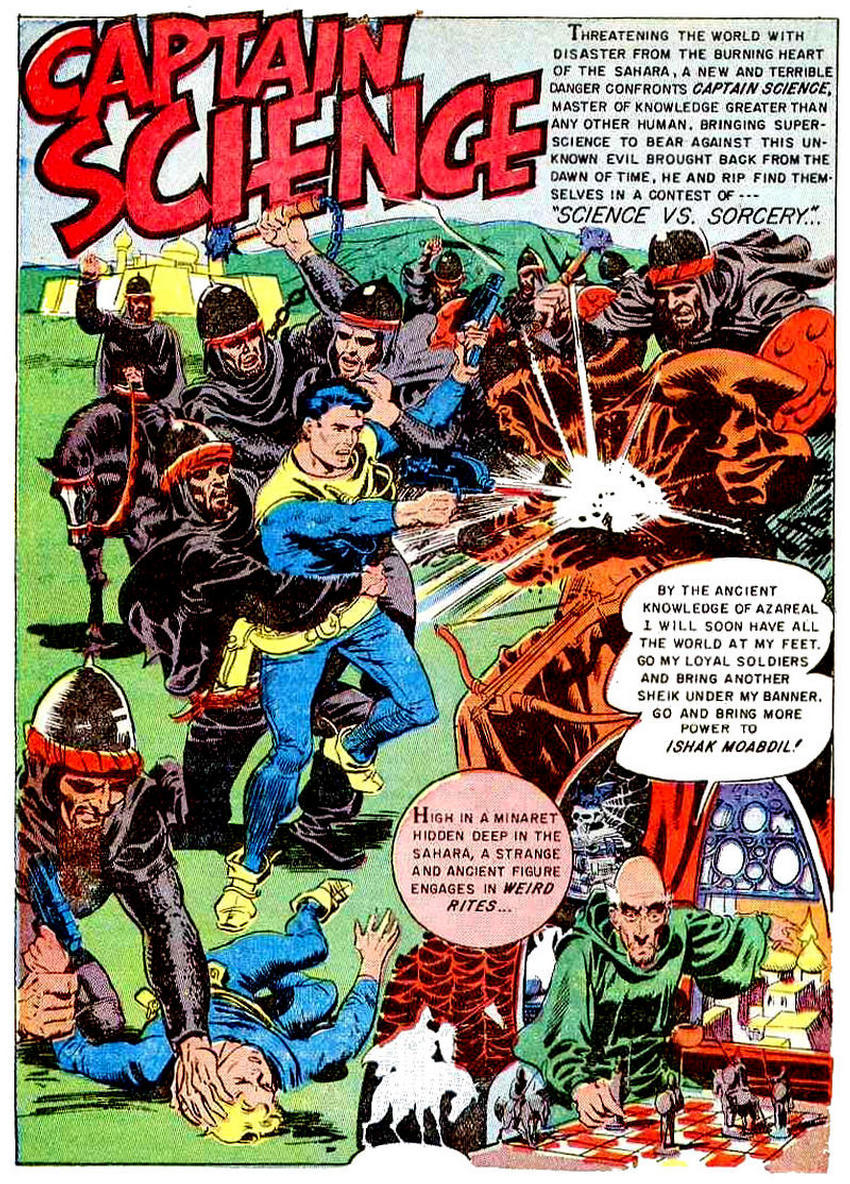
I showed “The Flower of Death,” a few years ago. I’m re-presenting it with new scans. What I said about it then was that it was a story I chased for years without knowing what it was. I’d seen it when I was very young, maybe six-years-old, at a friend’s house. Despite being surrounded by two very cool Wood and Orlando Captain Science stories, what I remembered about the comic book was the transition of flower to ape. People write me sometimes and ask if I can help them identify a story they remember, and without fail I can't. I can't even help myself. This was a story stuck in my memory for many years that I couldn't find, and then one day opened up Captain Science #5 and there it was. Eureka!

Except...it's not much of a story. Artwork is serviceable, credited by the Grand Comics Database in their question mark fashion as being by Bill Fraccio? and Vince Napoli? So they're not sure. I wondered about the clumsy transition panels (which look like photostats), flower to ape and ape to flower, and then I found the origin of it in a gasoline ad from a 1950 issue of Life. This is another of my discoveries in Life that later turned up in comic books.


I've also included a Captain Science story from the issue because I love this Joe Orlando-Wally Wood science fiction and so do you. These are my scans from the original comic, but the story is also included in the book Wally Wood: Strange Worlds of Science Fiction, edited by J. David Spurlock. It's a trade paperback available from Amazon.com, among other bookselling sites, and if you're fortunate, at your favorite local comic book shop.

From Captain Science #5, 1951:


Monday, August 06, 2012

Number 1205: Subversive love

This story has a pretty clear message: rich people are bad to hardworking common people. That sounds a lot like pinko talk, doesn't it? Except we are still having a discussion in America about rich vs. poor. I doubt it will ever be resolved, but while the rich would like us commoners to believe that speaking up for one's economic class is tantamount to treason, we're less interested in sedition and just trying to get our slice of the American pie, nowadays sliced pretty thin.

Cattlemen against sodbusters! I watched stories like that in many cowboy movies when I was growing up. The movies demonized bankers and rich cattlemen because as little as the poor sodbusters had, the greedy bastards wanted it all! Bankers were hard hit because they were looked at with suspicion by the generation who came out of the Great Depression, including the people who wrote and drew comic books. This tale, where love trumps wealth, is from Quality Comics Range Romances #1 (1949), It's credited by Heritage Auctions and the CGC people as being by Paul Gustavson. The Grand Comics Database has ? for the artist.


Friday, August 03, 2012

Number 1203: Sign of the Hangman


The Hangman (Bob Dickering) had an interesting gimmick. When he cornered the guy he was after the shadow of the gallows fell on the felon's face. I wondered how he did that...then I watched one of those “reality” shows where we’re not supposed to think about a platoon of cameramen, lighting techs, sound guys, etc., following these “real” people around in their “real” daily endeavors. Maybe Hangman had a lighting guy who stood over his shoulder, and when the time was right would hold up a tiny gallows in front of a powerful light. Okay...so it’s a comic book and they don't have cameramen. I just needed to get that out, because Hangman's gimmick always bugged me, and if they explained it in any of the Hangman stories I've missed it (or forgotten).

This story, which comes from Pep Comics #34 (1942) is a good example of the series. Bob Fujitani, working in his early style with overtones of Will Eisner’s influence, drew some very dynamic and dramatic pages. There's even a scene of a guy getting shot through the head, which wasn't exactly typical of these stories, but gory stuff did happen. M.L.J. Magazines, Inc., publishers, was into the action, violence and horror that appalled parents and grownups across America. They also sold to servicemen who were more likely to handle this sort of thing, but it was the kids everybody worried about. After a time the line began concentrating on their teenage comics and out of bloody M.L.J. cleancut Archie Comics was born. Well, cleancut compared to this episode of Hangman. I remember some sexy stuff going on in Archie, but no one got a bullet through the brain.

I'm including a page on editor Harry Shorten. Shorten did comics, paperback book publishing, a comic strip (“There Oughta Be A Law” with Al Fagaly) and then comics again in the sixties with T.H.U.N.D.E.R. Agents. All of that was ahead of Shorten when this biography was written, but you can see from it that Shorten took to the industry early on.


Wednesday, August 01, 2012

Number 1202: Star of radio and television


As a feature, “Roy Raymond, TV Detective,” lasted a long time in Detective Comics, 1949 to 1961. For the first few years the feature was called “Impossible -- But True!” with art chores handled originally by Ruben Moreira. The strip's name change came in 1953. Roy Raymond had a busy career, spanning radio and then television. He was a professional debunker, whose investigative powers would be used to expose fakers. In his very first tale, shown here, Raymond is challenged by stories of a valley where people instantly age fifty years (gee, the story of my life!) and the second puts Roy underwater with a group of mermen.

Moreira, who also used the name Rubimor to draw the Sunday comic strip Tarzan in the mid-'40s, both penciled and inked. Moreira was born in Puerto Rico. He moved back in 1958 and mailed in his work. In 1962 Moreira quit comics. He died in 1984.

From Detective Comics #153 (1949) and #252 (1958):