Translate

Showing posts with label Rudy Palais. Show all posts

Wednesday, November 03, 2021

Number 2571: Magno and Davey, and their personal magnetism

Little Davey Landis is a big fan of Magno, the Magnetic Man. Davey’s sister makes him a Magno costume, and by golly, it leads to him palling up with Magno himself, in his magnetic flesh. Gosh. Davey becomes yet another youthful sidekick of an adult superhero, exposed to danger from Magno's enemies.

I consulted the Public Domain Super Heroes website, wondering if Davey was hanging around with Magno, but without his idol’s magnet powers. Here the PDSH assures us that “At first, Magno had to ‘magnetize’ Davey every time they had to fight crime, but eventually, the recharges became unnecessary and Davey was able to use magnetic powers 24/7. ”

The website also told me that Magno (and Davey, when he joined his hero) first appeared in 1940 from Ace Periodicals. The feature was featured in Super-Mystery Comics #4-29, and Four Favorites #1-26.

This story, drawn by Rudy Palais, is from Four Favorites #20 (1945):


Friday, July 20, 2018

Number 2209: “Dam the rotten luck!” Murder morals in a crime comic

Joseph Federal is a very bad man. He strangles women for money. In “Joseph Medley Lady Killer,” from Murder Incorporated #3 (1948), he curses his luck after killing a young woman: “She wasn’t lying I know! That money is nowhere in this room. Dam the rotten luck!” Yes, the word “damn” was deliberately misspelled.

The story was reprinted four years later in Shock Detective Cases #20,* and “dam” was replaced by a standard comic book “#*@*”, using symbols to replace cursing. Showing murder wasn’t forbidden...just some mild swearing.

 Original printing, 1948

Censored, 1952.

The original version was published by Fox, and came from the height of the crime comics boom in 1948. It was the sort of thing that got parents, teachers, and guardians of public morals in a dither. I don’t think Dr Wertham ever saw this, because if he had he could have easily used several panels in his book, Seduction of the Innocent, to show how brutal crime comics could be. Sexy, too. L.B. Cole, editor of Shock Detective Cases, in a couple of panels had the dresses extended to appear more modest. This is the world of editorial decision-making: what an editor thinks goes too far, and how to fix it.

Artwork, signed by Carter, is actually by Rudy Palais. Palais, who died in 2004, was an early comic book artist who had work in various genres, including crime and horror. His artwork for Harvey’s horror comics line is known for the sweat drops flying off characters’ faces, although his style is so distinctive I don’t need sweat drops to identify it


Wednesday, September 06, 2017

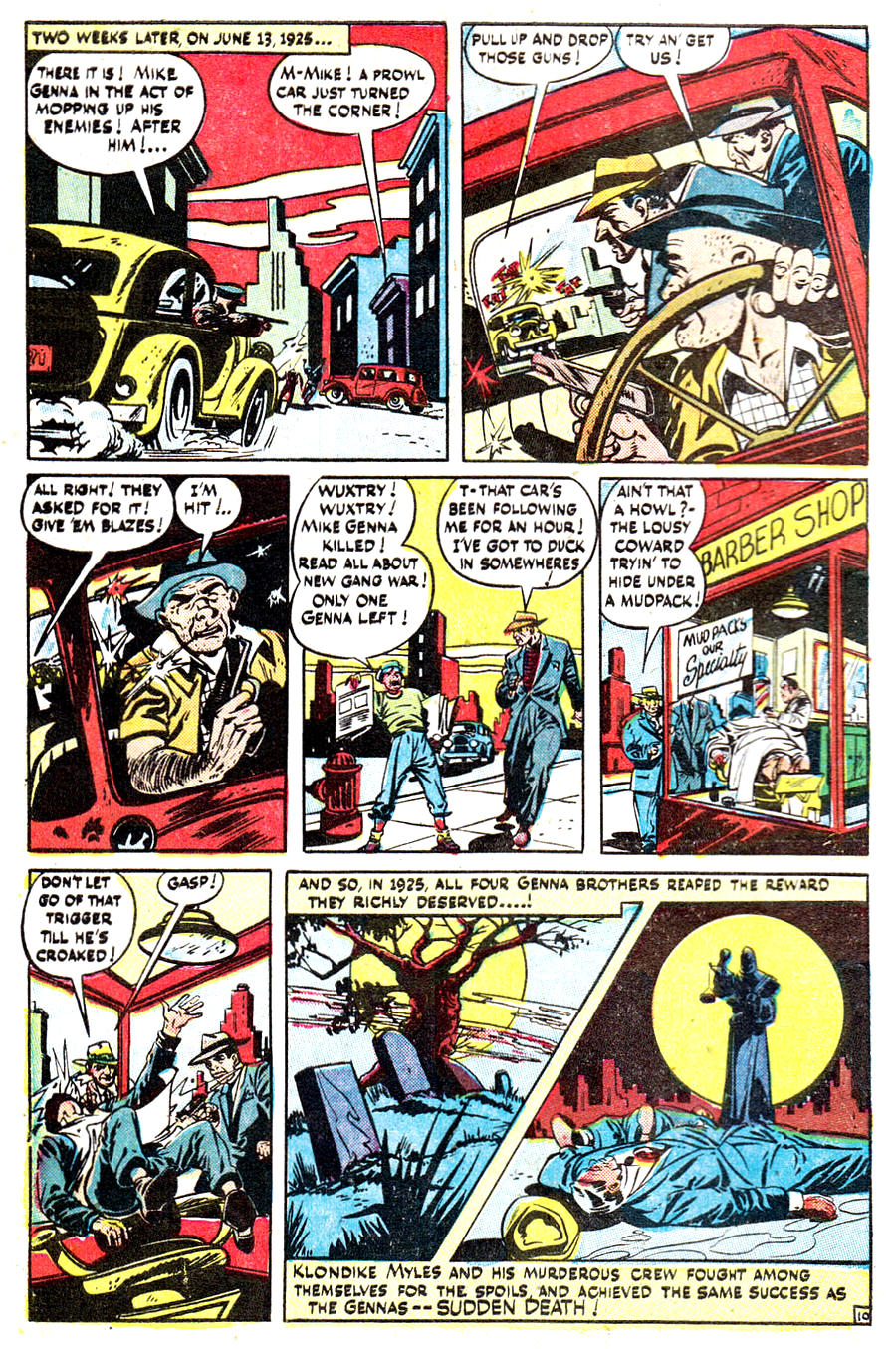
Number 2098: The Terrible Gennas

The Genna Brothers were prohibition-era gangsters operating in Chicago in the early 1920s. It was a violent era and each of the brothers came to a violent end. Despite their reputations at the time, after death the “Terrible Gennas,” as newspapers of the day called them, have been mostly forgotten. Especially after Al Capone took over the rackets.

The Gennas, from Sicily, had the American entrepreneurial spirit for their criminal enterprise. While other gangs owned breweries, the Gennas set up stills in the apartments of fellow immigrants. While a centralized brewery could be shut down, a whole lot of home-brewers could not. The Gennas paid the people $15 a load, not a bad payday for the times. Of course, the Gennas were reaping much greater financial rewards. And by having other people do their manufacturing, the Gennas did not face the risks of the folks making the illegal brew. Sometimes the stills would explode, sending shrapnel into hapless amateur brewers. It reminds me of the meth cooks of today, some of whom blow themselves up. “No risk, no reward,” I have heard.

Rudy Palais drew the story for Ace Comics’ Crime Must Pay the Penalty #4 (1948).


**********

GOODBYE TO FOUR-COLOR SHADOWS

On a personal note, Steven Thompson, known as Booksteve, has closed his Four-Color Shadows blog. Since 2010 Steve has kept a steady stream of Golden Age material popping up in his blog. Steve is leaving his blog’s archive online for the time being.

I want to wish Steve the best of luck on his future projects, one of which is Steve’s current book compiled from his pop culture blog, The Best of Booksteve’s Library, available now. Check his website for details.

Friday, March 24, 2017

Number 2027: The fighting Captain Fight

Fiction House, like most comic book publishers of the early forties, had some superheroes. Fight Comics, one of their main titles, featured Super-American, whom we have shown in this blog, and for a short time a second patriotic hero, Captain Fight. The patriotic Captain Fight lasted just four issues (Fight Comics #16-#19). I don’t see a lot of originality in the first story, but the art, credited to Rudy Palais, is action-packed. The artist poured a lot into his work.

Captain Fight was a high school athletic coach, Jeff Crockett, and what’s this? He was recognized by one of his students, Yank Adams, who became his sidekick. We have spoken before of comic book characters who don’t recognize their friends or relations in a flimsy mask (even no mask), and I have questioned if they have face blindness. Yank sees right through Jeff’s mask! Yank is a smart guy. Along with great powers of observation, he even has a ham radio license.

We learn in the story that "Murder is fashionable in Freeville," and not only murder, but torture. The Nazis string both Captain Fight and Yank up by their thumbs. Based on the benign expressions on their faces they must have really strong thumbs. I would be shrieking with pain before passing out, mostly from the knowledge I'd never be able to again hold a soup spoon. Jeff and Yank, though, are heroes, and apparently impervious to torture.

Despite this Captain Fight being short-lived, Fiction House introduced another Captain Fight in issue #44. He was a buccaneer who lasted though issue #69.

From Fight Comics #16 (1941).


Monday, January 11, 2016

Number 1834: Doll Man, conked by the Black Gondolier

In the United States research is ongoing into the problem of head trauma. Not only from accidents, combat injuries and assault, but also concussions from sports injuries. Unlike old movies, detective novels and television shows where the hero often gets some blunt force applied to his noggin and comes out with little more than a headache, it is a serious problem which leads to permanent consequences. So when the Black Gondolier of this episode from Doll Man #1 (1941) knocks Doll Man unconscious, the tiny hero is lucky the villain didn’t take his head off, much less cause him some major brain damage.

That is what being a superhero is all about! They can dish it out, and they can take it! The Black Gondolier, though...he isn’t so lucky. He is a one-and-done bad guy (sorry for the spoiler).

Artwork credited by the Grand Comics Database to Rudy Palais, who put a “?” after his name because they aren’t sure.


Here is another story from Doll Man #1. Just click on the thumbnail.