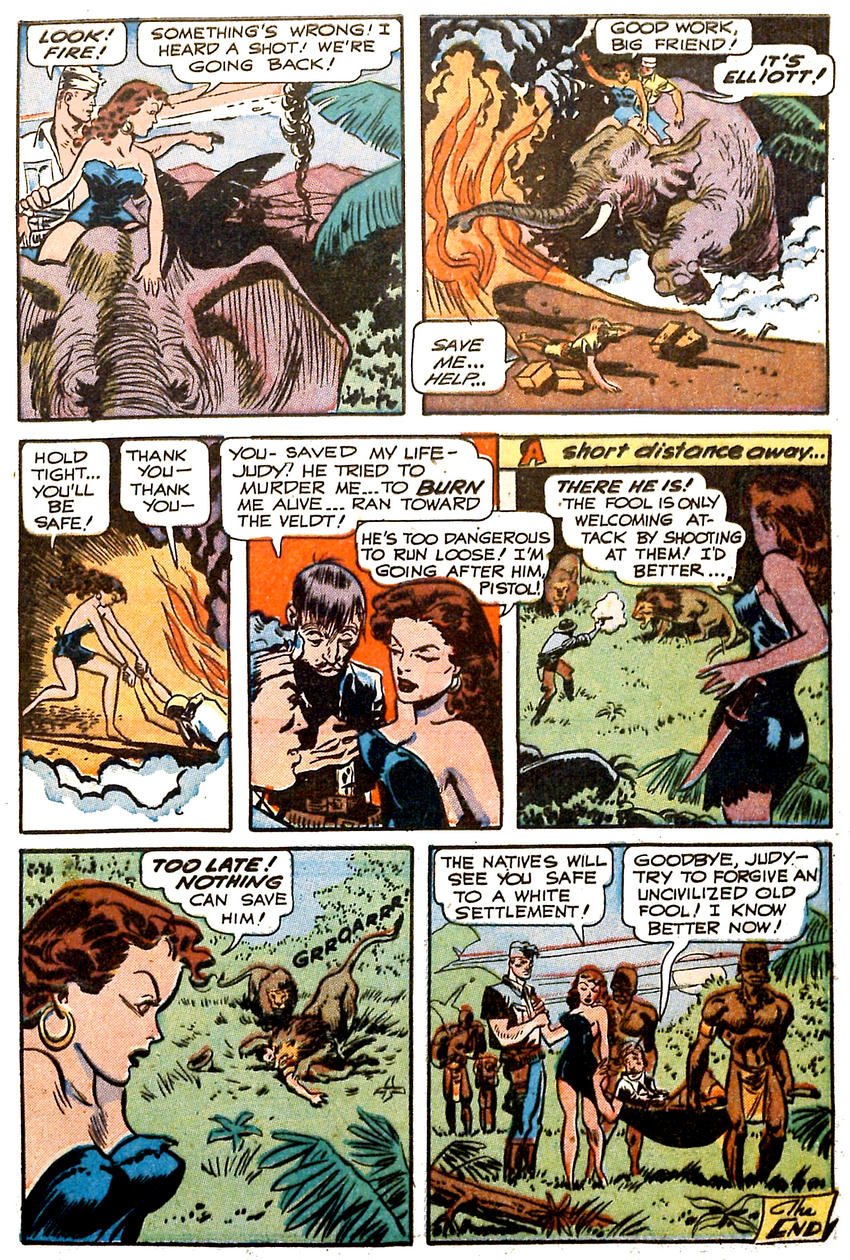
Maybe it’s just me, but for a jungle girl, the name Judy just doesn’t have the ring of Sheena or Rulah or any of a myriad of exotic names for comic book white girls cavorting about dangerous jungles. Judy as cover girl, though, as shown in Alex (“Xela”) Schomburg’s sexy bondage cover — being bought by a pith-helmeted white man for a watch (from a presumed “cannibal” with cooking pot) — for Exciting Comics #59 (1948), was sure to catch the reader’s eye.
Couple of notes: Judy kills a lion, even calls him an evil jungle prowler for killing sweet little Angela the doe. Shucks, folk, the lion was obeying the law of the jungle, and Judy should have been inured to violent death in the local food chain by this time in her career.
Frank Frazetta gets credit for the artwork. Although his style peeks out, I’ll crawl a ways out on a jungle tree limb and say that another inker, or inkers, worked heavily over his pencils. Another clue is the misspelling of his name as “Frazeta” in the splash panel.
“First appearance: Exciting Comics #15 (Nedor, 12/41). The details of Liberator’s origin story don’t suggest much of a patriotic motive for his actions: chemistry professor Nelson Drew discovers an ancient Egyptian formula that temporarily gives him superhuman strength, speed, invulnerability, and the ability to hold his breath for an extended length of time. But that was the 1940s for you: you get superpowers, you cut up a flag for your costume, you go out and kick the asses of whatever fifth columnists you could find, including X-3, the ‘diabolical Nazi spy and man of a thousand faces!’ His final Golden Age appearance took place in Exciting Comics #35 (10/44), but like a lot of other public-domain superheroes he was revived by Alan Moore for his 1999 Tom Strong series. A guy could do a lot worse than end up in an Alan Moore story.”
This is the Liberator’s first appearance, and is not an origin story as such. Nedor didn’t spend their valuable paper ration on long-winded explanations of the pseudo-science needed for making ordinary people into super people. They just got right to that ass kicking the above short article mentions. It is best not to think too much about it anyway.
No credits are given by the Grand Comics Database for writing or art .
I have a new masthead, based on the cover of Exciting Comics #49 (1946), drawn by the greatest Golden Age cover artist of them all, Alex Schomburg. As you can see I have done my usual, distorting the illustration to fit over the top of the blog. Forgive me, Schomburg fans.
Black Terror was a superhero from the World War II era, who lasted during the 1940s and in this original incarnation disappeared before 1950. According to Don Markstein’s Black TerrorToonopedia entry, the Black Terror was instantly popular. I think it was the costume with the skull and crossbones. Otherwise Black Terror’s adventures during the war involving saboteurs, Nazis, Japanese and the usual suspects, were fairly typical of the era.
Black Terror’s origin, brought about by “formic ethers” is pure hokum. That is de rigueur for a superhero origin, which just has to give off some illusion of making sense. It is from Exciting Comics #9 (1941). Story attributed to Richard E. Hughes, art by D. Gabrielson.
Here is another Black Terror story. You can see it and a link to another BT story by clicking on the thumbnail.
Wednesday, May 26, 2010
Number 743
Space Rover, Space Rover, send Flash Gordon right over...
The Space Rovers feature was short-lived in Exciting Comics, lasting a mere seven issues, from #2 to #9, in 1940. In #9 Black Terror was added to the Exciting line-up, and his popularity apparently pushed Space Rovers out of the book. Or, it could be that someone at King Features called up publisher Ned Pines and said, "Your Space Rovers feature looks a lot like our Flash Gordon feature."
And it did. Drawn by Max Plaisted, it was another in the comic book tradition of swiping a popular newspaper comic strip. Flash Gordon, with its popularity and elegant artwork by Alex Raymond, was just too tempting to steal.
Flash and Dale became Ted and Jane in Space Rovers. Imitation or not, it's fun. Any strip with giant robots and kings on other planets lusting after the heroine is OK in my book. Other Flash Gordon imitators featured here have been in Pappy's #584 and Pappy's #673.
I couldn't find much online information about Max Plaisted, other than he worked in comics from the mid-'30s to mid-'50s, and worked around the industry, sometimes under pen-names. In "Space Rovers" he showed, swipes or not, he was a fairly good artist.