Translate

Wednesday, September 12, 2007


Number 188

The Not-Quite-Kelly


Howie Post is one of those comic artists who worked in the business for so many years his work is everywhere. This particular strip, from DC's Animal Antics* #9, July-August 1947, was drawn when Post was only 21 years old, based on his birth year of 1926. He started in comics when he was still in his teens, not as young as Joe Kubert or Frank Frazetta, but still a prodigy, as far as I'm concerned.

In his later career Post did a daily syndicated comic strip called The Dropouts, and Harvey Comics are filled with his pages, mostly in Hot Stuff. The Little Devil and Spooky, The Tuff Little Ghost. He has a very appealing style, full of action and humor

Post's early art was inspired by Walt Kelly. According to Post he met with Kelly and comic book packager Oscar Lebeck about doing work for them. His method of inking and penciling was inspired by Kelly, but different enough that it is wholly Post. "Presto Pete" is a funny animal magician strip. I think it's quite good. I don't know if Post wrote his own material, but it's well done. Rather than being a clone of Walt Kelly, Howie Post went on to develop his own style, instantly recognizable. That is until he invented Anthro for DC Comics in 1968, where he went from funny devils, funny ghosts and funny animals to funny cavemen.


*Post mistakenly calls Animal Antics a book he packaged for Timely (Marvel), rather than DC in his TwoMorrows interview from Comic Book Artist #5. This is the danger of interviews with artists who have fallible memories stretching back five or six decades, or even more.

Monday, September 10, 2007


Number 187


The Waterboys


Here's something you don't see anymore: a monster story combined with Cold War jitters. "The Merman Menace" is from Forbidden Worlds #5, published by the American Comics Group, dated March-April, 1952. The writer is unknown, but according to the Grand Comics Database, the artist is Lin Streeter, about whom I know little. About all I could learn about Streeter is that he was active in comics from the early '40s until at least the 1950s.

You've gotta love having a monster pumped full of adrenalin and benzedrine to get him back up to speed, so he can get revenge on the Reds. It's in the story, folks. I don't make this stuff up.


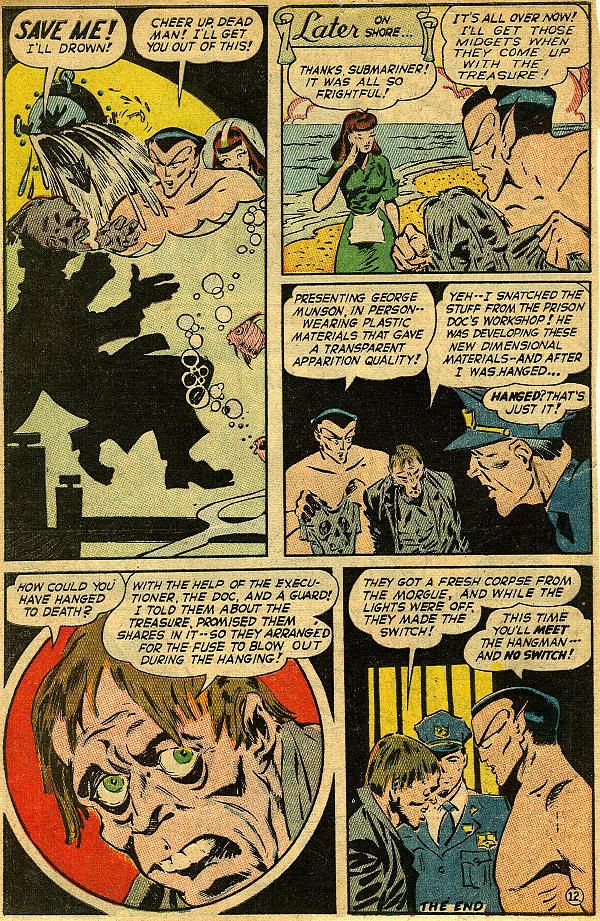
It's a bonus! I'm enclosing an extra story about another famous half-fish, half-human hero. The story is from the late 1940s, and was part of the box full of comic book tear sheets I received years ago. I went through and assembled the complete stories, of which this is one. Comic title unknown, by a writer and artist unknown. (See note by reader Darci below.)


Saturday, September 08, 2007

Number 186


When Rick Griffin Was In Drag


When people think of artist Rick Griffin, they think of his psychedelic dance posters, his comix work, and artwork like this, taken from the important 1972 publication, The Man From Utopia:


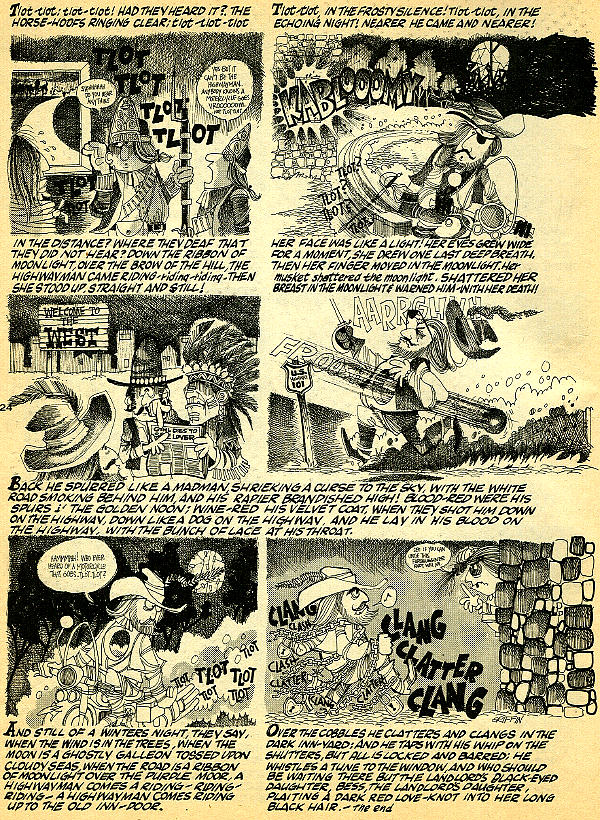
They might not realize the Rick Griffin they know was preceded by a Rick Griffin they don't know. I've owned this copy of Drag Cartoons #12, dated February 1965, since it was new on the stands without knowing that Rick Griffin illustrated two of the strips, for a total of five pages in the magazine. Hard to explain, but I just never noticed. I stumbled onto them while looking at an Alex Toth strip in the same issue.


Griffin started out doing cartoons for Surfing magazine. I have no idea how many issues of Drag Cartoons he appeared in. That's for the Griffin completists amongst us to tell us.

When Rick did these strips he was about 20 or 21 years old, influenced by the cartooning styles of the early 1960s, and by Mad comics, which he might have read off the newsstands as they appeared, or later encountered in the series of Mad paperbacks. Or both. In the last panel of "The Highwayman" strip he uses the word "furshluginer." A dead giveaway as to his influence.

The artwork on "The Highwayman"--writer not credited, but for the record it's by Alfred Noyes from his 1906 poem--is more detailed, using a lot of pen and ink lines. The second strip isn't as ornate, and frankly, not as good. I'm including it anyway because I just know you guys wanna see this stuff. Looking at Griffin's work during his salad days can give you a comparison of how much development he made during his career. In his case there was a huge leap of development during a very short period of time, just a couple of years.

Griffin died in 1991 in a motorcycle accident. He wasn't even 50 years old. He left a legacy of some wonderful artwork that will outlive us all. I believe that one hundred years from now the San Francisco dance posters of the 1960s will be as the Toulouse-Lautrec and Alphonse Mucha prints are to our era. The art lovers of a century hence will be celebrating an important art form, by then long gone, but idolized along with the work of the best fine artists of the era. A Rick Griffin Website is available.


Monday, September 03, 2007


Number 184

Historic Horror


It's uncommon for a horror comic story to have a background in historical events, but this story, "All The King's Men," from Amazing Ghost Stories #15, has just that.

From what I've been able to research on Henri Christophe, king of Haiti, I wouldn't recommend using this story as the basis of a high school term paper, but it gives the story something exotic. Setting a story in Haiti without it being expressly about voodoo seems almost sacrilegious. Voodoo is practically the exclusive reason for stories set in Haiti. However, the comic is called Amazing Ghost Stories, and this story does have some voodoo, but the historical background using Haiti's only king is what drives the plot.

The Citadelle, shown in the story, actually exists, and is shaped like a ship, just like the character claims and the artwork shows. Unlike the story, in the encyclopedia entries I read, Christophe committed suicide using a silver bullet, not a gold bullet. Maybe he thought he was a werewolf.

The artwork is by the excellent Bob Powell, whose artwork is up to its usual high standards. St. John was the publisher of this comic, which was the continuation of the title Nightmare, and ran for three issues on its own, just before the Comics Code was implemented in 1955.


The cover is by Matt Baker, and has a voodoo theme, although it appears unrelated to this story.

Some publishers, St. John included, appear to have been spooked by the witch hunt against comics, and anticipated the Code by toning down their comics. This story probably would not have appeared in a post-Code title without some changes, but it isn't as gory as it could have been for the time it was published. The main character is a typical horror comics character, though: an irredeemable killer who gets what's coming to him.


Friday, August 31, 2007


Number 183


Imitation Madness


In my opinion the best story in Mad comics not done by one of the Big Three, Wood, Davis and Elder, is "Plastic Sam," by Russ Heath in Mad #14. Heath, mostly known for his illustrative approach, was freelancing from his regular gig at Atlas Comics, working for Stan Lee.

I think he really liked the idea of the humor comics, because he approached "Plastic Sam" by tightening up and inking Kurtzman's layout. At Atlas, he did the story I'm posting here, "The Wild Blue Yonderrrr," from Crazy #3, in an ersatz Bill Elder/Wally Wood style, with lots of jokes in each of the panels. I like puns and wordplay so I enjoy them, although overall the story is typical Mad imitation; without Kurtzman it's mostly nonsense, rather than satire.

You've got to give companies that went after Mad's popularity credit for trying. Try is all they could do. None of them succeeded, which is why they're obscure and Kurtzman's Mad is still revered.

Heath, who was born in 1926, had a great career at Atlas, turning out Westerns like Kid Colt, Outlaw. He also created some memorable science fiction and horror stories. From there Heath went to DC, where he made his mark in war comics, Sea Devils, et al. All-in-all, a remarkable career by a remarkable artist.

In his humor work Heath liked to insert a self-caricature as part of his signature, as he did in "The Wild Blue Yonderrr."


I've always admired the comic book artists who, when the going was the toughest during the 1950s, still signed their work.