Translate

Friday, February 06, 2015

Number 1693: Funnyman dooed it

I have shown Funnyman stories before. The character was created by Jerry Siegel and Joe Shuster after their creation, Superman, was seized and then S and S were kicked to the curb by their publisher. That isn't funny, man.

Funnyman was not a big hit as a comic book, lasting a short run of six issues, and for a short time as a newspaper comic strip. ME was the publisher, and several artists did the drawing. This particular episode, from Funnyman #3 (1948), is credited by the Grand Comics Database to John Sikela for pencils, and inks by the Shuster studio. I see the character as being modeled after Danny Kaye and Red Skelton (“I dooed it!” is taken directly from Skelton). Throw in some baggy pants and some superhero-style gimmicks and voila, Funnyman.


More Funnyman. Just click on the thumbnail:


***********

Another superman before Superman

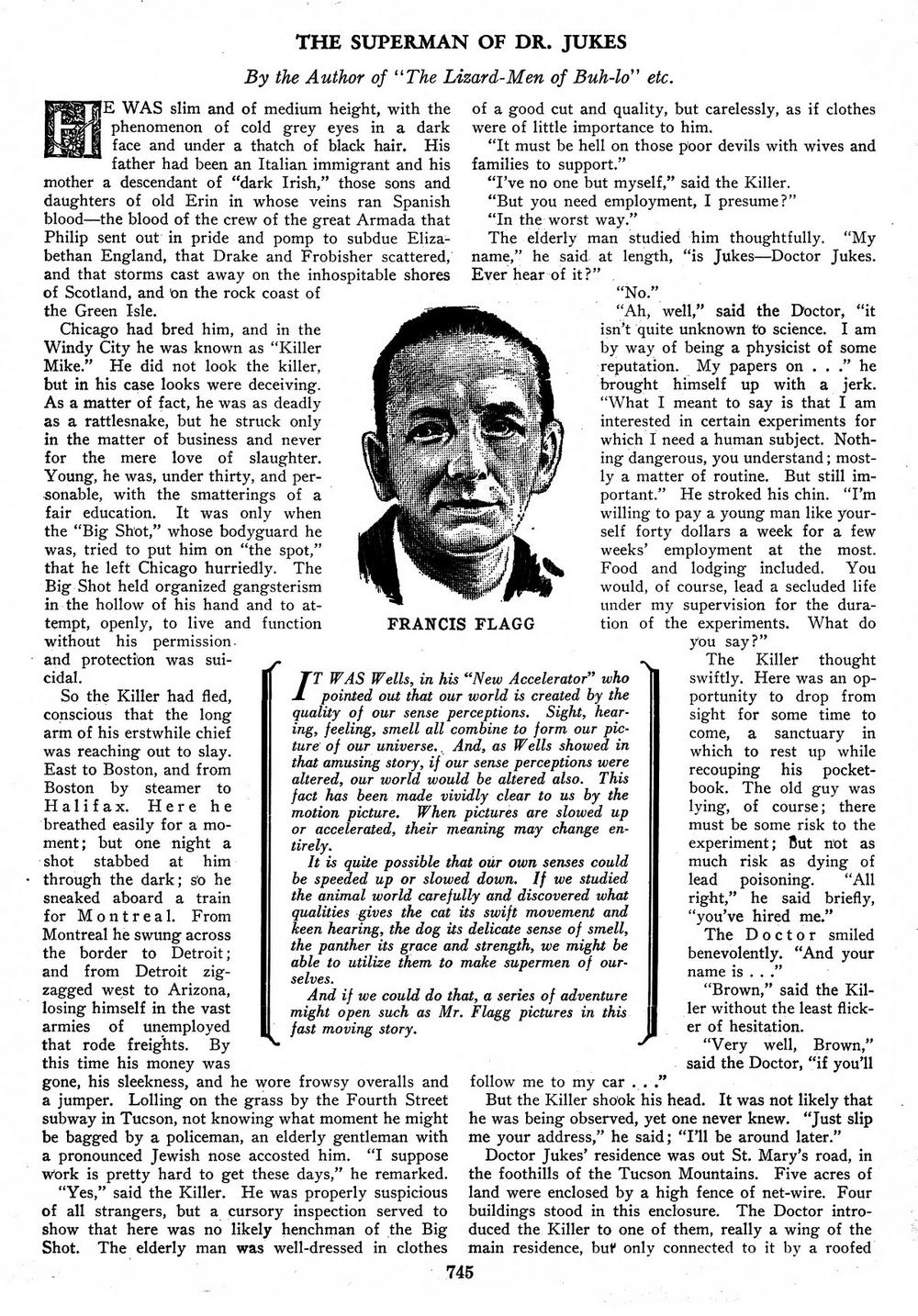
It is no secret that Siegel and Shuster had their models for Superman, even a villainous Superman. Philip Wylie’s novel, Gladiator, is widely touted as a direct inspiration. Wylie always believed it, anyway, even if Siegel denied it (why put yourself on record with a statement that can get you sued?). Gladiator was published in 1930, and this story, “The Superman of Dr. Jukes” by Francis Flagg, is from the November, 1931 issue of Wonder Stories.

“Killer Mike” is Dr. Jukes’ superman, and the author makes it fairly clear that the story is also about Al Capone — called Frazzini, or “The Big Shot” —  throughout the story. Killer Mike makes more like the Flash than Superman, moving so fast everything appears to him to be in slow motion.

To me the story if of its era, corny in spots. Brad Ricca, who wrote Super Boys, a book about Siegel and Shuster, says that Siegel read it. It is true that Siegel’s early fanzine story, “The Reign of the Super-Man” was about a criminal superman, not unlike Flagg’s.

These are scans of the pages of the story from its original appearance in Wonder Stories, so you can see for yourselves.



Wednesday, February 04, 2015

Number 1692: Mooning the Phantom...the Lunar Cult

This adventure of the Phantom, written by Lee Falk and drawn by Wilson McCoy, is taken from scans of an early Indrajal Comic: #6, from 1964. Indrajal was a line of comics, now defunct, published by the Times of India. I have mentioned before that I have never seen an actual Indrajal issue, just what is posted online. So I thank those fans who have made them available.

I believe “The Lunar Cult” is adapted from a story called “The Thuggees,” which appeared in newspapers from August 22, 1949 to February 25, 1950. As Thuggees were an Indian murder cult there was probably some sensitivity toward the original title. There is internal evidence in some speech balloons that something (presumably “Thuggee”) has been whited out and replaced by the world “Lunar.”

The Phantom’s territory was a mix of India and Africa. There is more on that subject in a link below the 16-page story. For more about Thuggee go here.

UPDATE: On February 5 our friend J D LaRue furnished us with information that the story is not from the Thuggee continuity, but instead from “The Crescent Cult,” published as Sunday strips from April 10, 1955 to August 7, 1955. Thanks, J D,  for the information. As J D pointed out, there are many Muslims in India, so the change from Crescent to Lunar was done in response to cultural and religious sensitivies.


As promised, more on the blurring of India and Africa in the Phantom. Just click on the thumbnail. 


Monday, February 02, 2015

Number 1691: Hunt and his “friend”

Hunt Bowman, the appropriately named hero who wields a bow as a weapon against alien invaders, the Voltamen, takes an unexpected flight to Paris for this episode of “The Lost World.” It's drawn by Graham Ingels several years before his time as “Ghastly” at EC Comics. He has a sense of humor...check out the restaurant sign in panel 2 of page 7.

I also got a smile at the description on page 1 of Hunt’s companion, Lyssa, as his friend. A friend in a top with plunging neckline, mini-skirt and spike heels, who stalks the enemy with Hunt.* I assume they are friendly enough to keep each other warm at night.

*Hunt looks kinda kinky, himself.

Cover illustration attributed to Joe Doolin. From Planet Comics #30 (1944):


Here is an extra bit of Ingels for you. After EC folded Graham Ingels, like other comic book artists, was looking for work. Here is a short four-page strip from a 1957 issue of Treasure Chest, a wholesome comic book published for Catholic schoolkids.