 Number 99
EC Comics: Adultery Is For Adults!
EC Comics'
Shock Suspenstories #11 was the first non-
Mad EC Comic I ever read. I was too young to read EC's when they were originally available, and I was buying them blind via mail-order from Bill Thailing of Cleveland, Ohio. Bill sold most EC's for about 50¢ each in 1960 and '61.
Click on pictures for full-size images.
I remember being disappointed by the cover; a guy and girl (even if the girl was in a bikini) on a sailboat, another guy getting knocked out. It didn't look like what I thought of as a horror comic. When I looked inside I was additionally puzzled. There was a splash panel with a pretty girl carrying a basket, a man behind a tree, and big letters, THE TRYST. I thought, "What's a tryst?"
Well, at age 12 I wasn't really expected to know, which was a problem with EC Comics. They were written for older readers, but a lot of kids read them, too. I'm sure that if parents were looking over their young boys' shoulders in 1953 when this comic came out, they had their eyes widened by that word. A tryst is a lover's rendezvous. And in the case of this story, refers to one character's perception of the tryst as an adulterous one.
When I read the story I didn't know the older man hiring the young girl wanted to protect her virginity from other men because he wanted her for himself.

Virginity was also a word I didn't know. You may think I was naïve when I was 12, and you'd be right. It's hell when you have to get your sex education from EC Comics.
The panel where the new wife asks her older husband, who has stashed her away on an estate to keep her away from other males, if she could have a baby, got my attention. I knew a bit about babies and where they came from, but I was a bit weak on the mechanics of the process. I sure did like the picture that artist Johnny Craig drew of the young blonde babe, though.

In the story the old man suspects his young wife is having an affair with another man, so he kills that man.

I knew about jealousy, but sexual jealousy of this sort was beyond my comprehension at the time. Actually, it still is. I'm aware of the crimes people commit when under its influence.
The capper is when the husband follows his young wife into the woods, thinking she's having a tryst with a lover. Craig, writer as well as artist, loads up the captions with information about her buttoning her blouse, or blowing kisses, which would lead a reader to suspect she's up to no good.


So the husband does the ultimate act: he shoots into the woods, killing the person he thinks is his wife's lover.

The "lover" that the young wife was meeting was an orphan boy named Tommy, who lived behind the estate in an orphanage. The last panel shows a dead boy near a pond. Then as now, victims in fiction are objects, not "real" victims, like we find in life.
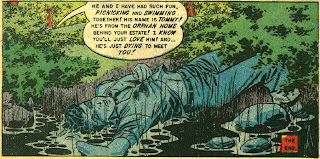
The fact that the orphanage hadn't been mentioned before didn't bother me at the time, but now I realize that it's good to plant that information in the story somewhere so the reader doesn't feel the denouement has come out of left field. Which is exactly what this ending did. We know the young woman wants companionship, but the husband's jealous mind has turned her actions into cheating, when she's innocent of nothing more than making friends with a young boy. What we don't know ahead of time is that there is anything like an orphanage nearby.
Well, that's comics for you! They don't have a lot of room for information, so sometimes this sort of thing is left out, and it weakens the ending. Still, when I read this story the first time I wondered why the husband would have a problem with his wife meeting a young boy. Wow, was I dumb, missing the whole point of the story because of my unfamiliarity with the ways of sex, love and lust.
Three of the stories in
Shock Suspenstories #11 deal with adultery. Only the second story, "In Gratitude," doesn't deal with a triangle love affair.
I bet most of the readers of
Shock Suspenstories were probably in the 13-to-16 year age group, almost all of them male. In that more innocent time this issue should have set off alarm bells somewhere with somebody's parents, but maybe the excesses found in the horror comics trumped this comic. I think parents were probably more upset by walking dead than jealous husbands.
In my personal opinion, showing a dead child, murdered as a result of mistaken sexual jealousy, seems over the line. By that time in EC's history I'm sure it was just another snap ending to another story. In retrospect it seems more powerful and disturbing.


