These two stories are early work for two issues of Weird Science, and despite Feldstein’s tendency to use too much text, his pictures have impact. The scans are taken from Heritage Auctions, without permission, but with love in my heart for them, posting enough original art for what is for me an online museum of comic book artwork.
Feldstein gave what was probably his last interview to Comics Journal publisher Gary Groth in 2013. I have excerpted some things I think are pertinent.
GROTH: Now I’ve heard you say that you were dissatisfied with your drawing; is that true? Do I remember that correctly?From Weird Science #13 (Actual issue #2, 1950):
FELDSTEIN I always felt that my drawing was stiff. Although there were periods where I improved, when I started doing the romance stuff with Bill. And my drawing was better. I always felt that a guy like Johnny Craig was so much more talented than me. I have since learned that my particular style of drawing was very unique. And though I felt it was static and stiff, it had a kind of personality.
GROTH: Absolutely, absolutely. I can see where you would notice that Johnny Craig had a kind of fluidity to his work that I suppose yours lacked. But yours had a kind of baroque inking style that gave it this marvelous finish.
FELDSTEIN: I don’t know how it developed over the years. I started with Iger, I sat next to Matt Baker and learned to draw headlight comics. Jack Kamen and the rest, all the rest of those wonderful artists in Iger’s shop.


“Made of the Future” is a concept I don’t think is that far off. When AI can be successfully adapted there will be guys lining up like they are for the latest iPhone. I disagree with Gary Groth’s assessment that it is “not a realistic possibility.” The idea of a robot used for sexual purposes is already here. Not like the Feldstein story. Not quite yet, anyway. (Disclaimer if my wife is reading this: Not for me, of course. Heh, heh.) (See this article from Rolling Stone magazine.)
On February 14, 2013, Gary Groth interviewed Al Feldstein for Child of Tomorrow (a collection of EC comics drawn by Feldstein).
On “Made of the Future”:
GROTH: One of the stories you did that was not a realistic possibility was “Made of the Future.”From Weird Science #5 (corrected numbering, after four issues using numbering continued from Saddle Romances, 1951)
FELDSTEIN: I tried to step further into the future of science and technology in terms of being able to create your own robot human.
GROTH: The perfect wife.
FELDSTEIN: In that case, yes.
GROTH: [Laughs.] Which was such a crazy premise, but it worked.
FELDSTEIN: I think it fulfilled a kind of an idealistic fantasy. To be able to have a realistic enough robot to be able to relate to sexually and otherwise.
GROTH: And as crazy as it was, you believed it while reading the story.
FELDSTEIN: All the stories were tacked on a realistic level, because that’s the only way I could convince the reader that this was what could happen.


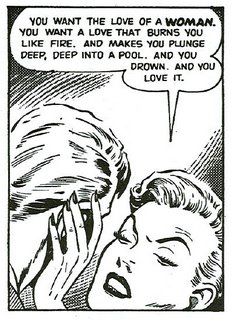
 I'm not advocating the use of swearing, but probably throwing in a couple of hells and damns might have made the novel seem more adult, more apart from the movies and color newsstand comic books it was inspired by.