Here's another hilarious story from ACG's funny animal Ha Ha Comics. "Those Bank Robber Blues" appeared in #59 from 1948.
I don't know the artist. GCD guesses Ken Hultgren. You laser beam-eyed art spotters out there tell me who did it.
Sunday, June 28, 2009
Number 548
Lee Elias' Green Lantern
Longtime comic artist Lee Elias drew every kind of comic book, including super heroes. I'm a fan of his Milton Caniff-styled artwork. Elias worked as Caniff's assistant for a time. The first time I saw his work was in the early '60s on Tommy Tomorrow for DC's Showcase. I searched out his earlier work, which included Black Cat for Harvey, a cute chick, Linda Turner, movie star by trade. Linda wore a mask and sexy costume for her alter-ego as a crime fighter.
This particular and un-sexy Green Lantern story, "Situation Wanted," is written by Robert Kanigher, penciled by Elias and inked by Bob Oksner.
I got this story circa 2003 from a DC fan web site; it's scanned from Comic Cavalcade #29, 1948. Comic Cavalcade was originally a DC anthology featuring stars like Wonder Woman, Flash and GL. If the original poster comes forward I'll give him credit.
Does anyone else find characters like Doiby Dickles completely obnoxious? Did kids of the era like this kind of comic relief? Ugh.
Friday, June 26, 2009
Number 547
Comics McCormick
Here's a story that up until now I've hesitated to show because of the racist character, Ajax. This sort of crude caricature wasn't uncommon in old comics, when racism was more upfront and public. I decided to show it, despite trepidations, because I like Ed Wheelan, a big favorite of mine since I discovered his 1920s comic strip, Minute Movies.
I've featured Wheelan before in Pappy's #215, a Minute Movies story he did in Flash Comics. You can check it out and see what I had to say about him.
"Comics McCormick" was published in the early EC Comics' Fat and Slat, a vaudeville-styled, "Mutt and Jeff"-inspired strip Wheelan did. The scans are from Fat and Slat #1, Summer 1947.
Wednesday, June 24, 2009
Number 546
The Shores of Horror
Web of Horror #1 came out in 1969, published by Cracked magazine's publisher, Bob Sproul. This issue used some (then) new artists, Berni Wrightson, Ralph Reese, Wayne Howard. It also used Don Norman, a name I believe is a pseudonym for Norman Nodel of Classics Illustrated fame, and the old Timely/Atlas/Marvel stalwart, Syd Shores. "Blood Thirst" would fit right into an Atlas horror comic, and showed that Shores lost nothing in the decade-and-a-half since the horror comics were erased by the Comics Code.
I especially like the dynamic panels of the crypt on page 3 and the vampire swooping in on page 4. Syd Shores learned his craft during the 1940s, batting out pages with Al Avison, carrying on Captain America from Simon and Kirby. His action figures jumped right off the page, as they do in this story.
Web of Horror lasted two more issues before expiring. Shores lasted four more years, dying in 1973. We fans lost both times.
Monday, June 22, 2009
Number 545
An Octeel for the Octomom!
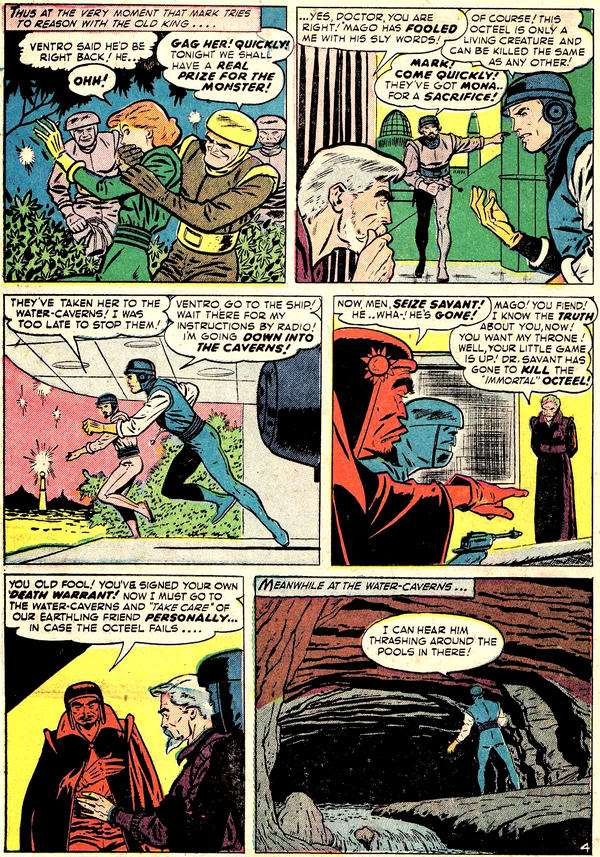
George Tuska, another longtime veteran of the comic book wars, did the art for this science fiction short from St. John's Amazing Ghost Stories #16, the last issue of that title. Dated February 1955, it was also one of the last pre-Code comics. Comics with early '55 dates and no Code seal were usually the last of their breed.
Since a science fiction story in a ghost story comic book is about as out of place as an octeel in your bathtub, I believe "The Tentacles of Death" was an inventory story. As unassuming as it seems to us now, it was probably used because they knew it wouldn't pass the new Comics Code without changes.
Sunday, June 21, 2009
Number 544
Pirates in the water!
I should have shown this a couple of months ago when the Somali pirates were in the news. The Boy Commandos and their leader, Rip Carter, take on modern day (circa 1946) pirates in "Torpedo Pirates" from Boy Commandos #19, January 1947.
Grand Comics Database has more question marks which means they're qualifying their attributions. They say Jack Kirby? did the art and Howard Sherman? did the inking. It looks like Kirby to me, but I'll leave it to you hawkeyed art spotters to judge.
Friday, June 19, 2009
Number 543
Summer Camp stories
"What I Did At Summer Camp," by Pappy.
First of all, it was cold. It was wet, rained all the time. I had diarrhea, so I stayed close to the facilities. The sergeant made me clean rifles...
Wait a minute. That wasn't summer camp, that was Army basic training. Summer camp, when I was a kid, was actually a lot of fun! A lake, canoeing, swimming, leathercrafts in the afternoon...a big fire at night, marshmallows burned black, molten on the tongue. Or maybe I'm just thinking of an old episode of "Spin and Marty" from the Mickey Mouse Club.
Oh well, at least my memory isn't faulty when it comes to the Dell Giant Comics that arrived just before school let out for the summer. They were kind of a vicarious vacation, promising a lot of summer fun. I never had as much fun--or adventure--as the characters in the Dell Giants, but at least I had the comics, which I pored over. I bought this one, Little Lulu and Tubby at Summer Camp #2, in 1958. Not only did it contain one Little Lulu storytelling time with Alvin, a Witch Hazel story, but also a Tubby storytelling time with Alvin. I don't know if writer John Stanley ever did that again, but the story Tubby tells is every bit the whopper that is usually Lulu's imaginative stock in trade.
Not only did that break tradition, but having Lulu show up at the end of the story breaks the tradition from regular issues of Little Lulu, where the Tubby story at the end didn't have Lulu.
School's out...what are you doing that's fun this summer?
More summer camp from #1 of this series from Frank Young of Stanley Stories. You can access it here.
Wednesday, June 17, 2009
Number 542
Kirby's Kansas City Massacre
Since Jack Kirby was great at everything he drew it's no surprise that his crime comics stories are great, also. Maybe it's because he grew up in Hell's Kitchen, but he seemed to really know bad guys. His action-filled drawings were perfect for tales of killers and outlaws. He drew many crime stories in the 1940s at the peak of the crime comics craze, and he also probably felt the heat from a dismayed public, led by Fredric Wertham, M.D., who thought crime comics were contributing to juvenile delinquency.
What the hell. Wertham could've admitted some crime comics were well drawn, at least.
The Kansas City Massacre is famous in the history of the FBI and that lawless era of the early 1930s. The crime comics all covered it extensively. I read up on the K.C. Massacre and Kirby's version is fairly accurate, hitting the high points of the incident. Verne Miller actually didn't end up dead in a bathtub, but in a ditch. These "true" stories always use some artistic license.
The scans are from Headline Comics #26, 1947.
Monday, June 15, 2009
Number 541
Demon of Destruction!
This is a famous story, reprinted in fanzines at least a few times that I can remember. "Demon of Destruction," by Al Williamson and Frank Frazetta is from Forbidden Worlds #1, from 1951.
Only Williamson signed the story, on page 2, but he was known to ask his buddies to dive in and help.
Except for the artwork, "Demon" is pretty standard ACG fare. A man and woman get mixed up with the supernatural, in this case a demon, Marzo, who is "worse than Satan." Wow, that's bad. As always, the humans are smarter than the evil-doers in these stories. There really was no need for Marzo to grant three wishes because they turned against him, but such is the way of ACG plots.
Sunday, June 14, 2009
Number 540
Target
The Target and Targeteers lasted through the 1940s. Created in 1940 by cartoonist Dick (Frankenstein) Briefer, using the name Dick Hamilton, the Target was a metallurgist who wore a costume made of metallic fibers that bullets bounced off. His two business partners joined him as the Targeteers.
This episode is fromTarget Comics Volume 3 Number 12, February 1943. By this time the Target and Targeteers were servicemen, and this particular story uses only one Targeteer. Maybe the other guy was on KP peeling spuds.
Sid Greene did the artwork along with somebody named Ryan. Greene was another of the comic book journeymen I'm always glad to feature. He's probably best known to modern comics fans for the work he did during the '60s at DC, where I saw him first as an inker. He was hired to replace the retired Bernard Sachs. I saw Greene's pencils and inks in various places. I showed a story of his from Mystery in Space a couple of weeks ago. Sid Greene died in 1972.
Friday, June 12, 2009
Number 539
Powell's Bad Bad Girls
Last Friday I showed you the original art from two stories by Bob Powell of good girls who are tempted into being bad. Here are two stories about girls who are just bad. Witches. And I don't mean that euphemistically.
"Cavern of the Doomed," from Tomb Of Terror #3, 1952, is a tale of a witch who gets her comeuppance. If I'd seen this story and its vision of Hell when I was a kid it might have straightened me out.
"The Spell of the Black Gloves" is a tale that shows us that genes mean a lot. With her ancestor a witch, impoverished Abegail has no choice but revenge and evil. It's from, appropriately enough, Witches Tales #5, 1951.
Both of these stories are courtesy of Heritage Auctions, where I ::evil cackle:: swiped 'em.
Wednesday, June 10, 2009
Number 538
Alex Niño
Alex Niño's angular, psychedelic style was probably the most unique of the Philippine comic artist invasion of the 1970s. He could take even the most routine script and turn it into something interesting. As I recall he had some trouble with editors over his style when he stretched his imagination too far, and made the stories difficult to decipher.
There's no problem with that here. These stories are written by Jack Oleck. "Fish Story" is from Secrets of the Haunted House #1 from '74, and "The Evil Power" is from Weird Mystery Tales #9, 1975.
Grantbridge Street has posted an Oleck/Niño DC story here.
Monday, June 08, 2009
Number 537
The Blowhard
Fremont Frog is a lot like some guys I've known over the years. Blowhards. No matter what you bring up they've done it bigger and better. You'd like to put them in their place.
So that's what Fremont's friends do to him. This is a hilarious story from Giggle Comics #67, September-October 1949. It's hilarious because it's drawn by one of the greatest funny animal comic book cartoonists, Jack Bradbury. I've shown you several Bradbury stories, and they all have something in common: great drawing and funny gags.
Jack Bradbury's son has a website devoted to his father's work. http://jbrad.org/
He shows many of Bradbury's stories for Giggle and Ha-Ha Comics, including some more Fremont Frog. If you like this story you'll love what he has on his website.
Sunday, June 07, 2009
Number 536
Comet, cop killer!
Stan Nichols, who goes by Nix, provided these scans for Jack Cole's Comet from Pep Comics #3 and #4, 1940. Nix's synopsis: "Comet is hypnotized by a bad guy named Satan, and kills some cops. He kills Satan, then rather than turn himself in, he takes off to prove his innocence!"
As it turned out for the Comet, he in turn was killed in Pep #17, and his brother sought revenge as the Hangman. Jack Cole drew the Comet stories a couple more times, ending his participation with Pep #8. These episodes, like a lot of Cole's earliest work, appear to be rushed, but the energy Cole put into his drawings still comes through.
Thanks, Nix.
There's a great new blog devoted to Jack Cole. Check out Cole's Comics. I was guided to it through Frank Young's Stanley Stories.
Friday, June 05, 2009
Number 535
Bob Powell's Good Bad Girls
Regular Pappy's readers know I can't go long without showing something by Bob Powell; in this case original art for two love stories.
Love comics were once the best selling comic books. Can you believe that? That meant that unlike today's testosterone-driven comic book market, girls and young women were buying a lot of comics. What the female readers got with these two stories are cautionary tales of girls with bad reputations. Everybody knows about the girl in school who goes "all the way," or at least has that reputation.
I found scans for the original art to these two 1950's Harvey Comics stories on the Internet, and you may have seen them here and there. They're worth looking at again, though.
"I Joined a Teen-age Sex Club," besides having the wildest title ever to appear in a comic book, is about a girl trying to fit in with the crowd. In this case she ends up with a group of teen swingers who hold regular make-out parties. Propriety and good breeding, also the idea of losing a straight-laced boyfriend, straighten Geri out.
"Anybody's Girl" is about a girl who does succumb to temptation. She's lucky to get out of one bad situation only to have created another when her bad rep costs her a boyfriend. Tsk tsk. You know about those nights in a ski lodge. I had a few fantasies like that myself. I love the line in panel two of page one: "You're even more fun than your sister!" I think I'll put that on a t-shirt or bumper sticker.
The artwork is Bob Powell at his big-lipped best. The kissing scenes are great. With those lips a guy could kiss two girls at once.
Wednesday, June 03, 2009
Number 534
Journeymanny
Manny Stallman was yet another of the journeyman comic book artists whose name usually provokes a "...Manny Who-man?" from comic book fans. Stallman was born in 1927, and was working in comics as a teen.
This "Young Robinhood" splash page from Boy Comics #13 (I showed you the Crimebuster story from the same issue last Sunday) is very crude. It was published in 1943. I estimate it was done when Stallman was 15 or 16 and it looks it.*
But Stallman went on to a career in comics and did a lot of them. He often worked as a team with John Giunta, who inked the really creepy "The King is Dead" in Witches Tales #50. This black and white version came from the 1991 reprint in Silver Scream #2. I'm not sure if Giunta helped Stallman on these other two stories. "Monkey Face" is from Astonishing #26. It's signed "S.L.", which probably doesn't mean Stan Lee, who would never miss a chance to put his full name on anything, but Stallman and an as yet unidentified inker whose name starts with "L." "Swap Shop" is from Marvel Tales #141. Stallman spent his last years in the field doing things like the giveaway Big Boy Comics, the circulation of which put his artwork in front of many more readers than the average comic book.
Stallman died in 1997.
*I can't show you the "Young Robinhood" story because I'm missing the last two pages.
Monday, June 01, 2009
Number 533
Monsteroids of the underworld!
Captain Rocket returns in the second story from his one and only appearance, Captain Rocket #1, from 1951.
In this story we have a villain named Gorgo, a gas that turns humans into monsters (or monsteroids, as they're known here), a primitive version of the Internet where Captain Rocket references the story on Gorgo, an earth-boring machine, art swipes from Flash Gordon...this is fast-paced and goofy, just how I like my comic book science fiction.
Pappy--I just want to thank you for the great job you do on your comics site. I check you out every day, always amazed at what you put up.
--Ralph Bakshi
Is there any scanblog better than this?
--www.awesome-engine.com
Pappy's Golden Age Comics Blogzine collects stories from, as promised, Golden Age comics, with some commentary on the side. This is definitely a site aimed at adults, but the comics include children's comics and it's a good place to go if you're looking for a particular title --www.schoollibraryjournal.com
Pappy's Golden Age Comics ist auch so ein Schrottplatz auf dem man gerne länger verweilt.
--svvwomen.antville.org
I don't know where he finds it all, but God bless Pappy's Golden Age Comics Blogzine. I could spend days--probably weeks--just reading through the treasures there. . .Keep up the good work, Pappy.
--newsandheadlice.blogspot.com
"And, just what I needed – another time sucking site!"
--Jeffro, referring to Pappy's in a comment to dustbury.com.