Pappy's First Law of Horror Comics: “The main character shall be as unpleasant and irredeemable as possible.”
Web of Evil was a horror comic from Quality Comics. It lasted 21 issues from 1951-1954. It follows the usual plots of horror comics, making the bad guys truly evil, and the victims sometimes not much better. In each of the four stories in this issue Pappy’s First Law is observed. In the first story the irredeemable bad guy is the last of a family who were evil slave owners. The ghosts of the slaves, along with their giant alligator are there to wreak vengeance.
The second story looks to be inspired by Tod Browning’s infamous Freaks, a controversial horror film from 1932. The other two stories, including the third, drawn (or at least penciled) by Jack Cole and the final tale, both fit into the First Law category. The Grand Comics Database lists no credits for the non-Cole stories.
From Web of Evil #1 (1952):
Translate
Sunday, August 16, 2020
Sunday, August 09, 2020
Number 2445: All in color for a nickel
If you are a geezer like me you remember when you could use a nickel to buy something. A candy bar, perhaps. I did occasionally pay a nickel for comic books when I bought coverless comics from a neighborhood drug store. (That was illegal, as I later found out. The covers had gone back to the distributor as unsold periodicals, and the store got credit.)
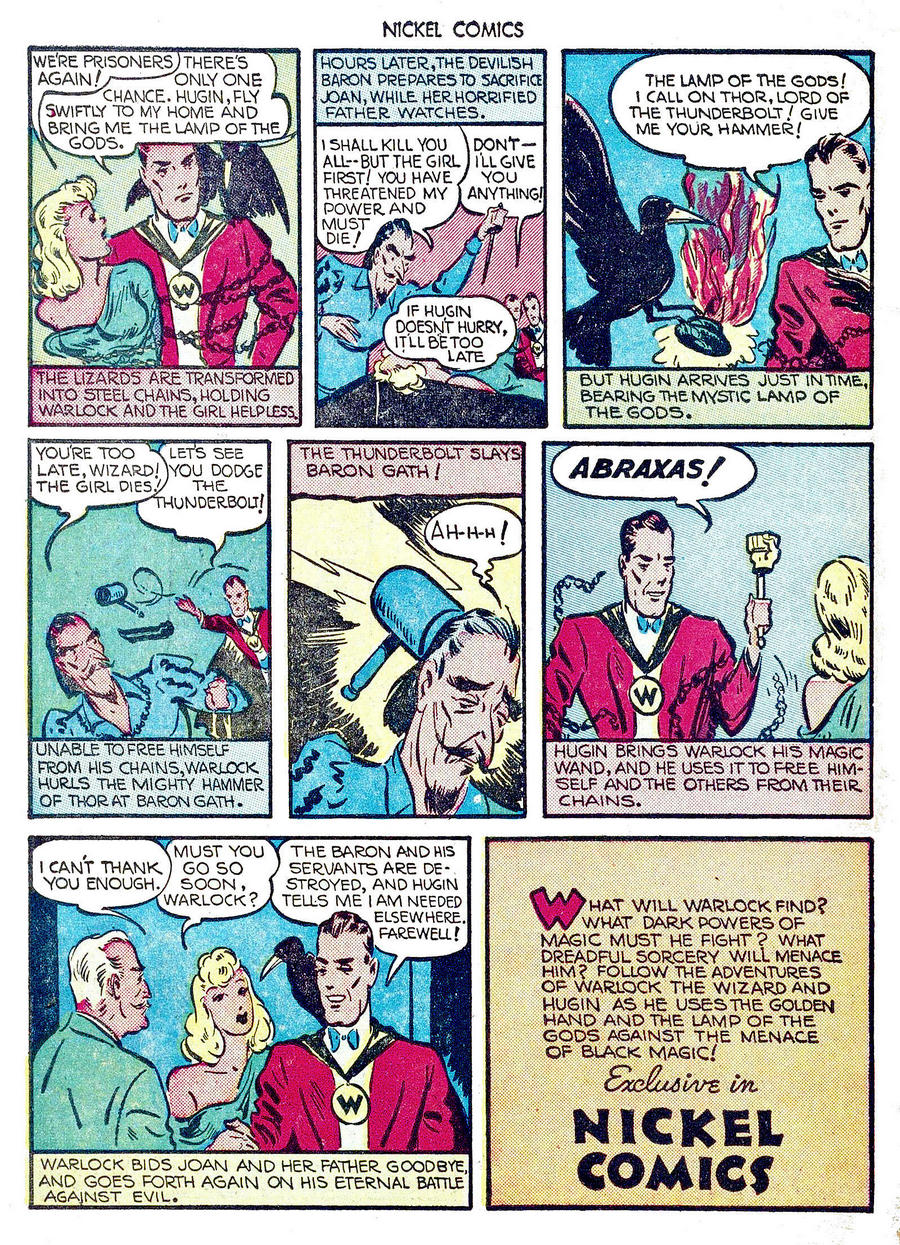
Nickel Comics #1 came out in 1940, with an eye-catching cover by Jack Binder. It also had 5¢ in large type on the cover. The magazine is 36 pages, half the industry’s 68 pages standard. It came out every two weeks. It only lasted eight issues. The Grand Comics Database explains it was an attempt to undercut other 10¢ comics, and it failed “due to distributors and newsstands refusing to carry a less profitable title.”
But Nickel Comics had the debut of Bulletman, who was a superhero for Fawcett. Bulletman, with his girlfriend, Bulletgirl, lasted for about nine years, so for the 1940s Bulletman and friends lasted longer than most superheroes.
The first story was written by Bill Parker (who had the habit of using unnecessary captions on the bottoms of many panels in a story), and drawn by Jon Smalle, and as a short biography from Lambiek says, “Jon Small was an artist from the UK, who lived and worked in the USA from the mid-1930s to the mid-1950s.” Small was also known as Smalle, maybe to make his name sound fancier. The second feature, “Jungle Twins,” was also written by Parker, drawn by Sven Elven, whose name reminds one of “seven eleven.” (A note that this story has outdated racial depictions. It is 80 years old, and attitudes of the time have also become outdated.) The third entry, “Warlock the Wizard,” is yet another entry in the line of comic book magicians, with no credit for writing or artwork.
Subscribe to:
Posts (Atom)