I was 10 years old in 1957, and aware of the buzz on the movie, Baby Doll, from a play by Tennessee Williams. I thought the images of actress Carroll Baker sucking her thumb were odd, but not only was I only 10, I was completely naïve about sex and sexual symbolism. Baby Doll was controversial because of its sexual theme. But all of it went over my head.
That summer I bought Humbug #1 at a local pharmacy. Later in the summer I bought Mad #35. Both of them took off on the image of Carroll Baker. Humbug did a more traditional satire, probably written by editor Harvey Kurtzman, and Mad did a 4-page mash-up of Williams’s plays, Baby Doll, A Streetcar Named Desire, and The Rose Tattoo, drawn by Wallace Wood. Despite my innocence, I “got” the Humbug satire, but was puzzled by Mad. That was because at the time I knew more about Tennessee Ernie Ford* than Tennessee Williams.
When looking at Humbug and its bad printing, it did not match Mad, but I recognized the names Harvey Kurtzman and Jack Davis from the Mad Reader paperback. (And Humbug cost 10¢ less than Mad; important for a kid with a small allowance.) I knew more about Mad than I did sex. Not impossible, because I knew nothing about sex except I liked looking at pictures of actresses like Carroll Baker, Marilyn Monroe, and especially the incredible Brigitte Bardot . . . sigh. Oops, I’m going off into a reverie. Sorry about that.
The Humbug scans come from my copy of Humbug #1, and the Mad scans come from the CD set, Totally Mad.
*From YouTube, Tennessee Ernie’s biggest hit, “16 Tons”.
Translate
Friday, October 18, 2019
Wednesday, October 16, 2019
Number 2401: The Demon judge
Bill Draut went to work for Simon and Kirby when he was discharged from the U.S. Marine Corps. He knew Joe Simon from their service days, and Joe invited him to do some comic book work for them. Among the jobs he did were four episodes of “His Honor and the Demon” (on today’s episode it’s “His Honor and the Red Demon”). Draut worked in comic books for years. His work was very slick and illustrative, and biographical information says he worked drawing love comics and also mystery comics for DC. I have never associated him before with any costumed heroes except the one I am showing today.
The Demon, or Red Demon, is actually a judge who goes out in costume to bring bad guys to justice, so he can preside over their trials and send them to prison. At least that is how I read it. A real conflict of interest, and even in the late 1940s would have been frowned on by his professional colleagues. He is Judge Straight, and he (mostly) lives up to his name. He is a hardass jurist...on page 4 he sentences Joe Monsi “to death by electrocution at midnight two days hence!” Does not give poor Joe much wiggle room for proving his innocence, does it?
This particular episode comes from Black Cat Comics #6 (1947), and while it is the third episode to appear, it is an origin story. I believe the Red Demon stories were probably inventory at Harvey Comics, and plugged into a number of pages of the comic book no matter whether they were sequential or not. At the point of his career that this was drawn Draut’s artwork looks to have been influenced by Terry and the Pirates creator/artist Milton Caniff.
Oh yeah, let me call the first page splash to your attention...the beautiful blonde is tied with rope in a bondage pose. That doesn’t happen in the story so the writer, or even Draut, took a little artistic license for theperverts readers who like to see females trussed up.
Draut, born in 1921, died in 1993.
The Demon, or Red Demon, is actually a judge who goes out in costume to bring bad guys to justice, so he can preside over their trials and send them to prison. At least that is how I read it. A real conflict of interest, and even in the late 1940s would have been frowned on by his professional colleagues. He is Judge Straight, and he (mostly) lives up to his name. He is a hardass jurist...on page 4 he sentences Joe Monsi “to death by electrocution at midnight two days hence!” Does not give poor Joe much wiggle room for proving his innocence, does it?
This particular episode comes from Black Cat Comics #6 (1947), and while it is the third episode to appear, it is an origin story. I believe the Red Demon stories were probably inventory at Harvey Comics, and plugged into a number of pages of the comic book no matter whether they were sequential or not. At the point of his career that this was drawn Draut’s artwork looks to have been influenced by Terry and the Pirates creator/artist Milton Caniff.
Oh yeah, let me call the first page splash to your attention...the beautiful blonde is tied with rope in a bondage pose. That doesn’t happen in the story so the writer, or even Draut, took a little artistic license for the
Draut, born in 1921, died in 1993.
Sunday, October 13, 2019
Number 2400: The flesh and blood ghost
Halloween is coming up in a couple of weeks so I looked for a ghost story. The splash panel of “Ghost of an Old Romance” looked promising. However, this is not the ghost of a dead person, but the other kind of ghost...the symbolic type that is alive but haunting. (Good drawing, though.)
Elaine has a good thing going with Paul, but she makes the mistake girls make in love comics: she falls back in love with her original beau, Dud. When I was in a U.S. Army artillery battery, we called a howitzer projectile that did not explode a dud. A person can be a dud, also. This dud, Dud, wants Elaine back. Elaine falls for his smooth words and slick demeanor. In a love comic girls invariably screw up a current relationship for an old one. Think, Elaine! Why did you break up with Dud in the first place? Uh-huh. I thought so. You know deep in your heart that Paul is the guy for you, and Dud will just repeat what he did to make you leave him originally.
Also, Pappy’s rules for love includes an admonition against pencil-thin mustaches. You see a guy with a meticulously trimmed mustache and you know he is trouble.
From Love Letters #11 (1951). Jim Vadeboncoeur Jr gives credit for the artwork to John Forte for pencils, and Bill Ward for inks. We get a lingerie panel in the story, which is a clue Ward worked on it.
Elaine has a good thing going with Paul, but she makes the mistake girls make in love comics: she falls back in love with her original beau, Dud. When I was in a U.S. Army artillery battery, we called a howitzer projectile that did not explode a dud. A person can be a dud, also. This dud, Dud, wants Elaine back. Elaine falls for his smooth words and slick demeanor. In a love comic girls invariably screw up a current relationship for an old one. Think, Elaine! Why did you break up with Dud in the first place? Uh-huh. I thought so. You know deep in your heart that Paul is the guy for you, and Dud will just repeat what he did to make you leave him originally.
Also, Pappy’s rules for love includes an admonition against pencil-thin mustaches. You see a guy with a meticulously trimmed mustache and you know he is trouble.
From Love Letters #11 (1951). Jim Vadeboncoeur Jr gives credit for the artwork to John Forte for pencils, and Bill Ward for inks. We get a lingerie panel in the story, which is a clue Ward worked on it.
Friday, October 11, 2019
Number 2399: “You don’t think Caius Martius Wheeler is a man!”
The Dart is an ancient Roman, a “racket buster” named Caius Martius. He had been trapped by a sorcerer in a block of stone until he worked his way out in this modern era, taking the surname “Wheeler.” He became a teacher. And who better to teach about ancient Rome than a Roman imprisoned by magic in a block for 2000 years?
Caius has a woman in his life, Miss Tillbury, and she is tough on him. She insults him with her opinion that he lacks manhood. “If I were a man, I’d get that state witness back, to give crime a black eye!” He says he understands but then exclaims, “You don’t think Caius Martius Wheeler is a man!” Ouch! But he knows something she doesn’t, that he is the Dart, a costumed hero who is more than capable of taking care of the Black Spot Gang, but to do that he brings along his young sidekick, Ace the Amazing Boy.
The Grand Comics Database doesn’t list a writer or artist, but it is not the pseudonymous Jerry Arbo from the splash panel. The Dart was created by Louis Cazeneuve, an early comic book artist, according to the Public Domain Super Heroes website. They also tell us the Dart appeared in Fox Features’ Weird Comics numbers 5-20.
This story is from Weird Comics #7 (1940).
Caius has a woman in his life, Miss Tillbury, and she is tough on him. She insults him with her opinion that he lacks manhood. “If I were a man, I’d get that state witness back, to give crime a black eye!” He says he understands but then exclaims, “You don’t think Caius Martius Wheeler is a man!” Ouch! But he knows something she doesn’t, that he is the Dart, a costumed hero who is more than capable of taking care of the Black Spot Gang, but to do that he brings along his young sidekick, Ace the Amazing Boy.
The Grand Comics Database doesn’t list a writer or artist, but it is not the pseudonymous Jerry Arbo from the splash panel. The Dart was created by Louis Cazeneuve, an early comic book artist, according to the Public Domain Super Heroes website. They also tell us the Dart appeared in Fox Features’ Weird Comics numbers 5-20.
This story is from Weird Comics #7 (1940).
Wednesday, October 09, 2019
Number 2398: Short in the saddle
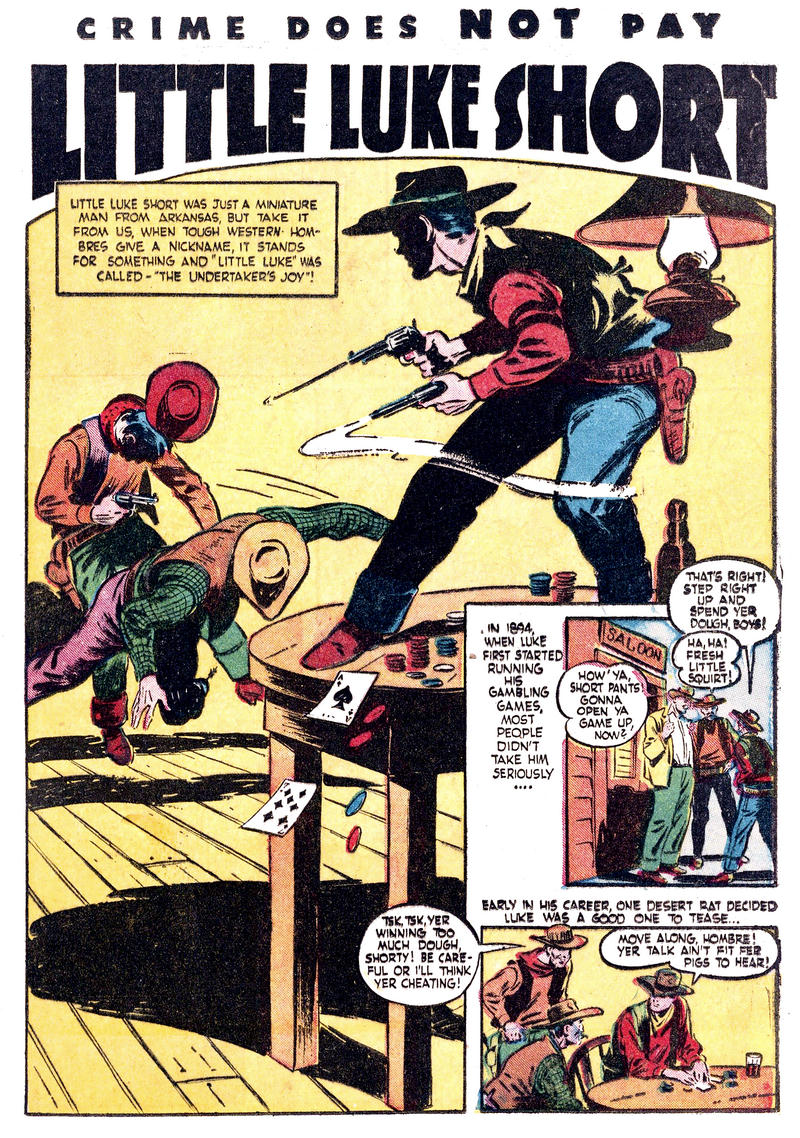
Luke Short’s name seems almost too good to be true. Short, an old West character who shot several men and killed many, if not most of them, was a short man. Maybe that is why men who were apt to pull their guns in a fight took him for an easy target. They were short-sighted.
Luke Short was something of an entrepreneur; he opened gambling dens, taverns, got into the boxing game as well as horse racing. But he also shot and killed people. Everyone has their flaws, I suppose. Short lived at the same time as well-known people like Wyatt Earp and Bat Masterson (who wrote a biographical tribute about Short after his death), but I had not heard much about him until I did a bit of research on this story from Crime Does Not Pay #29 (1943). The crime comics tried to justify showing crime and violence by having the criminal in the end get justice by being executed. They could not do much with Luke Short because he died of kidney disease, not a noose. A court found against him once for a shooting; he was fined $150 and released. You’d be selling Luke Short short if you assumed, as I did, that he was a typical Western bad man.
P.S. The Western novelist, Luke Short, used the name as a pseudonym. His real name was Frederick Dilley Glidden,
The Grand Comics Database has no idea who wrote or drew the story.
Luke Short was something of an entrepreneur; he opened gambling dens, taverns, got into the boxing game as well as horse racing. But he also shot and killed people. Everyone has their flaws, I suppose. Short lived at the same time as well-known people like Wyatt Earp and Bat Masterson (who wrote a biographical tribute about Short after his death), but I had not heard much about him until I did a bit of research on this story from Crime Does Not Pay #29 (1943). The crime comics tried to justify showing crime and violence by having the criminal in the end get justice by being executed. They could not do much with Luke Short because he died of kidney disease, not a noose. A court found against him once for a shooting; he was fined $150 and released. You’d be selling Luke Short short if you assumed, as I did, that he was a typical Western bad man.
P.S. The Western novelist, Luke Short, used the name as a pseudonym. His real name was Frederick Dilley Glidden,
The Grand Comics Database has no idea who wrote or drew the story.
Monday, October 07, 2019
Number 2397: Hooray for the Ray
I haven’t shown any other stories of the Ray, and that surprises me. I am easily surprised, mind you, but surprises aside, here is the origin of the Ray. Grand Comics Database uses their system for showing they’re not quite sure if an attribution is correct by using a question mark. In this case it applies to Will Eisner, who has been widely credited with creating the Ray. But did he write the origin story? That’s why the question mark behind his name on the GCD listing of Feature Comics #14 (1940), where the Ray first appeared.
At least it’s clear that Lou Fine did the artwork. The Ray’s origin is typically comic book strange...caused by a trip in a stratospheric balloon by reporter Happy Terrill, who then becomes a super being. GCD points out that the origin story is the only one in which the Ray’s legs are bare, rather than in tights.
Maybe I have asked this before, but have you ever noticed that superheroes, even before they are superheroes, look like superheroes? Happy is handsome, tall, and muscular. Wow, lucky guy! No wonder he became a super being. Physique and movie star looks aside, the Ray only lasted until 1943. Maybe good-looking Happy Terrill got drafted? Question mark means I don’t know.
At least it’s clear that Lou Fine did the artwork. The Ray’s origin is typically comic book strange...caused by a trip in a stratospheric balloon by reporter Happy Terrill, who then becomes a super being. GCD points out that the origin story is the only one in which the Ray’s legs are bare, rather than in tights.
Maybe I have asked this before, but have you ever noticed that superheroes, even before they are superheroes, look like superheroes? Happy is handsome, tall, and muscular. Wow, lucky guy! No wonder he became a super being. Physique and movie star looks aside, the Ray only lasted until 1943. Maybe good-looking Happy Terrill got drafted? Question mark means I don’t know.
Subscribe to:
Posts (Atom)