Walt Kelly’s beautifully drawn adaptation of Hans Christian Andersen’s original 1837 story is fairly faithful to the original. The Kelly touches and comic exaggeration are all over it, though. Andersen’s story works on several levels, but is also political satire. Andersen, according to some sources, was either bribed or bought off with a royal gift of jewelry so he would quit writing such satiric fare. It worked. It was a lot easier on Andersen than some governments’ responses to satire, including banishment, or imprisonment, or even death.
From Dell’s Fairy Tale Parade #2 (1942):
After leaving Disney, Walt Kelly went on to his comics career, doing much work for Dell in the 1940s, including early versions of Pogo. Pogo became a newspaper feature in the late forties, even while Kelly was still working on the comic books. My understanding is he had a falling out with Dell in the early fifties over his objection to reprints of early Pogo strips in the Dell giant, Pogo Parade. (Despite Kelly’s problem with it, from a fan’s perspective one of the best squareback Dell giants ever published).
Kelly occasionally had things to say about comic books. These short sequences from the Pogo newspaper strip take aim at comic books of the day, under heavy criticism for content. That would not be Dell Comics, though, a publisher that mainly kept itself out of the censors’ line of fire.
Scanned from The Incompleat Pogo, published by Simon and Schuster in 1954. My thanks to friend Dave Miller for providing me with a gift of this and other early Pogo books.
Translate
Friday, March 20, 2015
Wednesday, March 18, 2015
Number 1710: Frankenstein and the Terror
David J. Skal’s excellent 1993 book, The Monster Show, A Cultural History of Horror, reminds us that what we take for granted now, horror movies, were widely criticised, censored and reviled in the days when Dracula and Frankenstein became cultural icons. To paraphrase an old saying, everybody hated them but the ticket-buying public. A couple of decades later the comic books took the same kind of heat over horror. With the benefit of history and an overview of pop culture, nowadays we see both old horror movies and horror comics as relatively harmless entertainment...even quaint. We can watch a television program like The Walking Dead (itself made from a comic book) with graphic violence, exploding heads and gruesome walking corpses, and it makes the original horror movies look tame by comparison. But those original movies made a real impact. Unlike about 90% of the motion pictures made at the same time as Frankenstein and Dracula, the horror movies are still being watched.
Trading on the popularity of the movies, cartoonist/writer Dick Briefer kept his own versions of Frankenstein going through three different incarnations over a dozen years or so. The Comics Code, not villagers waving torches, killed his Frankenstein.
In this tale from Briefer’s cartoony, funny Frankenstein, the monster meets his mirror image in a Wild West tale from Frankenstein #15 (1948). At 17 pages the story is longer than usual, setting up a whole series of situations based on a Frankenstein “doppleganger.”
Shifting gears and becoming like the critics I criticise, I have a criticism of this otherwise harmless story. There is one panel of a bloody bullethole in a forehead, used as comedy. Bulletholes are not funny. This is from 1948, and a bullethole in a forehead is probably a spillover from the crime comics that proliferated that year.
Monday, March 16, 2015
Number 1709: Kaleidoscope
When William M. Gaines had to finally admit defeat and place the Comics Code symbol on his covers, then it was time to call it quits for his comic book line. I haven’t checked (too lazy, too tired) to see if Incredible Science Fiction #33 (1956) was the last EC comic book, but if not it was the last issue of ISF, at any rate. Jack Oleck wrote the contents for all four issues of the comic, re-titled from Weird Science Fantasy because the Code forbade the word “weird.” The usual EC artists contributed, including Jack Davis, whom I have never thought of as a science fiction artist. He could draw all of the Wallace Wood-styled machinery, and rocket ships, and render a raygun blast as well as anyone, but when I think of him I just never think of him as drawing SF.
The character is named “Davis” and I think Jack Davis drew himself in the part. From here Davis went on to other freelance jobs, including Mad and later comic book jobs, humor magazines like Humbug, Cracked, Sick, and then back to Mad. EC Comics, its horror comics and Mad led Davis to a high profile career doing album jackets, movie posters, book and magazine covers. No one needs to look at “Kaleidoscope” and feel sorry for Jack Davis. The end of EC Comics was a new beginning for him. The cartoonist from Georgia did mighty fine for himself. Mighty fine.
A day after posting “Kaleidoscope” I found a used paperback of scripter Jack Oleck’s 1959 novel, Messalina. Half-a-million copies in print. Not bad.
This is a 1963 printing, with a James Bama cover. After this Oleck did not publish another novel until the early '70s. Jack Oleck bio and bibliography.
The character is named “Davis” and I think Jack Davis drew himself in the part. From here Davis went on to other freelance jobs, including Mad and later comic book jobs, humor magazines like Humbug, Cracked, Sick, and then back to Mad. EC Comics, its horror comics and Mad led Davis to a high profile career doing album jackets, movie posters, book and magazine covers. No one needs to look at “Kaleidoscope” and feel sorry for Jack Davis. The end of EC Comics was a new beginning for him. The cartoonist from Georgia did mighty fine for himself. Mighty fine.
**********
A day after posting “Kaleidoscope” I found a used paperback of scripter Jack Oleck’s 1959 novel, Messalina. Half-a-million copies in print. Not bad.
This is a 1963 printing, with a James Bama cover. After this Oleck did not publish another novel until the early '70s. Jack Oleck bio and bibliography.
Friday, March 13, 2015
Number 1708: Origin(s) of Uncle Sam
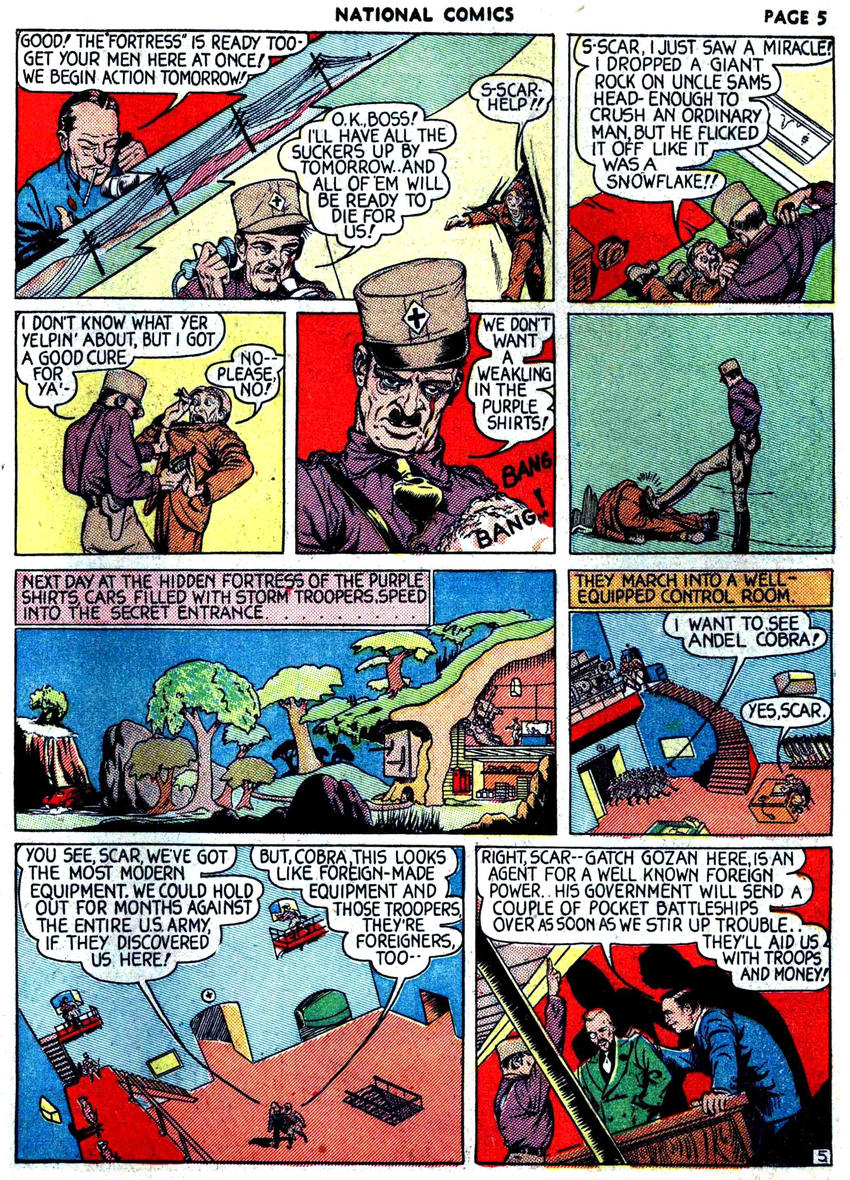
In retrospect it seems only a natural. It appears Will Eisner stole a march on his fellow comic book creators by grabbing an American icon, Uncle Sam, to be the star of a new comic book. War was going on in Europe, and the threat of involvement was reaching across the Atlantic to America. National Comics #1 (1940) presented Eisner’s version of an origin. Uncle Sam is a symbol so Eisner chose to make Uncle Sam a supernatural being, paired up with a human youngster. They fight enemies of America, internal and external. It is a tall order. This Uncle Sam did not even last out the end of World War II. My feeling is Eisner should have put him in cape and domino mask, which would have made him look more like a comic book hero. But, no. That would be blasphemy to some, wouldn’t it?
Life had a 2 1/2 page article, shown below, in its July 2, 1956 issue that shows us a different origin of Sam. According to Life, Sam had once been a “country bumpkin,” Brother Jonathan. Not a bad secret identity! Maybe Eisner could have used it.
Life, July 2, 1956:
Life had a 2 1/2 page article, shown below, in its July 2, 1956 issue that shows us a different origin of Sam. According to Life, Sam had once been a “country bumpkin,” Brother Jonathan. Not a bad secret identity! Maybe Eisner could have used it.
Life, July 2, 1956:
Subscribe to:
Posts (Atom)


